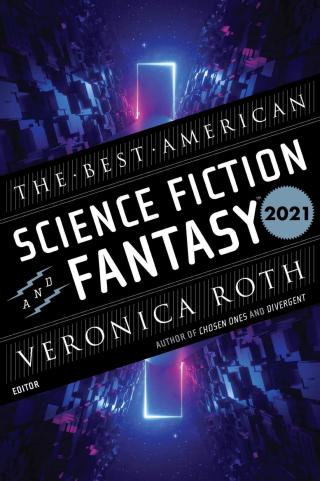
The Best American Science Fiction and Fantasy 2021
- Автор: Рот Вероника, Адамс Джон Джозеф
- Год: 2021
- Язык: английский
- Год: HMH Books : Mariner
- ISBN: 9780358470076
- Жанр: Малые литературные формы прозы

Электронная книга - «The Best American Science Fiction and Fantasy 2021». Краткое содержание книги:
This year’s selection of science fiction and fantasy stories, chosen by series editor John Joseph Adams and bestselling author of the Divergent series Veronica Roth, showcases a crop of authors that are willing to experiment and tantalize readers with new takes on classic themes and by exchanging the ordinary for the avant-garde. Folktales and lore come alive, the dead rise, the depths of space are traversed, and magic threads itself through singular moments of love and loss, illuminating the circulatory nature of life, death, the in-between, and the hereafter.
The Best American Science Fiction and Fantasy 2021 captures the all-too-real cataclysm of human nature, claiming its place in the series with compelling prose, lyrical composition, and curiosity’s never-ending pursuit of discovering the unknown.
“Rechecking,” the computer said. Then, “Seventy-two life signs detected.”
“Is that the real count, computer?”
“As requested, the total is between one and eighty-six. Is this acceptable?”
“If it’s the actual count, yes.”
“The actual count is seventy-two.”
Alice was pretty sure the computer didn’t perform anything like an actual count, which was a minor problem masking a much more serious one. Clearly, something was wrong with the Erwin’s computer; counting things wasn’t a difficult task.
“Computer, run a full internal diagnostic.”
“Running diagnostic.”
“Let me know what you find,” she said. Then she pressed the override code for the door and left the hangar for the crew’s living quarters corridor.
“Hello?” she shouted. “Is anyone here?”
Nobody responded.
All the doors were closed. Alice’s override code could open any one of them, but—and this was a decidedly odd but undeniable truth—she was afraid to do it.
Alice Aste had been working with the USF Security Force for fifteen years, and before that she’d been a veteran of five interplanetary conflicts. She’d once spent two months adrift and alone in a disabled life raft, rescued by chance some fifteen hours before her oxygen ran out. Before that, she’d suffered a childhood of privation during her waking hours, and nightmares when she slept. She came to grips with her own mortality when she was ten. She did not get afraid, or rather, she wasn’t afraid of the unknown. (Fear of the known, on the other hand, was quite sensible.)
And yet, on an impossibly empty vessel adrift in an unusually empty deep-space quadrant, Alice had to admit that she was one loud noise from freaking the hell out.
“Anybody?” she asked. She hesitated at the first door.
Just plug in the code and ask whoever’s on the other side what’s going on here.
She didn’t plug in the code. Her pulse was up, and her breathing was shallow. She wondered if this was what a panic attack felt like.
“Calm down,” she said to herself. “Just go straight for the bridge. You can see the stars from the bridge.”
That was one of the tricks she picked up when she was ten; there is comfort in the vast emptiness of space. At least for her.
“Diagnostic complete,” the computer said. Alice jumped two feet in the air.
“Computer, report results,” she said, once she got her heart started again.
“Results are terrific,” the computer said.
“. . . computer, please repeat.”
“Terrific. Self-diagnostic reports computer is terrific. Perfect score. Computer would report a thumbs-up if computer had thumbs.”
The Erwin’s computer had evidently lost its mind. This was, of course, just as impossible as the constantly adjusting life sign count. Computers had no minds to lose.
“Are you certain, computer?” she asked.
“Computer is certain. Computer has no thumbs.”
Alice wondered if a full reboot of the ship’s computer was in order. She’d have to do that from the bridge, but that was where she was heading anyway. It might take a while, but if there really was nobody on this vessel aside from her, she’d need to interrogate the ship’s logs. For that to work, a sane and rational computer would be important.
She headed down the hall at a normal walking pace that quickly devolved into a jog. A door might open and that, she decided, would be bad.
There’s no such thing as irrational fear, she thought, recalling the wisdom of one of her academy trainers. Your instincts know why they’re afraid; you just gotta catch up.
She made it to the other end of the hall, to the elevator, punched the button for the top deck, and checked the corridor behind her twelve times while waiting for the elevator to arrive.
It did. She jumped in, and the doors swished closed reassuringly. Up she went.
And up, and up. The elevator should have taken less than thirty seconds to reach the bridge. After well over a minute, Alice became concerned that maybe deck one wasn’t where they were headed, except there was no further point to travel to while still remaining on the Erwin.
“Computer, are we going to deck one?”
“Confirmed, deck one.”
“What’s taking so long?”
“Traveling from deck five to deck one takes a nontrivial amount of time,” the computer said, “and time is a construct.”
“That isn’t a helpful answer.”
“Would you like to try a different narration?”
“A what? No, I just want to go to deck one.”
“Deck one, coming up.”
Alice sighed.
“When?” she asked.
“I cannot provide an exact time,” the computer said.
“All right. Computer, if I stopped the elevator right now, where would I be? What deck.”
“Would you like to stop the elevator right now?”
“No, just tell me where I would be if I did.”
“You would be on deck one and five-eighths.”
“Computer, this ship has no deck one and five-eighths.”
“That is incorrect,” the computer said. “There are multiple fractional decks.”
“How many?”
“Unclear. How many would you like for there to be?”
“Never mind. Is it a finite amount?”
“This computer infers that the amount must be finite, as otherwise, deck one would be unattainable. It is coming up shortly, and is therefore not unattainable.”
Alice had an unkind response for that, but then the elevator came to a stop and the doors opened.
“Arrived, deck one,” the computer said.
Alice stepped out onto the bridge. For a vessel of this type, the bridge was really very small—especially as compared to the military ships to which she was accustomed. It had two seats at the front, a raised seat in the middle for the captain, and two seats in the back, with instrumentation spread throughout.
Captain Matthew Hadder—unshaven, in dirty clothing, looking tired, and shorter than she expected—was in the chair, and an ensign she didn’t know was at the console to her left.
“You’ve shot Ensign Anson,” Hadder said, which was an interesting thing to say given that Alice hadn’t done anything of the kind.
But then the ensign fell over dead, having indeed been shot by a blaster. Still more interesting, it was only then that Alice drew her blaster from its holster and fired it. It struck Ensign Anson directly in the chest two seconds prior to being fired.
“What?” Alice said.
“Ensign Anson has been shot,” Hadder said. “By your blaster, which you used to shoot him with.”
“But I didn’t shoot him.”
“He was shot, and then you did it. Don’t worry, it wasn’t your fault. It was, because if you hadn’t run in with a gun, Ensign Anson would not be shot, but the shot came faster than the blaster off your hip. Don’t worry, it’s been happening all day. He’s dead, but only now. He wasn’t earlier, and may not be later. Who are you and what are you doing on my ship?”
“I’m . . . I don’t understand. How could I fire my blaster before I fired my blaster?”
“It happened before you decided to do it, but if you want to know why you decided before you decided, I can’t provide you with that. He may have been about to shoot, with a gun he both had and did not have. He does not right now have a gun, but may have had one before you decided to shoot.”