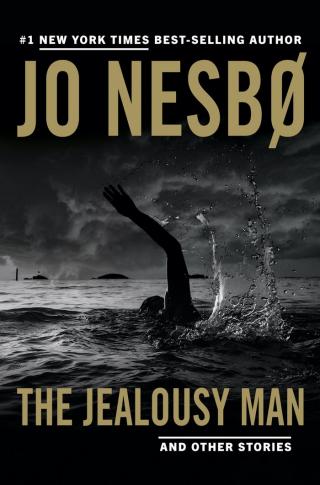
The Jealousy Man and Other Stories
- Автор: Несбё Ю
- Год: 2021
- Язык: английский
- Год: Alfred A. Knopf
- ISBN: 978-0-593-32100-3
- Переводчик: Robert Ferguson
- Жанр: Криминальные детективы

Электронная книга - «The Jealousy Man and Other Stories». Краткое содержание книги:
A detective with a nose for jealousy is on the trail of a man suspected of murdering his twin; a bereaved father must decide whether vengeance has a place in the new world order after a pandemic brings about the collapse of society; a garbage man fresh off a bender tries to piece together what happened the night before; a hired assassin matches wits against his greatest adversary in a dangerous game for survival; and an instantly electric connection between passengers on a flight to London may spell romance, or something more sinister.
With Nesbø’s characteristic gift for outstanding atmosphere and gut-wrenching revelations, The Jealousy Man confirms that he is at the peak of his abilities.
‘Oh really? And what are they saying?’
‘That you...’ She gave a little laugh. ‘That you’re slightly crazy.’
‘Crazy? In a good way?’
‘In a very good way.’
He knew exactly what she meant. They had talked about it. That the writers who fascinate us are the ones who describe a world that is easy enough to recognise but one viewed through glasses that are very slightly different from the ones we wear. Or they wear, thought Odd Rimmen, since what his editor was telling him was that he had now been promoted to the league for those who see things differently, the intellectually eccentric. But did he belong there? Had he always done so? Or was he a bluff, a conventional wannabe who acted weird just for effect? As he listened to his editor describing the interest in Odd Rimmen, could he not also hear a greater respect in her voice? As though not even she, who had followed him so closely, from sentence to sentence so to speak, was immune to this sudden change of mood, all brought on by a single event: that, almost on impulse, he had run out on an interview just before he was due onstage. Now she was telling him she had just reread The Hill and been struck by how good the book they had worked on together really was. And even though Odd Rimmen suspected she had merely read the book in another light — the light of the admiration of others — he said nothing.
‘What is this about, Sophie?’ he asked when she paused for breath.
‘Warner Brothers have been in touch,’ she said. ‘They want to buy an option on The Hill.’
‘You’re kidding.’
‘They want to get Terrence Malick or Paul Thomas Anderson to direct.’
‘They want to?’
‘They’re wondering if you’d be happy with either of them.’
Would I be happy with Malick or Anderson? thought Odd Rimmen? Thin Red Line. Magnolia. Here were two top-quality directors who had managed the almost impossible feat of getting the public at large to go to art films.
‘What do you say?’ Sophie’s voice had the whining overtones of a fourteen-year-old, as though she herself could hardly believe what she was telling him.
‘I would’ve been very happy with either of them,’ he said.
‘Great, I’ll call Warner Brothers and—’ She stopped. She had probably heard it.
Conditional sentence, type 2. Would’ve been. Which, as she had once pointed out to him, was actually a verbal contraction of I would have been, but one which the copy editor had let pass. Nevertheless, the Conditional. Something that would have happened, had certain conditions been fulfilled. And now she was wondering what the conditions might be. So he told her.
‘If I’d’ve wanted to sell the film rights.’
‘You... you don’t want to?’ The whining overtone was gone. Now she definitely sounded as though she couldn’t believe what she herself was saying.
‘I like The Hill fine just the way it is,’ he said. ‘As a book. As you said yourself, just lately the book seems to have turned out to be really quite good.’
He didn’t know if she registered the irony in what he had just said. Normally she would have done. Sophie had a good ear, but right now she was so shaken by everything that was happening that he wasn’t so sure.
‘Have you thought this through properly, Odd?’
‘Yes,’ he said. That was the strangest thing. Less than a minute ago he’d been told that one of the biggest film companies in the world wanted to ask two of the world’s best directors to direct The Hill and make a film, something that would boost not just this book but every book with Odd Rimmen’s name on it, past and present, and turn him into a global superstar. But he had thought through the possibility of getting a really big film offer. Daydreamed about it would be a more accurate description. Because apart from the aforementioned sex scenes there was nothing filmatic about Odd Rimmen’s novels. Rather the opposite, in fact. They were largely interior monologues with few external events and little conventional dramaturgical structure. And yet still he had thought it through. Only as a hypothetical possibility, naturally, a thought experiment, in which he weighed the arguments against each other while gazing out over the Bay of Biscay. Charles Dickens wouldn’t just have yelled out a jubilant Yes! The old ham would have insisted on playing at least one of the main characters himself.
The old, pre-Charles Dickens Theatre Odd Rimmen would have said yes as well but it would have left a bad taste in his mouth. He would have justified himself by saying that in an ideal world he would have said no thanks and kept his book pure. Reserved it for the patient reader, the reader who did not accept simplifications, who would take each sentence at his own pace, guided by the speed of the eye, the maturing of contemplation. But in world ruled by money and vacuous entertainment he could not say no to the kind of attention his type of book (serious, literary) was being offered here, since he was under an obligation to spread the (literary) word, not just to himself, but to everyone who was actually trying to say something in their writing.
Yes, that’s what he would have said, and in secret savoured all the attention garnered by the film, the book, and by his own apparent dilemma.
But the new Odd Rimmen rejected that type of hypocrisy. And because he had thought it through, and reality was turning out not to be all that different from the daydream, he was specific about it to his incredulous editor.
‘I’ve thought it through, Sophie, and the answer’s no, I’m not going to let The Hill get cut down to a two-hour synopsis.’
‘But it’s so short anyway. Have you seen No Country For Old Men?’
Naturally Odd Rimmen had seen this, and naturally she would mention it, he thought. Sophie knew that he loved Cormac McCarthy, knew that he knew that the Coen brothers had managed to film that short novel in a one-to-one correlation unlike any other film he could think of. And Sophie also knew that Odd Rimmen also knew what that film had meant for the spread of the books of a writer who had until then been a literary cult figure — and without doing (too) much apparent damage to his reputation among the literary elite.
‘Cormac wrote it first time around as a screenplay,’ he said. ‘The Coen brothers themselves said that when they were writing the screenplay one of them held the book open while the other copied from it. That won’t work with The Hill. Anyway, I’m in the middle of something in the new book, I’m going to have to hang up now and get back to the writing.’
‘What? Odd, don’t...’
Odd Rimmen was standing in the queue outside the Louvre in Paris when he saw her coming out. Esther Abbot looked as though she wanted to pretend she hadn’t seen him but must have known that her surprised expression gave her away.
‘So, we meet again,’ she said. She was walking arm in arm with a man whom she pulled in closer, as though the mere sight of Odd Rimmen was a reminder that men could disappear at any moment unless she kept a close eye on them.
‘I’m sorry,’ said Odd Rimmen. ‘I never got the chance to apologise.’
‘Never? Was there someone or something preventing you?’
‘No, not really. I apologise.’
‘Perhaps you should have saved it for all those people who turned up to hear you.’
‘Absolutely. You’re right.’
He thought she looked good. Better than he remembered her from the theatre. He thought that perhaps then she had been concentrating too much on the job. Too ingratiating for her to have aroused the seducer in him, the way prey will play dead until the predator loses interest. But standing here now, with a summer tan, slightly angry, with the wind in her hair and a man on her arm, she was quite simply attractive. So attractive that it seemed strange to Rimmen that she had automatically drawn the man she was with closer to her as soon as she saw him. It should really have been the other way round, with the male discreetly marking his territory when confronted by another male of about his own age, and one of a presumably higher social status now, following that article in the New Yorker.