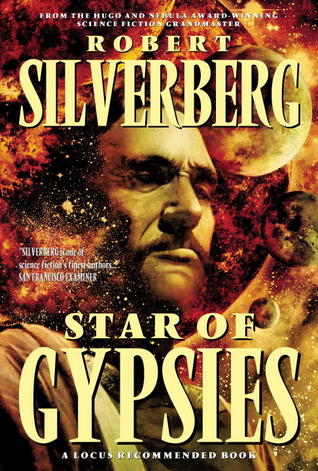
Star of Gypsies
- Автор: Силверберг Роберт
- Язык: английский
- Жанр: Научная фантастика

Электронная книга - «Star of Gypsies». Краткое содержание книги:
I suppose it still might have been possible to overthrow the usurper and restore Loiza la Vakako to his place, if anyone had been willing to lead the way. Pulika Boshengro had come to Nabomba Zom with only a handful of men from his home world. And Loiza la Vakako was wise and good and everyone loved and respected him, while Pulika Boshengro had shown himself to be a man to fear and mistrust.
But there wasn't any uprising of loyal vassals. After the first shock and amazement of the events of the banquet and the coup that had followed it, life went on as usual for the people of Nabomba Zom, both great and small. The family of Loiza la Vakako was in custody-we were all dead, for all anyone on the outside knew-and there was a new master in the palace. A change of government, that was all it was. Within days the vassals of Pulika Boshengro were arriving by the thousands and the spoils were being divided; and that was that. Loiza la Vakako had fallen; his wealth and splendor had passed to his brother; life went on. And I had lost my beloved and all my bright prospects for the future in one terrible moment.
We were kept in cells behind the palace stables, penned in foul little force-spheres like beasts awaiting the butcher. Loiza la Vakako and I shared one cell. I knew we were going to be put to death sooner or later and I started making my final atonements every time I saw the shadow of the jailer outside. But Loiza la Vakako had no such fears. "If he had meant to kill us," he said, when I had voiced my uneasiness for the hundredth time, "he would have done it at the feast. He'll get rid of us some other way."
He was entirely at ease, altogether placid and composed. The loss of his kingdom, his palace, his world itself, seemed to mean nothing to him. I knew that the murder of his daughter before his eyes had seared and withered his soul, but he refused even to speak of her death and showed no sign of grief
"If only your brother had been a moment slower," I blurted finally. "If only she had been able to get away and give us a warning-"
"No," he said. "It was wrong for her to attempt it." "Wrong? Why?"
"Because no warning was ever given. If it had been meant for there to be a warning, we would have received it, and none of this would have happened."
"But that's exactly it! If she had managed it she could have changed everything!"
"Nothing can ever be changed," said Loiza la Vakako.
There it was again: the fatalism of the Rom, the cool acceptance of what is as what must be. As though it is all written imperishably in the book of time and for all our power of ghosting we dare not try to alter it. A streak of that fatalism runs through our souls like dark oil on the breast of shining water. A thousand times a day I thought of slipping away myself to the hour before the banquet and giving the warning that would save Malilini; but each time I looked toward Loiza la Vakako I came up against his steely acceptance of what had happened, and I didn't dare. No warning could be given because none had been received. As Malilini had said in a happier moment long before, "There is never any in the first place. " Everything is circular and everything is fixed. There is no such thing as prophecy: there is only the giving of reports on the known facts of the future, which is as sealed and unchangeable as the past. When I came to do more ghosting myself I would understand that more clearly. That there is a law-call it a moral law; no monarch ever put it on the lawbooks-that we must not use our power to change the past, lest we tumble everything into chaos. Loiza la Vakako meant to live by that law even though it cost him his daughter and his domain. By daring to break the law that must never be broken Malilini had condemned herself and no one now could save her. I had to abide by that. But inside myself I was screaming against the madness of it, telling myself over and over that it still was possible to save Malilini and to spare Loiza la Vakako from overthrow, if only Loiza la Vakako would permit it. And that he would never do. Why, he seemed almost to be blaming her for her own death!
I waited now for mine. But the days passed and we were left to ourselves, thrown a little food now and then but otherwise ignored. We grew filthy and sour-breathed and our teeth felt as if they were coming loose. I could not believe how far we had fallen. I wondered what depths still gaped for us.
Loiza la Vakako's serenity never faltered. I asked him how he remained so tranquil in the face of such grief and he shrugged, and said that everything was part of God's plan: who was he to debate strategy with the Master of All? It is God who orders events and we who obey, no matter how strange or wrong or even evil the shape of those events may seem to us.
I tried to accept his wisdom and make it part of me. But my despair was too great. I could abide the loss of the comforts that my life on Nabomba Zom had brought. Those things had come to me by pranks of fate; I could accept their departure in the same way. But what kind of God was it who let brother cast down brother? How did it serve the welfare of this world to put the tyrant Pulika Boshengro in the place of the wise Loiza la Vakako? And most bitter of all to me-who could justify the slaying of Malilini? To cast such beauty from the world so soon-no. No. No. No.
Sometimes ghosts came to me as I lay sobbing to myself They never spoke, but they would hold out their hands to me in gestures of consolation, or smile, or even wink. One who came was the one who I now knew to be my future self, robust and hearty and overflowing with laughter. He was the one who winked. So I understood that I was not going to die in this place. And I saw also, from his wink, that my sense of heavy tragic gloom was one day going to lift, that I would laugh and know joy again. Inconceivable though that was to me in my despondency.
What was happening during all these days or weeks of captivity was that Pulika Boshengro was negotiating our enslavement. He meant to scatter the family of Loiza la Vakako to the far corners of the sky.
"All right, come out of there, you two," our jailer told us finally, and we crept forth into the great blue blaze of day.
I had been sold to a place called Alta Hannalanna, which I had never heard of. Loiza la Vakako's lips quirked ever so slightly when I told him, as if he had to struggle to hold back from me the truth of how dreadful a place that was. He himself was to go to Gran Chingada: again, a world unknown to me. I asked him about it and he said only, with a barely perceptible toss of his head, "They have great forests there, extraordinary trees. Wood from Gran Chingada draws a high price wherever it is sold." Only later did I learn what sort of conditions prevailed in the terrifying forests of that prehistoric world: the men in the logging camps were lucky to last eighteen months on Gran Chingada, where the grass itself would eat you alive if you gave it half a chance. Where vampire lizards the size of your hand came springing up out of scarlet flowers and went straight for your throat. Loiza la Vakako was being sent to his death. And so, I suspected, was I, despite the visits of my ghosts. But Loiza la Vakako would not tell me anything at all of Alta Hannalanna.
In those days there was no imperial starship service from Nabomba Zom to Alta Hannalanna, or to Gran Chingada. And so I discovered for the first time what it was like to travel by relay-sweep. Loiza la Vakako and I were marched out and trussed up and journey-helmets were clapped over us and our coordinates were set for us, so that we would be caught and thrown out into space toward the worlds of our slavery.