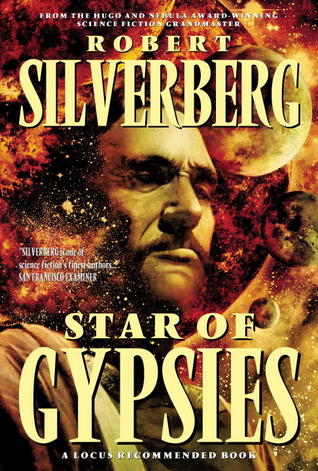
Star of Gypsies
- Автор: Силверберг Роберт
- Язык: английский
- Жанр: Научная фантастика

Электронная книга - «Star of Gypsies». Краткое содержание книги:
A great pavilion was built in the courtyard of the palace, and long tables, Rom-fashion, were set up under an arbor of arching glimmervines that would cast a sweet tingling radiance over the feast. Now came the cooks, platoons of them, legions of them, to set to work at mincing meats and chopping garnishes, seasoning the game birds with sage and thyme and marjoram, flavoring the beasts on the spits with peppercorns and rosemary, preparing the huge platters of beans with cream and lentils, mashed peas in vinegar, cucumbers rich with yogurt and dill, the olives, the horseradishes, the meatballs spiced with nutmeg, all the dishes that have been beloved of the Rom for so many thousands of years. And the casks of wine! The flagons of brandy! The barrels of beer!
And when everything was ready and the whole clan had assembled Loiza la Vakako came forth from the palace in robes of such majesty and opulence that it was hard for me to remember the simplicity of his private rooms, the austerity and even asceticism of his inner life. I was in robes of the same magnificence, walking beside him. And Malilini, shimmering with her own beauty and gowned in something that seemed to be nothing more than spun air, against which her dark glowing loveliness burned all the more brilliantly.
Loiza la Vakako had intended this feast to be one such as Nabomba Zom had never seen before. That would go down in the legends of the Rom as unsurpassed in all our history and unsurpassable by the generations to come. Well, there is no denying that it was a feast such as Nabomba Zom had never seen before. But not in the way that Loiza la Vakako had in mind. And as for being unsurpassed and unsurpassable-no, that was not to be.
We took our seats at the high table: Loiza la Vakako in the center, his brother Pulika Boshengro at his left, Malilini to his right, me on Malilini's other side. All about us were lords and ladies of the realm, the six daughters, the six sons-in-law, the local archimandrite and three of his thaumaturges, the imperial consul and a bunch of his hierodules, assorted high vassals from the outlying plantations, and a host of others, including a cadre of nobles that Pulika Boshengro had brought with him from his own court, all garbed in swirling costumes of the most startling brightness.
Loiza la Vakako stretched forth his arms in benediction, inviting everyone to sit.
The servitors poured the first round of wine. They heaped the salads and smoked meats on our plates. We all waited. The guest from the most distant land must taste the first morsel.
That was Pulika Boshengro. He rose-a small, compact man like his brother, full of coiled energy and passion. His eyes gleamed with a chilly sort of intelligence.
Beside him on the table lay his lavuta, his violin, a good old Gypsy fiddle. This Pulika Boshengro was said to be a musician of high attainments, who would open our feast with one of the ancient tunes, a quick fiery melody to start the festivities the right way. A great silence fell. Pulika Boshengro ran his fingers lightly up and down the fingerboard of his fiddle and reached for his bow. All around the pavilion people were smiling and nodding and closing their eyes as if they could already hear the music.
Pulika Boshengro drew the bow across the strings. But what came forth was no sweet old Gypsy tune. It was three harsh fierce discordant scraping notes.
A signal. A cue for action.
The henchmen of Pulika Boshengro moved with astonishing speed. Before the third note had died away I was pulled roughly to my feet and I felt an arm tight across my throat and a knife in the small of my back. All along the head table the same thing was happening to Loiza la Vakako, to Malilini, to the six sons-in-law and their wives. Sharp gasps went up from the guests at the lower tables, but no one moved. In a single instant we were all hostages.
I turned my head to the left and stared across Malilini at Loiza la Vakako. His face was calm and his eyes were untroubled, as though he had seen this coming and wasn't at all surprised, or as though the strength of his soul was such that not even being seized at his own feasting-table could disturb his balance. He smiled at me.
Then one of Pulika Boshengro's men grunted in alarm. He pointed at Malilini.
If I live to be a thousand this moment will blaze furiously in my mind. I looked toward her; and I saw her face going strange. Her eyes were clouded, her nostrils were flaring, the corners of her mouth were pulled back in a grimace that was not a smile.
I knew the meaning of that expression. She was summoning her power so that she could go ghosting.
Pulika Boshengro knew what that face meant too. And saw at once what I was too dense to understand in that first wild moment: that what she intended to do was slip away a short distance into the past, a week perhaps or even less, and warn her father that his brother must not be admitted to the feast.
Now that coiled energy of his came into play, and that chilly intelligence. An imploder leaped into Pulika Boshengro's hand, a little steeljacketed frog-nosed weapon. He fired once-a soft blurping soundand Malilini seemed to rise and float away from him, up and back and across the feasting-table. She lay sprawled face upward amidst the wine-flasks and the platters of meat and she did not move.
For a moment Loiza la Vakako seemed to crumple. His face dissolved and his shoulders heaved as if he had been struck by an enormous mallet. Then his great strength reasserted itself and he stood straight again, unmoving and seemingly unmoved. But I saw that winter had entered his eyes. And then for a time I saw nothing at all, for my tears came flooding forth and with them came such an eruption of fiery anger that it blinded me. I let out a tremendous cry and tried to swing around, giving no thought to the blade that was pricking my back or the arm pressing with choking force against my throat. My hands were still free; I clawed for eyes, lips, nostrils, anything.
"Yakoub," said Loiza la Vakako quietly. "No.
Somehow that voice cut through my madness; or perhaps it was the powerful arm tightening on my windpipe.
I subsided all at once, and stood slumped, looking at my feet. It was over. We were prisoners and Pulika Boshengro had captured Nabomba Zom with three screeches of his fiddle. A whole world had fallen and there had been but a single casualty.
He had brooded in secret for years over what he imagined to be the injustice of the family inheritance that had given Nabomba Zom to his brother, and nothing but two bleak and stormy little worlds to him. All this time Pulika Boshengro had pretended love and fealty, waiting for his moment. No one but a brother could have overthrown Loiza la Vakako; for he was well guarded and even the armies of the Imperium would have been hard pressed to take Nabomba Zom. But who looks for treachery at his own feasting-table? Who places armed guards between himself and his brother? Certainly not a Rom, you would say, not anyone in whose heart the true blood flows. Our family bonds come before all else. Yet we are not all saints, are we? For Pulika Boshengro there was a stronger force than love of family.
It was done and it could not be undone. No matter that there had been hundreds of witnesses, high officials of the Imperium among them, and judges and senators of Nabomba Zom. To the Imperiurn this was purely an internal matter, a squabble among the Rom lords of Nabomba Zom; there was no reason to interfere. And the judges and senators of Nabomba Zom were nothing more than vassals; they owed their allegiance not to some code of laws but to the prince of their world, who was Loiza la Vakako no longer, but now Pulika Boshengro, by right of conquest.
Primitive, barbaric stuff, yes. But we do well to remember that such things still can happen even in our age of magic and miracles. We may live two hundred years instead of sixty, we may dance from star to star like angels, we may wrench whole planets from their orbits and set them spinning through the sky; but even so we carry the primordial ape within us, and the primordial serpent as well. We live by treaties of courtesy and civilized behavior; but treaties are only words. Greed and passion have not yet been expunged from our genes. And so we remain at the mercy of the worst among us. And so we must beware. Only in a village without a dog, the old Rom saying goes, can a man walk without carrying a stick.