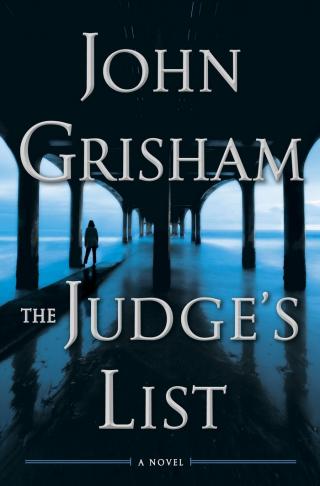
The Judge’s List
- Автор: Гришэм Джон
- Серия: Lacy Stoltz #2
- Год: 2021
- Язык: английский
- Год: Doubleday/Random House
- ISBN: 978-0-385-54602-7
- Жанр: Триллеры

Электронная книга - «The Judge’s List». Краткое содержание книги:
Then she meets a mysterious woman who is so frightened she uses a number of aliases. Jeri Crosby’s father was murdered twenty years earlier in a case that remains unsolved and that has grown stone cold. But Jeri has a suspect whom she has become obsessed with and has stalked for two decades. Along the way, she has discovered other victims.
Suspicions are easy enough, but proof seems impossible. The man is brilliant, patient, and always one step ahead of law enforcement. He is the most cunning of all serial killers. He knows forensics, police procedure, and most important: he knows the law.
He is a judge, in Florida — under Lacy’s jurisdiction.
He has a list, with the names of his victims and targets, all unsuspecting people unlucky enough to have crossed his path and wronged him in some way. How can Lacy pursue him, without becoming the next name on his list?
The Judge’s List is by any measure John Grisham’s most surprising, chilling novel yet.
There were a dozen on his list, give or take. More or less. Ten down, two to go. Maybe three. Dunwoody didn’t count because he was never on the list. His timing was bad, and he was one victim that still troubled the judge. He didn’t deserve to die, like the others. Troubled as he was, though, there was nothing he could do about it.
And now there were far more serious troubles.
A killer can’t help but look over his shoulder, and for years he had feared this reckoning. In fact, he’d had so much time to think about it that he had pieced together several possible reactions. One was to simply go away, vanish, before being subjected to the humiliation of an indictment, arrest, and trial. He had plenty of money and there was a big world out there. He had traveled extensively and been to several places where he could easily blend in and never be found. He preferred those countries beyond the reach of U.S. extradition treaties.
Another strategy was to stay and fight. Declare innocence, even persecution, and lawyer up for a big trial. He knew precisely who to hire for his defense. No jury could convict him because no police department had the evidence. It was his firm belief that no prosecutor would ever indict, for the same reason. No sitting judge had ever been put on trial for murder in America, and to do so would cause a media circus of epic proportions. Even the most ambitious prosecutor would shy away from the horror of losing before such an audience.
Which of his murders would be the easiest to prove at trial? It was the great question that he toyed with almost every day. Because of his cunning and brilliance, he was of the lofty opinion that none of them could survive past the indictment phase. Staying and fighting was the most attractive option.
Staying would allow him to finish his list.
The last strategy was the easiest. He could simply end the game himself and take his crimes to his grave.
Judge Bannick allowed himself a martini late on Friday afternoons, usually with another judge or two, and there were several preferred bars in the area. One favorite was at a club on the oceanfront with the Gulf stretching in the distance. On this Friday, though, he was in no mood for socializing, but he did need the martini. He mixed it in the back room and sipped it in the Vault, and as he did so he asked himself the obvious question: “Who is this person?”
A cop would not bother with anonymous mail. Why waste the time? Why alert the suspect? Why play games? And the cops weren’t looking. He had hacked his way into all the police departments and he knew how cold the files were. The sheriff in Biloxi and his detective Napier were still working the case every day, but that was only because there were two victims and one was local. They had nothing to show for their efforts and now, after six months, they were following the same pattern as the others.
A private investigator would cost too much money. Regardless of the hourly rate, there was simply too much labor involved to link the murder of Eileen in 1998, in North Carolina, to the murder of Perry Kronke in 2012, then to Verno and Dunwoody in Biloxi last fall. No one could afford such a project. He knew his victims and their families well. Perry Kronke was by far the wealthiest of the lot, but his widow was in poor health and probably reluctant to spend a fortune trying to find his killer. His two sons were Miami businessmen of modest success.
Bannick stepped to a corner and pulled back a rug. With a key he unlocked a safe hidden under the flooring and removed a thumb drive. He stuck it into his computer, pecked here and there, and within seconds a file labeled kronke appeared. Since he had researched and written everything in the file, he knew it by heart, but the constant review of his past was part of his life. Constant vigilance was just as important as meticulous planning.
Kronke’s estate had been probated in Monroe County, Florida, four months after his murder. His older son, Roger, was named executor of his will and was so appointed by the court. Inventories of assets were filed on time. There were no mortgages and no debts other than routine credit card charges. At the time of his death, Kronke and his wife jointly owned their retirement home, appraised at $800,000, two rental homes at $200,000 each, a stock portfolio valued at $2.6 million, a money market account with a balance of $340,000, and various bank accounts that totaled $90,000. With his cars and boat and other smaller assets, the inventory added up to $4.4 million.
The estate file was public record. Hacking into the probate judge’s office email had been a breeze because of Maggotz and its familiarity with the entire Florida court system. Rafe was also spying on Mrs. Kronke and her finances as a new widow. He watched her bank records and knew that she drew a Social Security check of $2,000 a month, a retirement check from the law firm for $4,500 a month, and $3,800 from a 401(k).
The bottom line was that she had plenty of cash but there was no indication she was writing big checks to private investigators. She didn’t email much, but there was correspondence between her and the two sons. She was contemplating selling the house and moving into an expensive retirement village. Emails between the sons indicated the usual worries about Mom spending too much and screwing up their inheritances.
There had been no chatter about devoting time and money to search for the killer.
Bannick convinced himself that “the person” was not stalking him on behalf of the Kronke family.
At the other end of the economic ladder was Lanny Verno. Having no estate, nothing had been probated. He left behind no assets, no children, no close family, nothing to hack, nothing but a live-in lady who’d come and gone and had shacked up with plenty. Verno was the last person on his list who might send in the investigators.
Bannick jumped to another file, labeled eileen nickleberry.
Her family was just as doubtful. She had died sixteen years earlier with no will and few assets. Her mother had been dragged into court to serve as administrator of her estate. Her condo and car were hocked and sold to satisfy the loans and pay off her credit cards. After all debtors were satisfied, her parents, who were divorced, and two siblings split about $4,000.
Interestingly enough, her father hired a lawyer to explore a wrongful death claim against the owner of the condo development where she was murdered. Rafe watched the emails for a year or so as the lawsuit fizzled. Bannick was intrigued by the idea of lawyers, not cops, digging through the murder. The police were baffled from the start, as were the lawyers, and the investigations went nowhere. Other than a handyman with no criminal record and a solid alibi, there had never been a suspect. Another perfect murder.
The last one mentioned by “the person” was Mike Dunwoody. Bannick went to his file, certain that his family had not hired private investigators. His murder was only five months old, and Sheriff Black and Detective Napier were doing and saying all the right things to convince the public they were making progress. The family seemed content to mourn in private and trust the authorities. Dunwoody’s will left everything to his wife and named her as executrix. Five months on, she had yet to begin probate. According to their bank records, personal and business, the company fell in line with most home contractors — up one year, down the next, successful as a whole but no one was getting rich. It was impossible to believe they were in a position to spend tens of thousands on their own investigation.
The person was not a cop and not a private eye. However, he was clearly using people like Rollie Tabor to snoop around. Who would hire an investigator from Mobile?