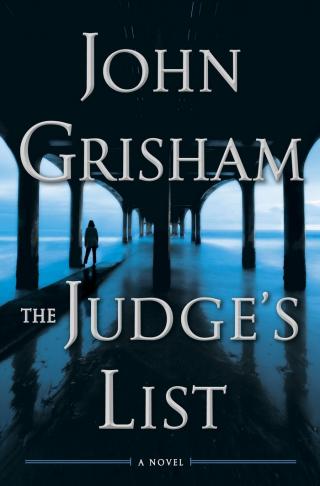
The Judge’s List
- Автор: Гришэм Джон
- Серия: Lacy Stoltz #2
- Год: 2021
- Язык: английский
- Год: Doubleday/Random House
- ISBN: 978-0-385-54602-7
- Жанр: Триллеры

Электронная книга - «The Judge’s List». Краткое содержание книги:
Then she meets a mysterious woman who is so frightened she uses a number of aliases. Jeri Crosby’s father was murdered twenty years earlier in a case that remains unsolved and that has grown stone cold. But Jeri has a suspect whom she has become obsessed with and has stalked for two decades. Along the way, she has discovered other victims.
Suspicions are easy enough, but proof seems impossible. The man is brilliant, patient, and always one step ahead of law enforcement. He is the most cunning of all serial killers. He knows forensics, police procedure, and most important: he knows the law.
He is a judge, in Florida — under Lacy’s jurisdiction.
He has a list, with the names of his victims and targets, all unsuspecting people unlucky enough to have crossed his path and wronged him in some way. How can Lacy pursue him, without becoming the next name on his list?
The Judge’s List is by any measure John Grisham’s most surprising, chilling novel yet.
He lived ten miles away in the town of Cullman, in a fine home with the usual busy man’s office, one that could be easily raided by men with warrants. And his professional office was his rather somber chambers on the second floor of the Chavez County Courthouse, a space owned by the taxpayers and, though not exactly open to the public, clearly susceptible to being searched.
Let them come. Let them seize all the files and computers in his home and his official chambers, and they would not find one shred of evidence against him. They could stalk him online, dig through his computers and judicial data server files, trace every email he’d ever sent from those computers, and they would find nothing.
He had lived most of his adult life in fear of arrest, of warrants, of detectives, of getting caught. The fear had so thoroughly consumed him for so long that his daily routines included all manner of cautionary moves. And he remained, so far, ahead of the bloodhounds.
The fear of getting caught was not driven by the fear of paying the price. Rather, it was the fear of having to stop.
His passion for technology, security, surveillance, off-the-wall science, even espionage, was rooted in a movie he had long since forgotten the name of. He had watched it as a frightened and damaged thirteen-year-old boy, alone in the basement one night after his parents had gone to bed. The protagonist was a scrawny misfit of a kid who was the favorite target of neighborhood bullies. Instead of lifting weights and learning karate, he delved into the world of weird science, spycraft, weaponry, ballistics, even chemical warfare. He bought the first computer in town and taught himself how to program it. In due course, he exacted revenge on the bullies and rode off into the sunset. It wasn’t much of a movie, but it inspired young Ross Bannick to embrace science and technology. He begged his parents for an Apple II computer for Christmas, and birthday too. Plus, he tossed in $450 of his own savings. Throughout high school and college, every paycheck and every spare dollar went for the latest upgrade, the latest gadget. In his younger days, he had secretly tapped phones, filmed frat brothers having sex with their girlfriends, recorded lectures that were off-limits, disabled surveillance cameras, picked locks, entered secured offices, and taken a hundred other stupid chances that he never regretted. He had never been caught, not even close.
The arrival of the Internet presented him with endless possibilities.
He took off his tie and jacket and tossed them on a leather sofa, a place he often slept. He had clothes in a closet in the rear, a small fridge with sodas and fruit drinks. There was a café a hundred yards away near the cinema and he often ate there, alone, when working late. He walked to a thick metal door, punched a code, waited for the lead bolts to release, then opened it and walked deeper inside his secret world. The Vault, as he proudly called it but only when talking to himself, was a fifteen-foot-square office that was soundproof, fireproof, waterproof, everything-proof. No one had ever seen it and no one ever would. There was a desk in the center with two thirty-inch computer screens. One wall was covered with IP cameras showing his home, office, courthouse, and the building he was in. On one wall there was a sixty-inch plasma screen television. The other two walls were bare — no ego puffery, no awards, commendations, diplomas. All that junk was preserved on walls that could be seen. Indeed, there was nothing anywhere in his other chamber that would indicate who owned the place. The name of Ross Bannick was nowhere to be found.
If he dropped dead tomorrow, his computers and phones would wait patiently for forty-eight hours, then wipe themselves clean.
He sat at his desk, flipped on his computer, and waited for the screen to come to life. He pulled the two letters out of his briefcase and placed them in front of him. The one in an envelope was postmarked pensacola and informed him of the BJC investigation. The other, a silly poem, was in the envelope postmarked montgomery. Both sent by the same person at about the same time.
He went online, activated his VPN to blow past security walls, and passworded his way into the dark web, where Rafe was always waiting. As an employee of the state, Bannick had long ago hacked his way into the data networks of Florida’s government. Using his customized spyware, called Maggotz, he had created his own data sleuth, a troll he christened Rafe, who roamed the systems and cloud with total anonymity. Because Rafe was not a criminal, was not stealing or holding data for ransom, but rather was only nosing around for esoteric information, his chances of being discovered were almost zero.
Rafe could, for example, observe internal memos between the seven members of the Florida Supreme Court and their clerks, and Bannick would know precisely how one of his cases on appeal would be decided. Since he couldn’t do anything about the case, the information was basically useless, but it was certainly interesting to know which way the wind was blowing.
Rafe could also see sensitive correspondence between the Attorney General and the Governor. He could read comments made by prosecutors about sitting judges. He could dig deep into the files of the state police and report their progress, or lack of it.
And, most importantly at that moment, Rafe could watch the goings-on at the Board on Judicial Conduct. Bannick checked it for the second day in a row and found nothing with his name on it. This was confusing, and troublesome.
Hell, at that moment everything was troublesome.
He swallowed more ibuprofen and thought about a shot of vodka. But he was not much of a drinker and planned to go to the gym. He needed two hours of pounding weights to break the stress.
It was amusing to read the complaints currently being investigated by BJC. He relished the allegations against his fellow members of the judiciary, a few of whom he knew well, a couple of whom he despised. Prolonged amusement, though, was out of the question.
Bannick reveled in his wrongdoing. The other complaints at BJC were chicken feed compared to his crimes. But now someone else knew his history. And, if a complaint had been filed against him, why was it being hidden?
This ramped up the head-spinning and he reached for the pills.
The person who sent the letter, and the poem, knew the truth. That person mentioned Kronke, Verno, and Dunwoody, and suggested others. How much did they know? If that person had filed the complaint with BJC, then he or she did so only with an agreement that there would be no record of it, at least not for the forty-five-day assessment period.
He went to a small room in the rear, undressed, took a long hot shower, and put on workout clothes. Back at his desk, he sent Rafe into the confidential files of the state police, files so sensitive and protected that Rafe had been waltzing through them for almost three years now. He found the Perry Kronke file from the town of Marathon, and was stunned to see a fresh entry by Detective Grimsley, the state’s lead investigator. It read:
call today from chief Turnbull in Marathon; he had a visit on March 31 from two lawyers with the Florida Board on Judicial Conduct — Lacy Stoltz and Darren Trope; they said they were curious about the murder of Kronke; said they might have a suspect but would not divulge anything; gave no names; they went to the approx site of where Kronke was found; revealed nothing; they left and promised to contact later; Turnbull was not too impressed, says he expects to hear nothing back, said no action needed on our part.
He had left nothing behind at the Kronke killing. He had even dipped himself into the ocean.
“Might have a suspect,” he repeated to himself. After twenty-three years of remaining invisible, was it possible that someone finally considered him to be a “suspect”? If so, then who? It wasn’t Lacy Stoltz or Darren Trope. They were simply low-level bureaucrats reacting to a complaint, one filed by the same person who was now sending him mail.