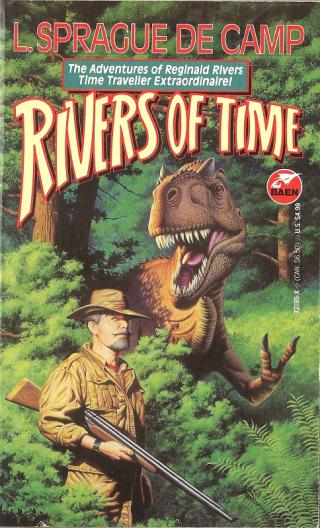
Rivers of Time
- Автор: Де Камп Лайон Спрэг
- Год: 1993
- Язык: английский
- Год: Baen Books
- ISBN: 9781555940232
- Жанр: Научная фантастика

Электронная книга - «Rivers of Time». Краткое содержание книги:
Includes:
• Faunas (1968)
• A Gun for Dinosaur (1956)
• The Cayuse
• Crocamander Quest
• Miocene Romance
• The Synthetic Barbarian
• The Satanic Illusion
• The Big Splash
• The Mislaid Mastodon
• The Honeymoon Dragon
The stegosaur maintained their circle for at least an hour after the theropod had disappeared; then they broke up and went back to browsing. Whether the Epanterias caught the camptosaur, or whether it lay down and died of its bullet wounds, I shall never know. It's against my principles to let a wounded animal get away, probably to die somewhere and be of no use to anyone but the local scavengers. Not sporting. But in this case, I think I could be excused for not following up the matter. I had enough problems from having to wet-nurse a pair of preachers who, though they tried to be nice about it, were sure I was a limb of Satan.
When we returned to the camp, Zahn grabbed his assistant in a smothering embrace, with tears running down his fat face. "Oh, Paul!" he cried. "I thought you were done for! I should never have let you come on this expedition, knowing your imprudence! What would I ever tell your sister?'
The upshot was that, since the day was nearly gone, we should camp there through the night and set out for the next stop, the early Eocene, on the morrow.
"I have seen all I need to here," said Zahn. "If I missed the behemoth, I have seen the dragon—the veritable dragon alluded to in Job, Isaiah, and sundry other places. Like the Behemoth, it evidently survived down to historic times. It is but one more proof of the Bible's literal veracity."
Of course any geologist would call that nonsense, citing the age of the last deposits in which dinosaurs are found, sixty-odd million years before Present. But such arguments would roll off the Reverend Zahn's mind like gravel off a turtle's shell.
During the night, McMurtrie was on watch and I was trying to get my four-hour turn of sleep, when the sound of raised voices from the next tent woke me up. It sounded as if the preachers were having a dispute. I heard Zahn, in that splendid orotund baritone, say:
"But, Paul, do you not see? Once you start admitting that certain verses in the Bible may be interpreted as figures of speech, you open the door to all the Biblical historians and analysts, who want to reduce God's word to a lot of legends and folk tales. You end up with a document with no more authority than the Mahabharata. It is the camel's head in the tent, the thin edge of the wedge."
"But, Gil!" protested Hubert. "On some points the scholars have us by the short hairs; for instance, where the Bible contradicts itself, as in the two diverse Creation narratives and the two Flood narratives."
"It only seems like a contradiction to our limited mortal minds," said Zahn. "To divine wisdom, the solution is plain; and we should not set ourselves up as wiser than God."
"But, Gil," persisted Hubert, "don't we have to allow some figures of speech, as for example where it speaks of the 'four corners of the earth' in Job and again in Revelations? We all know the Earth doesn't have corners."
"In such cases," said Zahn, "we apply Galileo's explanation, that the Bible was written in language that the people of the time of writing could understand, under divine guidance. But you miss the main point."
"What's that?"
"Once you admit Biblical fallibility, you undermine its authority as the moral code that God commanded men to live by, and you know as well as I that the morals of our country have—if you will excuse the expression—gone to Hell in the last century. You know the figures on divorce, juvenile criminality, and all the rest. If you start by saying: Oh, well, the 'seven days' of Genesis are just a figure of speech for the 'thousand years' of the ninetieth Psalm, the next step is to discard the prohibitions on adultery and fornication as just figures of speech; and you end up discarding the laws against theft and murder. We— ministers of God like us—are civilization's last defense against barbaric anarchy."
"But all those prohibitions can just as well be argued on a rational basis—"
"What rational basis?"
"Why, the long-term effect of unchecked offenses, from fornication to murder, when everybody starts indulging in those vices. You end up with gangster rule.'
"That's how the Secular Humanists talk. A secular philosophy may look fine on paper, but it's like a shiny new boat that will not float. Look what happened to Marxism, which had moral codes much like those of Christianity! It, too, looked fine and logical on paper; so it was tried out in Russia. After seventy years it was obviously not giving people the better fives it had promised. So the people, who had been forced by ferocious penalties to submit to it, rose up and threw it away. I fear, Paul, that you are headed down that same primrose path."
"I am not! If something's plainly untrue, you can't expect me to defend it to the laity—"
"Hush, man! You will awaken the whole camp!" The argument continued but in an unintelligible grumble.
It seemed to me that Zahn implied, without saying so out loud, that a little pious fakery was okay if it helped to lead the masses along the moral paths they ought to follow for their own good. I'm not qualified to judge such a view as either good or bad.
At breakfast next day, I noticed that feelings between two preachers were not of the best. They never spoke to each other, save for such needfuls as "Please pass the salt." It looked as if their disagreement over Biblical interpretation had blown up into a major quarrel. Otherwise they ate in grim silence, and this continued while the crew packed up the equipment for the next jump in time.
The next stop was in the lower Eocene, about the time of the Wasatch formations. This would show the profound difference between this fauna and the one that, fifteen or twenty million years earlier, had roamed the land. Before the K-T Boundary Event, the country swarmed with dinosaurs: big ones, little ones, and every size between. After the Event, there was nothing but the little mammals, the size of rats and mice, and the birds that survived the Event. The pterosaurs had also vanished; so had some of the marine reptiles, though I couldn't demonstrate that in the middle of a continent.
Cohen set us down on a little hill on a fine spring morning. I got out first, as usual, but there was nothing to be alarmed about. We were in a drier climate than on the last two stops, so the trees tended to cluster in valleys and along watercourses, leaving the hilltops clear. There were even little patches of real grass, though nothing like the grassy meadows and plains that appeared in the Miocene. Grass was a welcome sight after all the bare earth, even in well-watered places, of the Mesozoic and earlier. The bare Mesozoic earth is speckled with shrubs and herbs, often spiny; but these don't give the mental comfort of real grass. And wildflowers bloomed everywhere, red and violet and everything in the spectrum between.
Of animal life, none was in sight until, through my glasses, I picked up a herd of small beasts wandering over a hillside in the middle distance, nibbling at the greenery. I called my clients' attention to it, saying:
"That's the sort of thing you can expect to see in this period."
"How big are those animals?" asked McMurtrie.
"Hard to tell from here, but I should guess about the size of a setter dog. The condylarth Phenacodus, I think. You won't find many larger kinds."
Looking through his own binoculars, Paul Hubert said: "That's funny. They're eating leaves and buds, but they seem to have paws like a dog's instead of hooves."
"That's common in this period. The herbivores had only just begun to evolve their claws into hooves."
"Are you sure there are no dinosaurs?" said Hubert.
I shrugged. "I've been here before, and to the still earlier Paleocene, and I've never seen a sign of one. I won't say that a remnant of the dinosaurs—probably one of the little blokes—might not have survived the Event somewhere; but no fossils have yet been found of such survivors."