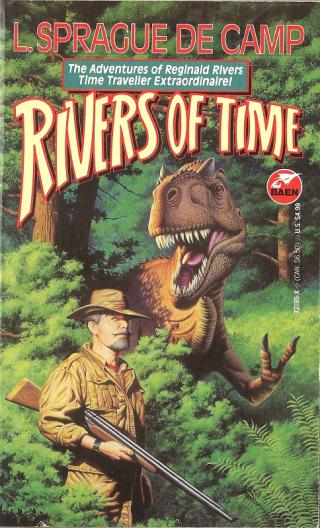
Rivers of Time
- Автор: Де Камп Лайон Спрэг
- Год: 1993
- Язык: английский
- Год: Baen Books
- ISBN: 9781555940232
- Жанр: Научная фантастика

Электронная книга - «Rivers of Time». Краткое содержание книги:
Includes:
• Faunas (1968)
• A Gun for Dinosaur (1956)
• The Cayuse
• Crocamander Quest
• Miocene Romance
• The Synthetic Barbarian
• The Satanic Illusion
• The Big Splash
• The Mislaid Mastodon
• The Honeymoon Dragon
"That'll teach you not to bother the local wildlife," I said, "unless you intend to shoot something for a trophy."
"Blast it!" he said. "Got my shoes soaking wet. Can I take them and my socks off to dry before we start back?"
"Whatever you like," I said.
When Hubert got his shoes and socks laid out on the strand, he decided to go wading. So he rolled up his pants legs above the knee and walked into the sea. McMurtrie decided to do likewise; since he was wearing shorts, the process was simpler for him. Presently the pair were splashing around and having a high old time.
"Like children," said the sonorous voice of Gilmore Zahn. "If you do not mind, I think I will take off my shoes and socks, also; but not for wading. I need to rest my feet."
"Takes a bit of practice to harden one," I said.
"You are right. Gluttony and sloth are my deadly sins, against which I ever struggle. I should take more regular exercise."
Then an outcry from the waders brought me round. They splashed back to shore with alacrity, and McMurtrie said:
"We just saw the damnedest thing out there! I guess you'd call it a Devonian lobster, only it didn't look like any lobster I ever saw."
Hubert chimed in: "About as long as I am, with a tapering jointed body. It had a lot of legs, with the first pair ending in pincers and the last pair flattened for oars."
"Probably harmless," I said. "Not that I should care to get into a tub with one. That's a eurypterid or sea scorpion."
"Scorpion, eh?" said Hubert. "Does it have a sting in its tail?"
"Don't know, but I doubt it," I said. "When you blokes have dried your feet and got yourselves shod again, it'll be time to start back."
There wasn't much more to the Devonian stop. There was really little for non-scientists like my sahibs to see, and we had bloody well exhausted the possibilities that morning. So it was no surprise when, that afternoon, they asked me to have Cohen bring them forward to the next stop without spending a night in the Devonian.
I passed the word to Cohen. Beauregard and his helpers looked a little disgruntled at having to pack up the tents and stuff without using them; but Beauregard was too practiced and self-disciplined to fuss. I thought I heard Pancho mutter something like "¡Tal tonteria!" I pretended not to hear, not wishing to make an issue of it. By tea time we were on our way through time again.
Our next stop was in the Pennsylvanian, which European geologists call the late Carboniferous. This turned out to be even less fruitful than the Devonian stop. The topography had changed around the site; we seemed to be in a flat, swampy plain. Whether anything was left of the range of mountains east and north of the Devonian site, we couldn't tell, because we arrived in a pelting downpour. It rained and rained from a blanket of low gray clouds, blotting out sight of any mountains that might have existed.
We did see a couple of big amphibians—or perhaps reptiles, or halfway between—like overweight newts over a meter long, waddling among the trees. These trees were much like those we had seen in the Devonian, only bigger and more of them, from what little we could see through the deluge. During the lulls in the storm, we heard some grunts and croaks, like the noises frogs make in springtime for mating calls, only these were basso profundo.
Since we had gained a day on our schedule, we thought to wait out the rain. But when on the third day it was pouring as hard as ever, my clients indicated they would be just as glad to go on to the next time stop.
"Very interesting," said Zahn. "I did not know there were any such rain-forest swamps left, since the Brazilians and others have destroyed theirs to grow crops. But I understand they have set aside some areas as national parks; perhaps this is one."
"You mean," said McMurtrie, "you just won't believe we're back two hundred million-odd years B.C.?"
"Not unless you can prove it by the word of God," said Zahn, smiling.
The crew packed up the tents and the galley again, sloshing about in the downpour, and off we went to the later Jurassic.
This time, when we got out of the chamber, I cautioned my clients to stay close by me. "There are some bloody dangerous theropods," I told them. I looked especially hard at the Reverend Hubert, because I had sized him up as an impulsive, combative sort of bloke, just the kind likely to put himself and his fellow trippers in harm's way in dinosaur country.
"But not the famous Tyrannosaurus?" he said.
"No; that comes forty or fifty million years later."
"According to your false theory," said Hubert sharply, as if he wanted to make a Donnybrook out of it.
"Be calm, Paul," said Zahn. "Reggie said he wouldn't try to convert us to evolution; merely present evidence and let us make up our own minds. So let us watch, and observe, and save our inferences till we get home."
"I've made up my mind," said Hubert. "Anyway, I shouldn't think there'd be anything much to worry about without the tyrant lizard."
"Not quite true, I'm afraid," I said. "There's a whole assortment of theropods of different sizes. That's how it works in nature; each size has its special prey, so different species of predator don't much compete. The biggest at this time is Allosaurus, or at least a tyrannosaur-sized theropod, which some think is just an allosaur that has lived a long time. You know, most reptiles lack our internal cut-off mechanism, which stops growth at a certain stage. So the longer they live, the bigger they get.
"Some of my paleontological friends think these biggies should be put in a separate genus, which they call Epanterias. In any case, they are not the sort of blokes you want to take chances with."
Hubert stared about him in the forest. "Don't see any of them here, now," he said.
"Lucky for us," I said. "Here, don't wander into the chamber area! It's got to be kept clear so the chamber wallah can set it down in the same place with the crew."
We were in well-wooded country. As far as I could see from the site—not very far—it was more rolling than the flat plain of the Pennsylvanian. The trees around us were mostly palms of one sort or another; and also cycads, looking like thick, stumpy palms with flowerlike growths on their trunks. There were also a few araucarias or monkey-puzzle trees. At this period ancient relatives of the modern ginkgo also occurred, but I didn't see any of these at this site.
Among the trees were shrubs, some of them calanines or horsetails like those that, back in the Devonian, were among the first plants to invade the land. These were smaller and less impressive than the Devonian ones. There was no grass whatever, since it hadn't yet evolved.
Altogether, the flora began to look a little more like plants from our own era and less like things from another planet. Everything was pretty much the same somber green, which gets monotonous if you have to look at it for a long enough time.
There was also a buzz of insects, lack of which I had noted on the Devonian stop. As to other life forms, we should have to wait and see.
"Don't anybody wander off," I said. "In woods like these, it's the easiest thing in the world to get lost the minute you're out of sight of your base. You memorize a particular tree to help you find your way back; then, when you look for it, it has turned into a dozen trees, all looking exactly alike and all beckoning in different directions."
The crew arrived and set up the camp. While they were doing this, McMurtrie called: "Hey, there's a critter!"
The beast that had wandered out of the trees and was looking at us in a blank sort of way was a camptosaur, one of the smaller iguanodonts. A typical adult must weigh around a hundred or 150 kilos. When it stands up on its hindlegs, using its tail for a prop, it looks you in the eye. When it drops down to walk or run, it's about waist high, with the head sticking out horizontally in front and the tail projecting aft to balance. Otherwise it's a bloody unimpressive dinosaur: no noteworthy horns, fangs, or killing claws.