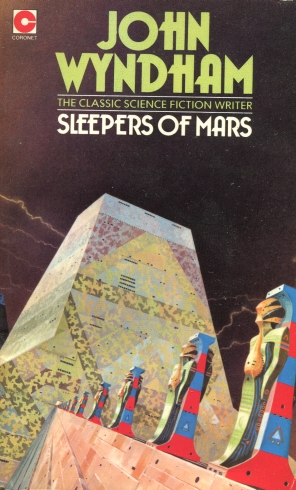
Sleepers Of Mars
- Автор: Уиндем Джон Паркс Лукас Бейнон Харрис
- Год: 1977
- Язык: английский
- Год: Coronet Books/Hodder & Stoughton Ltd
- ISBN: 0340173262
- Жанр: Научная фантастика

Электронная книга - «Sleepers Of Mars». Краткое содержание книги:
Of course, we are now well used to the idea of Man On The Moon, we have become blasé as to the possibilities of inter-planetary travel. But imagine two expeditions to Mars, one British, the other Russian, both in the process of discovering a mechanical race, invented and produced by the Martians as they believe their specie to be dying.
The other four novellas in this collection give further evidence of John Wyndham’s genius at invention, characterisation and sense of movement.
Beyond an idea that it would appear better not to be too eager, I had no reason for putting off my answer. Already I had determined to go—and to wreck the Nuntia. I had waited many years to get in a blow at I.C., and now was my chance. Ever since the death of my parents, I had set my mind on injuring them. Not only had they killed my father by their negligence in a matter of unshielded rays, but they had stolen his inventions, and robbed him by prolonged litigation.
Enough, you say, to make a man swear revenge. But that was not all. I had to see my mother die in poverty, when a couple of hundred pounds would have saved her life—and all our money had gone in fighting I.C. After that, I changed my name, got a job with I.C. and worked—hard. Mine was not going to be a paltry revenge: I was going to work up until I was in a responsible position; one from which my hits could really hurt them.
I had allied myself with Metallic Industries because this was their greatest rival, and now I was given a chance to wreck the ship to which they had pinned such faith. I could have done that alone, but it would have meant exile for the rest of my life. Now, M.I. had smoothed the way by offering me a passage home. Yes; I was going to do it. The Nuntia should make one trip, and no more. But I’d like to know just what it was they decided in the Board Room after I had gone––—
CHAPTER THREE
THE FATEFUL VOYAGE
The Nuntia was two weeks into space, but nobody was very happy about it.
In those two weeks, the party of nine on board had been reduced to seven and the reduction had not had a good effect upon our morale. As far as I could tell, there was no tangible suspicion afoot; just a feeling that all was not well. Among the hands it was rumoured that Hammer and Drafte had gone crazy before they killed themselves. But why had they gone crazy? That was what worried the rest. Was it something to do with the conditions in space; some subtle, unsuspected emanations? Would we all go crazy?
When you are cut off from your kind, you get strange fancies. Imagination gets overheated, and you become too credulous. That is what used to happen to sailors on their long voyages in the old windjammers, and it began to happen to our crew, out in space. They started to attribute the deaths to uncanny, malign influences in a way which would never have occurred to them on Earth. It gave me some amusement, at the time.
First there had been Dale Hammer, the second navigator. Young, a bit wild at home, perhaps, but brilliant at his job, proud and overjoyed that he had been chosen for this voyage. He had gone off duty in a cheerful frame of mind. A few hours later, he had been found dead in his bunk with a bottle of tablets by his side—one had to take something to ensure sleep, out here. Everyone agreed that it was understandable, though tragic, that he might have taken an overdose by mistake …
It was after Ross Drafte’s disappearance that the superstitions had begun to cluster. He was an odd man, with an expression that was frequently taciturn and eyes in which burned feverish enthusiasm. A failure might have driven him to desperation, but in the circumstances he had everything to live for. He was the designer of the Nuntia, and she, the dream of his life, was endorsing his every expectation. When we should return to make public the story of our voyage, his would be the name to be glorified through millions of radios, his the face that would stare from millions of newspapers—the conqueror of gravitation.
And he had disappeared–-The air-pressure graph showed a slight dip at one point, and Drafte was no more….
I saw no trace of personal suspicion. No one had even looked askance at me nor, so far as I knew, at anyone else. No one had the least inkling that one man aboard the ship could tell them exactly how those two men had died. There was just the conviction that something queer was afoot.
And now it was time for another….
Ward Govern, the chief engineer, was in the chart-room talking with Captain Tanner. The rest were busy elsewhere. I slipped into Govern’s cabin unobserved. His pistol I found in the drawer where he always kept it, and I slipped it into my pocket. Then I crossed to the other wall and opened the ventilator which communicated with the passage. Finally, after carefully assuring myself that no one was in sight, I left, closing the door behind me.
I had not long to wait. In less than a quarter of an hour, I heard the increasing clatter of a pair of magnetic shoes on the steel floor, and the engineer passed cheerfully by on his way to turn in. The general air of misgiving had had less effect upon him than upon anyone. I heard the door slam behind him. I allowed him a few moments before I moved, as quietly as my magnetic soles would allow, to the ventilator.
I could see him quite easily. He had removed his shoes, and was sitting at a small wall desk, entering up the day’s events in his diary. I thrust the muzzle of the pistol just within the slot of the ventilator, and with the other hand, began to make slight scratching noises. It was essential that he should come close to me: there must be a burn, or at least powder marks.
The persistent scratching began to worry him. He glanced up in a puzzled fashion and held his head on one side, listening. I went on scratching. He decided to investigate, and released the clips which held his weightless body to the chair. Without bothering to put on the magnetic shoes, he pushed himself away from the wall and came floating towards the ventilator. I let him get quite close before I fired.
There was a clatter of running feet, mingling with cries of alarm. I dropped the pistol inside my shirt and jumped round , the corner, reaching the cabin door just ahead of a pair who came from the other direction. We flung it open, and looked inside. Govern’s body, under the impetus of the shot, had floated back into the middle of the room. It looked uncanny, lying asprawl in mid-air.
‘Quick ! ’ I yelled. ‘Fetch the Captain.’
One of them pelted out of the door. I managed to keep my body between the other and the corpse, while I closed the dead fingers around the pistol. A few seconds later, everybody had collected about the doorway, and the Captain had to push them aside to get in. He examined the body. It was not a pleasant sight. The blood had not yet ceased to flow from the wound in the head, but it did not drip as it would on Earth; instead, it had spurted forth to form several red spheres which floated freely close beside the corpse.
There was no doubt that the shot had been fired at close range. The Captain looked at the outflung hand which gripped the automatic.
‘What happened?’
No one seemed to know.
‘Who found him?’
‘I was here first, sir,’ I said. ‘Just before the others.’
‘Anyone with you when you heard the shot?’
‘No, sir. I was just walking along the passage-’
‘That’s right, sir. We met Gratz running round the corner,’ somebody supported.
‘You didn’t see anyone else about?’
‘No, sir.’
‘And was it possible, do you think, for anybody to have got out of the room unseen between the time of the shot and your arrival?’
‘Quite impossible, sir. He would have been bound to walk straight into me, or the others—even if there had been time for him to get out of the room.’
‘Very well. Please help me with this.’ He turned to the other four who were still lingering in a group near the door. ‘You men get back to work, now.’
Two began to move off; but the other pair, Willis and Traill, both mechanics, held their ground.
‘Didn’t you hear me? Get along there!’
Still the two hesitated. Then Willis stepped forward, and the Captain’s unbelieving ears heard his demand that the Nuntia be turned back to Earth.
‘You don’t know what you’re saying, man! ’