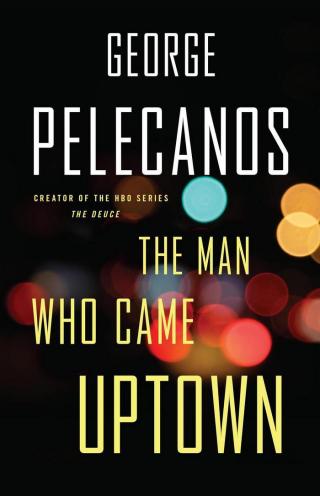
The Man Who Came Uptown
- Автор: Пелеканос Джордж
- Год: 2018
- Язык: английский
- Год: Mulholland Books / Little, Brown and Company
- ISBN: 978-0-316-47982-0
- Жанр: Криминальные детективы

Электронная книга - «The Man Who Came Uptown». Краткое содержание книги:
“I know where we’re at,” said Michael.
From the backseat, Ward began to laugh. Ornazian turned around and smiled. They dapped fists.
“What did Cesar say to you before we left?” said Ornazian.
“He said we’d meet again.”
The men grew quiet. As they crossed over into the District, Thaddeus Ward closed his eyes and drifted off to sleep.
Nineteen
He had clocked out, and the weather had broken to warm, so Michael decided to sit outside the restaurant at one of those picnic tables on the patio and read his book before he walked home. He had started in on Northline, the novel Anna had bought for him at the store on Georgia Ave. There were a few customers out here, young folks, mostly, who had come by for happy hour, and though they were not particularly boisterous, he found a table away from them where he could read in peace.
At first, Michael hadn’t thought this book was to his liking. In the very first chapter, a drunk girl named Allison Johnson has unloving sex with a drug addict named Jimmy Bodie in the bathroom stall of a casino out in Las Vegas. She passes out while they’re making it, falls down, and cuts her head. All right, thought Michael, that’s just the start of the book. That’s to show that the girl has hit bottom and has learned something. Now things are gonna get brighter. But the girl doesn’t learn.
This Bodie dude, a speed freak and all-around loser, comes by her mother’s house a couple of days later and begs Allison to forgive him for doing her dirty. And instead of throwing him out, she gives him another chance. They go out to the desert to one of those new-Nazi parties and get all fucked up again on drugs and alcohol, and then she sees Bodie running his hands up inside the skirt of another girl. Michael thinking, If Allison Johnson is just going to keep being a drunk and keep being a punching bag for this dude, I don’t know if I want to keep reading. He was beginning to wonder why Anna liked the book so much.
But then, in a chapter called “T. J. Watson,” an old trucker by that name picks Allison up by the side of the road and drives her back toward Vegas in his rig. She breaks down and cries, confessing that she’s pregnant with Bodie’s child. T. J. Watson comforts her. Talks to her about choices, and the accidental death of his son, and the love he still shares with his wife after so many years. He tells her about the value of moving forward in life and the moments of beauty that are there if a person can only see them. For Michael, at that point, the book changed. He knew that, in the story, things were going to get much darker for Allison before they got better. But there would be moments of humanity too.
“Mind if join you, young fella?”
Michael looked up. Gerard, the middle-aged mailman, was by his table, standing straight and fit. He was still in his uniform.
“Have a seat.”
Gerard signaled a waiter and ordered a draft beer, then sat across from Michael on the bench.
“I’ve seen you twice here now,” said Gerard. “This where you hang out?”
“I work here. I’m down in the kitchen.”
“How’s that going?”
“Good. I like to work, just like you.”
A car with D.C. plates but flying the Dallas Cowboy flags went past them on Eleventh. The blue star was decaled on its rear window.
“I hate to see that,” said Michael.
“I do too. But to understand it, you gotta know your history.”
“I know the Redskins were the last team to integrate in the NFL, if that’s what you mean. My mother told me that. Until they put Bobby Mitchell on the squad. Right?”
Gerard nodded. “That was the early sixties. There’s more to it, though. The owner, George Preston Marshall, had always resisted the integration of the Redskins. He said it was because his fans in the South wouldn’t accept it. See, the Skins were the southernmost team in the NFL at the time, and Marshall owned the radio stations down there where the games were broadcast. He claimed it was an economic thing. But Marshall was straight-up racist too. He just didn’t want any black football players on his team. You know the Redskins fight song, where everyone sings that line ‘Fight for old D.C.’? It used to be ‘Fight for old Dixie.’ That’s how blatant that bullshit was. Black folks picketed, and a sportswriter at the Post, Shirley Povich, wrote a rack of articles against the segregation on the team. When other squads who had black athletes on their rosters played Washington, they wanted to shove it up our asses. So there were a lot of angry folks, but Marshall stood his ground. Then, when he went to get the long-term lease for the new D.C. stadium, he met his Waterloo. President Kennedy sent his interior secretary, Udall was his name, over to speak to Marshall and tell him what time it was. No integration, no thirty-year lease on your stadium.”
“They forced the man’s hand.”
“Yeah, Marshall swallowed the bitter pill, but that didn’t change what was in his heart. When he died, his will set up a big charitable foundation to benefit kids in the D.C. area. A clause in that will said that no money would ever go to ‘any purpose which supports the principle of racial integration in any form.’ His dollars would go only to Caucasian kids. The man was like that, even past his deathbed. Some black Washingtonians who lived through that era would never support the Skins because of Marshall. That’s why they’re Cowboys fans. And now their kids, grandkids, and great-grandkids follow the star, even though they live in the DMV.”
“I still hate to see it,” said Michael.
Gerard laughed. “I do too. I root for two teams — the Washington Redskins and anyone who’s playing the Dallas Cowboys.”
Michael and Gerard touched fists.
“How long you been a mailman?” said Michael.
“Thirty-five years.”
“You go to school to get that job?”
“Marion Barry gave me this job.”
“That crackhead?”
“Don’t say that,” said Gerard, suddenly serious. “Let me tell you something about Marion Barry.”
The waiter served Gerard his beer. Gerard thanked him, waited for him to drift off.
“I come up in public housing in Southeast. The Eights. This was in the sixties and early seventies. Before the drug epidemic, gangs, street murder, all that mess. Lot of families stayed there, and mine was solid. My father was a good man but he had trouble finding steady work. Around that time, Marion Barry and a partner, Mary Treadwell, started this company, Pride Incorporated. It was set up to put black men to work, doing stuff like pushing brooms, picking up garbage... basically, cleaning the city up. Doesn’t sound too good, but it was work for men who were chronically unemployed. Why they gave it that name. It gave men back their pride.
“My father worked for Pride Incorporated and I saw what it did for him. It made him stand straight. As a kid, I saw by example that this is what a man does. He goes to work every day and he takes care of his family. I knew that, soon as I could, I would go to work too. So when I turned sixteen, my father and mother told me about this new thing, the summer jobs program. It was started by Marion Barry, who by then had become the mayor. The program put kids in the city to work. I went down and signed up for it. Soon I was working in a diner down at Nineteenth and Jefferson for a Greek man named Pete. Because of that program, I got into the culture of work. Around that time, Mayor Barry came to my high school, Ballou, and spoke to us kids. He shook my hand and he looked me in the eye and said, ‘Keep on it, son. You’re gonna do fine.’ He was real. Not like some of these cold-ass mayors we been had since. You never did see them talking to any kids.
“Anyway. After I come out of high school, I wanted a government job, so I went out to Riverdale, in Maryland, and took the postal-service exam. I had a good memory, and on that test they ask you to recall the original order of scrambled numbers. A week later, I got the results in the mail. I had scored highly. I was in.”