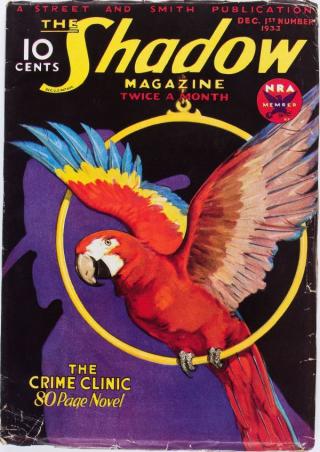
The Crime Clinic
- Автор: Грант Максвелл
- Серия: The Shadow #43
- Год: 1933
- Язык: английский
- Год: Street and Smith
- Жанр: Крутые детективы

Электронная книга - «The Crime Clinic». Краткое содержание книги:
“As Limps Silvey, I learned facts concerning Bing Claver’s proposed attack at Winchendon’s. I knew Cardona’s stools were trailing me. I deliberately drew you, Cardona, on my track so that I could make that pretended telephone call. It was I who called you at the restaurant in Corona. I wanted you and your men to get to Winchendon’s.
“Your tip-off came in time,” acknowledged Cardona, as the physician paused. “It wasn’t your fault that the road was blocked. You did your part — and fooled me into the bargain.”
“I again adopted the guise of Limps Silvey,” resumed Dubrong with a smile, “when you told me that there were rumors of The Jackdaw. I found out that your statement was incorrect. I began to watch Bart Melken. He seemed to be The Jackdaw’s only aid.
“WHEN I read in the newspaper that Garforth Lydell had returned, I suddenly sensed where The Jackdaw might be planning to make a final stroke. I went to Melken’s hotel. I learned that he had come here, to Sarborn’s apartment. Both men were gone. Sarborn’s servant tried to kill me. I killed him. I hurried to prevent crime at Lydell’s.
“I went around the house; but I picked the wrong way. I was late arriving at the door to the hallway — too late to hurry in until you had slain The Jackdaw, Cardona.”
“While I was upstairs,” interposed Garforth Lydell. “Upstairs, unpacking — knowing nothing until I heard muffled shots from far below. Had I known that Yvonne had risen to go downstairs and find Bart Melken—”
“Bart did a good deed,” broke in Dubrong. “I am not sorry that he died as he did. It was a worthwhile way to end a misspent life.”
Commissioner Weston was staring hard. These revelations were unquestionably correct. Yet he could not yet fully accept the theory of The Jackdaw.
“What about Casslin?” he demanded. “Where is The Bishenpur diamond?”
“Perhaps I can answer that,” remarked Lamont Cranston quietly.
All turned to the millionaire. His statement was unexpected. No one had figured Cranston as one with an active knowledge of these affairs.
“I do not claim to be a detective.” There was a tinge of calm irony in Cranston’s steady voice. “Yet I noticed, out at Winchendon’s, that Farrell Sarborn was a faker.”
“A faker?” questioned Weston.
“Yes,” replied Cranston, “a faker. Sometimes fakers prove to be crooks. This bird of his” — the millionaire pointed to the scarlet macaw, still perched upon a chair back — “was an impossible performer.
“Macaws, first of all, have a penchant for screaming. They can never be cured of the habit. Secondly, they are poor talkers. Yet here is a phenomenal macaw: one that never screams; one that speaks with almost human intelligence. Both are impossible factors, especially in a scarlet macaw, one of the most difficult species to train at all.”
“But this bird may be unusual,” exclaimed Weston.
“It is unusual,” declared Cranston, with a faint smile. “It is dumb.”
“Dumb!” cried Cardona.
“Most certainly,” explained Cranston. “Look at it now, Watch its moving beak, its ruffling throat. It is trying to scream — trying constantly — and it cannot do so.”
“It spoke for Sarborn,” protested Weston.
“Sarborn spoke for it,” retorted Cranston. “He was always close beside it, scratching its head, looking toward it. The simplest possible feat of ventriloquism is to imitate the falsetto cry of a parrot. The bird’s constant habit of trying to scream made Sarborn’s ventriloquism even more effective. He kept the people just far enough away to make the illusion perfect.”
The listeners found themselves nodding.
“Sarborn was a mimic,” added Cranston. “He gave a perfect imitation of a kitten’s mew at Winchendon’s. I realized then that he was a ventriloquist. I saw nothing in his game outside of trickery.” Cranston’s knowing smile and slight sarcastic tone remained unnoticed. “Now, however, that you are seeking facts, I am able to supply them. I was at Winchendon’s. Bart Melken evidently failed to give a proper signal — so Sarborn gave one instead. The macaw’s cry of ‘Robbers’.”
“When I was playing the part of Limps,” recalled Dubrong, “I remember hearing the end of a telephone call in which Bing Claver mentioned the word ‘Robbers’.”
“A wise guy,” decided Joe Cardona. “Sarborn had no more use for Bing, once the game was up. He played the hero act at the end of the big fight. I fell for it.”
“But Casslin’s death!” blurted Weston. “You spoke of that, Cranston. How does the macaw explain it?”
“Just an idea,” returned Cranston. “Let us see if it is correct. One pet played well for Sarborn. Maybe another was trained to do its work. I read about Casslin’s odd, barred tower. I noticed something, here at Sarborn’s, that has given me a potent thought.”
HE led the way to the other room. He opened the crate in the corner, and brought out the little monkey. In the corner, Cranston spied a coil of string. He gave an end of the twine to the monkey.
“This,” said Cranston, “is a sapajou — the most intelligent species of monkeys found in South America. Look up there — that bar over the window frame — ostensibly the macaw’s perch.”
Cranston released the sapajou. The little creature clambered up the wall, carrying the end of the string. It took the cord over the bar, and brought it down the wall to Cranston. The string formed a loop over the perch.
“I see it!” cried Cardona. “Sarborn was outside by Casslin’s tower. When he got the signal that the diamond was downstairs, he sent the monkey up with a rope. Then he climbed up the rope himself.”
“How could he have gotten the diamond?” questioned Weston. “I see how he killed Casslin — he thrust a revolver between the bars and fired. But the diamond—”
Cranston, holding the sapajou under one arm, placed his gold watch upon the seat of a chair. He drew the monkey in back of the upright rods in the chair back. When he released his hold, the sapajou wriggled between, picked up the watch, and brought it back through the rods.
“He sent the monkey in for it!” shouted Cardona. “In for the diamond! That explains it all. I’m going to look at the ivy on that tower; at those bars. From the outside, this time.”
Commissioner Weston was no longer skeptical. He thrust out his hand to Lamont Cranston.
“You’d make a good detective,” he commended. “After you squander those millions of yours, come around for a job on the force. Wait — wait a moment. What about the diamond?”
“The Bishenpur diamond?” queried Cranston. “Ah, yes. There must be a clew to it. Let us see — perhaps The Jackdaw—”
His smile broadened. Everyone seemed breathless. This keen-minded investigator had made another strike.
“The Jackdaw,” repeated Cranston. “The thieving bird — the bird that even steals eggs from other bird nests. The Bishenpur diamond was The Jackdaw’s egg. Farrell Sarborn, strangely enough, was a collector of birds’ eggs—”
He waved his hand as he spoke. All turned toward the glass case that contained Sarborn’s collection of eggs. Joe Cardona, suddenly impulsed, yanked out his revolver and shattered the glass.
“A condor’s egg,” remarked Cranston, picking out the largest ovoid in the group. “Very heavy — now that I am examining it for the first time. Look — it has a seam. It is not an egg at all. It is a thin metal container.”
With a twist of his hands, he wrenched the egg apart. In one half, he exhibited a gorgeous, glittering gem, that shone with ruddy tint.
It was the Bishenpur diamond!
CARDONA was breaking open another, smaller egg. He found some gems within it. He was exulting. Here were the fruits of former robberies — the other eggs from The Jackdaw’s nest!