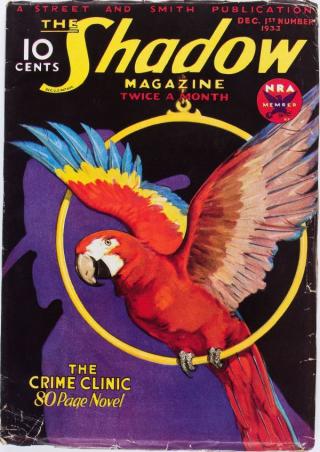
The Crime Clinic
- Автор: Грант Максвелл
- Серия: The Shadow #43
- Год: 1933
- Язык: английский
- Год: Street and Smith
- Жанр: Крутые детективы

Электронная книга - «The Crime Clinic». Краткое содержание книги:
“If those two get together,” he exclaimed, “there’ll be a battle. This little beast is a nuisance. Cute, but troublesome. I’m going to get rid of him.”
He dropped the monkey back into its box. Cranston lighted a cigarette. His gaze fell admiringly upon the glass case, with its collection of eggs. Chancing to look back toward the macaw, he observed that the bird was fluttering furiously. Sarborn noted it also. He took the scarlet bird from its perch.
“You wouldn’t think a macaw had nerves,” he laughed, “but I believe this one has. It was scared when the monkey came after it. I’ll take it out into the other room with us.”
Cranston preceded Sarborn into the living room. Sarborn closed the door of the room where he kept his pets. He perched the macaw on the back of a chair. He picked up the newspaper that he had been reading, and placed it on a table.
Lamont Cranston’s keen eyes observed a one-column portrait that adorned the page. It was a photograph of Garforth Lydell, who had just returned to New York. Headlines spoke of large banking transactions which would proceed now that Lydell had come back to the city.
Cranston chatted a while with Sarborn and Melken. He arranged a later appointment with Sarborn, on some evening when they could study a series of remarkable photographs of India, which Cranston had brought back with him. Mentioning that he was going to the Cobalt Club, Cranston added:
“If you intend to be about after midnight, Sarborn, perhaps we can get together then. I intend to call my home from the club. I can instruct Stanley, my chauffeur, to bring in the photographs. It is possible that I might be able to drop in here prior to midnight.”
“Very well,” agreed Sarborn. “I intend to be about. I shall expect to hear from you later tonight.”
Sarborn walked to the elevator with his guest. He came back to his apartment while the automatic lift was descending. He found Bart Melken pacing nervously.
“What’s the matter, Bart?” inquired Sarborn.
“I’m worrying about tonight,” confessed Melken. “I’m going up to Lydell’s — and I’m afraid of the consequences.”
“What consequences?”
Melken gulped at Sarborn’s question. He faced the other man squarely.
“Suppose, Farrell,” he said, “that I should tell you something startling — almost incriminating—”
“Regarding whom?”
“I don’t know. Except that it concerns me. Would you preserve silence regarding the matter?”
“Certainly,” returned Sarborn, “if it would prove of any aid to you, Bart.”
“All right.” Melken was pondering. He was trying to veil the truth, yet tell enough to convey the situation to Sarborn. “I’ll talk to you, Farrell. It’s about a telephone call that I received this afternoon.”
“Where?”
“At my hotel.”
“From whom?”
“I don’t know.”
Sarborn smiled. He was scratching the macaw’s head. He shrugged his shoulders in deprecatory fashion.
“Anonymous messages,” he declared, “should never be taken seriously.”
“But this one” — Melken caught himself. He had been about to say that it was not the first — “this one was serious, Farrell. It was from — well, from a man who means business.”
“Sit down,” urged Sarborn. “Light a cigarette, calm yourself, and talk to me. Something is worrying you, that’s certain. Let’s get at the root of it.”
As though to insure privacy, Farrell Sarborn went to the hall door and opened it. He glanced along the corridor. He saw no one. He closed the door and returned.
IT was then that a figure appeared in the hallway. From the gloom at the head of a flight of stairs, the form of The Shadow appeared. Evidently the black-garbed investigator had been expecting some action such as this. He knew now that the door would not be reopened immediately. He glided along the hall.
Stopped by the door, The Shadow drew a disk-like object from his pocket and placed it firmly against the door. Two tubes projected from the plate, like the connections of a stethoscope. These passed beneath the slouch hat which The Shadow wore. Equipped with this device that magnified sound, The Shadow could overhear the conversation within Sarborn’s apartment.
Beyond the door, Bart Melken was starting the plea that he had promised. He was telling Farrell Sarborn the burdens that were on his mind.
“A phone call this afternoon,” he declared. “It came from — from someone who called himself The Jackdaw. He — he threatened me unless I promised to do his bidding.”
“Threatened you with what?”
“With death, if necessary. Specifically, though, he threatened to load me with false accusations — to name me as responsible, in part, for certain crimes.”
“Which were?”
“The murder of Rutherford Casslin and the attempted raid at Silas Winchendon’s home.”
“You should not worry about such futile threats.”
“They are serious, Farrell. Do you remember that mob leader who was killed at Winchendon’s? Well, I knew him — I met him some time ago, when I was in what looked like a jam. Bing Claver helped me out of it.
“Since then — well, crimes have hit at places where I have been. I have been afraid that I would be implicated” — Melken paused — “falsely implicated.”
As he made the hasty addition, Melken looked hastily at Sarborn to see if his friend had noted it. Sarborn’s expression was entirely sympathetic. Melken was encouraged.
“I had feared,” he said, “that I might some day be called upon to commit crime. After Bing was killed, I thought that I might be safe. I knew that Bing served a big shot whom he called The Jackdaw. I heard from the man himself today.”
“What did he demand?”
“Cooperation in a crime.”
“When?”
“Tonight.”
“Where?”
“At Lydell’s.”
“You mean he wants you to aid him there?”
“Yes. To rob Lydell.”
“To rob Lydell!”
As he made this exclamation, Farrell Sarborn showed intense surprise. He ceased scratching the macaw’s head. A puzzled look came upon his face as he stared at Melken.
“You read the newspaper,” declared Melken soberly.
“About Lydell?”
“Yes. That he has arranged banking negotiations.”
“What has that to do with robbery?”
“Plenty. Lydell arrived in town today. This is a Saturday; tomorrow is Sunday; Monday happens to be a holiday. Yet a large banking transaction has been promised — immediately.”
“Yes, I read that.”
“Garforth Lydell’s methods are well known. He works quickly and effectively. It is obvious to anyone who understands his ways that Lydell must have hundreds of thousands of dollars in negotiable securities tucked away in his vault at home. That is where he does business. He will probably talk with bankers between now and Tuesday.”
“And you think The Jackdaw knows?”
“The Jackdaw does know. That is where I figure. I am to open the door of Lydell’s vault, so that The Jackdaw may enter.”
Farrell Sarborn stared in astonishment. Bart Melken hastened with a specific explanation.
“THERE are two doors to the vault room,” he said. “One opens into Lydell’s library, the other, into a disused hallway. The Jackdaw’s orders are that I shall open the door from the library; in the vault room, I can unbar the other door, which is kept barred on the inside.
“It should be simple for me to do this. Lydell keeps his keys in his desk. I may be able to obtain them. Once I have opened the door from the library, I can unbar the other door, then go out the way I came, and lock the library door behind me. That will leave the opening that The Jackdaw wants. He will have all the time in the world to crack the vault. It is an old contrivance with steel doors guarding its room; Lydell considers it sufficiently protected, however.”