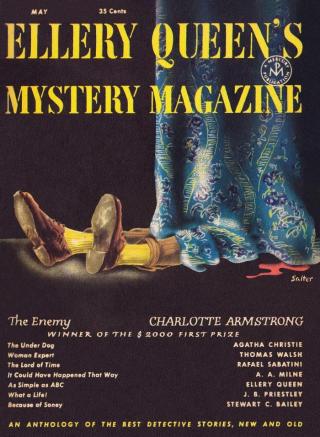
Ellery Queen’s Mystery Magazine. Vol. 17, No. 90, May 1951
- Автор: Кристи Агата, Куин (Квин) Эллери
- Год: 1951
- Язык: английский
- Год: Mercury Publications
- Жанр: Другие детективы

Электронная книга - «Ellery Queen’s Mystery Magazine. Vol. 17, No. 90, May 1951». Краткое содержание книги:
“But she has no reasons, eh?”
“None whatever.”
“Ha! Is that so? Really, now.”
“I told her,” said Lily, “that it would be no good coming to you with a mere statement like that and nothing to go on.”
“You told her that,” said Poirot, “did you really? That is interesting.”
His eyes swept over Lily Margrave in a quick comprehensive survey, taking in the details of her neat black tailor-made, the touch of white at her throat, an expensive crepe de Chine blouse showing dainty tucks, and the smart little black felt hat. He saw the elegance of her, the pretty face with its slightly pointed chin, and the dark blue long-lashed eyes. Insensibly his attitude changed; he was interested now, not so much in the case as in the girl sitting opposite him.
“Lady Astwell is, I should imagine, Mademoiselle, just a trifle inclined to be unbalanced and hysterical?”
Lily Margrave nodded eagerly.
“That describes her exactly. She is, as I told you, very kind, but it is impossible to argue with her or to make her see things logically.”
“Possibly she suspects someone on her own account,” suggested Poirot, “someone quite absurd.”
“That is exactly what she does do,” cried Lily. “She has taken a great dislike to Sir Reuben’s secretary, poor man. She says she knows he did it, and yet it has been proved quite conclusively that poor Mr. Owen Trefusis cannot possibly have done it.”
“And she has no reasons?”
“Of course not; it is all intuition with her.”
Lily Margrave’s voice was very scornful.
“I perceive, Mademoiselle,” said Poirot, smiling, “that you do not believe in intuition?”
“I think it is nonsense,” replied Lily.
Poirot leaned back in his chair.
“Les femmes,” he murmured, “they like to think that it is a special weapon that the good God has given them, and for every once that it shows them the truth, at least nine times it leads them astray.”
“I know,” said Lily, “but I have told you what Lady Astwell is like. You simply cannot argue with her.”
“So you, Mademoiselle, being wise and discreet, came along to me as you were bidden, and have managed to put me au courant of the situation.”
Something in the tone of his voice made the girl look up sharply.
“Of course, I know,” said Lily apologetically, “how very valuable your time is.”
“You are too flattering, Mademoiselle,” said Poirot, “but indeed — yes, it is true, at this present time I have many cases of moment on hand.”
“I was afraid that might be so,” said Lily, rising. “I will tell Lady Astwell—”
But Poirot did not rise also. Instead he lay back in his chair and looked steadily up at the girl.
“You are in haste to be gone, Mademoiselle? Sit down one more little moment, I pray of you.”
He saw the color flood into her face and ebb out again. She sat down once more slowly and unwillingly.
“Mademoiselle is quick and decisive,” said Poirot. “She must make allowances for an old man like myself, who comes to his decisions slowly. You mistook me, Mademoiselle. I did not say that I would not go down to Lady Astwell.”
“You will come, then?”
The girl’s tone was flat. She did not look at Poirot, but down at the ground, and so was unaware of the keen scrutiny with which he regarded her.
“Tell Lady Astwell, Mademoiselle, that I am entirely at her service. I will be at — Mon. Repos, is it not? — this afternoon.”
He rose. The girl followed suit.
“I... I will tell her. It is very good of you to come, M. Poirot. I am afraid, though, you will find you have been brought on a wild goose chase.”
“Very likely, but — who knows?”
He saw her out with punctilious courtesy to the door. Then he returned to the sitting-room, frowning, deep in thought. Once or twice he nodded his head, then he opened the door and called to his valet.
“My good George, prepare me, I pray of you, a little valise. I go down to the country this afternoon.”
“Very good, sir,” said George.
He was an extremely English-looking person. Tall, cadaverous and unemotional.
“A young girl is a very interesting phenomenon, George,” said Poirot, as he dropped once more into his armchair and lighted a tiny cigarette. “Especially, you understand, when she has brains. To ask someone to do a thing and at the same time to put them against doing it, that is a delicate operation. It requires finesse. She was very adroit — oh, very adroit — but Hercule Poirot, my good George, is of a cleverness quite exceptional.”
“I have heard you say so, sir.”
“It is not the secretary she has in mind,” mused Poirot. “Lady Astwell’s accusation of him she treats with contempt. Just the same she is anxious that no one should disturb t he sleeping dogs. I, my good George, I go to disturb them, I go to make the dog fight! There is a drama there, at Mon Repos. A human drama, and it excites me. She was adroit, the little one, but not adroit enough. I wonder — I wonder what I shall find there?”
Into the dramatic pause which succeeded these words George’s voice broke apologetically:
“Shall I pack dress clothes, sir?”
Poirot looked at him sadly.
“Always the concentration, the attention to your own job. You are very good for me, George.”
When the 4:55 drew up at Abbots Cross station, there descended from it M. Hercule Poirot, very neatly and foppishly attired, his mustaches waxed to a stiff point. He gave up his ticket, passed through the barrier, and was accosted by a tail chauffeur.
“Mr. Poirot?”
The little man beamed upon him.
“That is my name.”
“This way, sir, if you please.”
He held open the door of the big Rolls Royce limousine.
The house was a bare three minutes from the station. The chauffeur descended once more and opened the door of the car, and Poirot stepped out. The butler was already holding the front door open.
Poirot gave the outside of the house a swift appraising glance before passing through the open door. It was a big, solidly built red brick mansion, with no pretensions to beauty, but with an air of solid comfort.
Poirot stepped into the hall. The butler relieved him deftly of his hat and overcoat, then murmured with that deferential undertone only to be achieved by the best servants:
“Her Ladyship is expecting you, sir.”
Poirot followed the butler up the soft carpeted stairs. This, without doubt, was Parsons, a very well-trained servant, with a manner suitably devoid of emotion. At the top of the staircase he turned to the right along a corridor. He passed through a door into a little anteroom, from which two more doors led. He threw open the left-hand one of these, and announced:
“M. Poirot, m’lady.”
The room was not a very large one, and it was crowded with furniture and knickknacks. A woman, dressed in black, got up from a sofa and came quickly toward Poirot.
“M. Poirot,” she said with outstretched hand. Her eyes ran rapidly over the dandified figure. She paused a minute, ignoring the little man’s bow over her hand, and his murmured “My Lady,” and then, releasing his hand after a sudden vigorous pressure, she exclaimed:
“I believe in small men! They are the clever ones.”
“Inspector Miller,” murmured Poirot, “is, I think, a tall man?”
“He is a bumptious idiot,” said Lady Astwell. “Sit down here by me, will you, M. Poirot?”