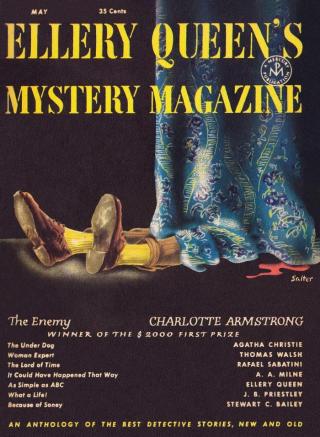
Ellery Queen’s Mystery Magazine. Vol. 17, No. 90, May 1951
- Автор: Кристи Агата, Куин (Квин) Эллери
- Год: 1951
- Язык: английский
- Год: Mercury Publications
- Жанр: Другие детективы

Электронная книга - «Ellery Queen’s Mystery Magazine. Vol. 17, No. 90, May 1951». Краткое содержание книги:
Soney lunged at me and buried her teeth in my neck and gouged at me with her long red fingernails. She knocked over the hub cap with its little fire, and the bills fell from my hand and showered around us like the snow outside.
Because Soney saw her dreams going up in smoke. The dreams she’d had since she was a little kid in Gary. All her have-nothing life of slinging hash and hitchhiking and drinking beer in places like The Triple T.
So I had to slug her. And then I put her on the back seat out of my way.
Soney died there from the cold as I fed her dreams into the fire in the hub cap. Crouched over it, trying to keep alive long enough to write this.
So you’d know it was because of Soney, and not me.
The under Dog (First of two parts)
by Agatha Christie[5]
Lily Margrave smoothed her gloves out on her knee with a nervous gesture, and darted a glance at the occupant of the big chair opposite her.
She had heard of M. Hercule Poirot, the well-known investigator, but this was the first time she had seen him in the flesh.
The comic, almost ridiculous, aspect that he presented disturbed her conception of him. Could this funny little man, with the egg-shaped head and the enormous mustaches, really do the wonderful things that were claimed for him? His occupation at the moment struck her as particularly childish. He was piling small blocks of colored wood one upon the other, and seemed far more interested in the result than in the story she was telling.
At her sudden silence, however, he looked sharply across at her.
“Mademoiselle, continue, I pray of you. It is not that I do not attend; I attend very carefully, I assure you.” He began once more to pile the little blocks of wood one upon the other, while the girl’s voice took up the tale again. It was a gruesome tale, a tale of violence and tragedy, but the voice was so calm and unemotional, the recital was so concise that something of the savor of humanity seemed to have been left out of it.
She stopped at last.
“I hope,” she said anxiously, “that I have made everything clear.”
Poirot nodded his head several times in emphatic assent. Then he swept his hand across the wooden blocks, scattering them over the table, and, leaning back in his chair, his fingertips pressed together and his eyes on the ceiling, he began to recapitulate.
“Sir Reuben Astwell was murdered ten days ago. On Wednesday, the day before yesterday, his nephew, Charles Leverson, was arrested by the police. The facts against him as far as you know are — you will correct me if I am wrong, Mademoiselle.
“Sir Reuben was sitting up late writing in his own special sanctum, the lower room. Mr. Leverson came in late, letting himself in with a latch key. He was overheard quarreling with his uncle by the butler, whose room was directly below the Tower room. The quarrel ended with a sudden thud as of a chair being thrown over and a half-smothered cry.
“The butler was alarmed, and thought of getting up to see what was the matter, but as a few seconds later he heard Mr. Leverson leave the room gaily whistling a tune, he thought nothing more of it. On the following morning, however, a housemaid discovered Sir Reuben dead by his desk. He had been struck down by some heavy instrument. The butler, I gather, did not at once tell the story to the police. That was natural, I think, eh, Mademoiselle?”
The sudden question made Lily Margrave start.
“I beg your pardon?” she said.
“One looks for humanity in these matters, does one not?” said the little man. “As you recited the story to me — so admirably, so concisely — you made of the actors in the drama machines — puppets. But me, I look always for human nature. I say to myself, this butler, this — what did you say his name was?”
“His name is Parsons.”
“This Parsons, then, he will have the characteristics of his class, he will object very strongly to the police, he will tell them as little as possible. Above all, he will say nothing that might seem to incriminate a member of the household. A house-breaker, a burglar, he will cling to that idea with all the strength of extreme obstinacy. Yes, the loyalties of the servant class are an interesting study.”
He leaned back beaming.
“In the meantime,” he went on, “everyone in the household has told his or her tale, Mr. Leverson among the rest, and his tale was that he had come in late and gone up to bed without seeing his uncle.”
“That is what he said.”
“And no one saw reason to doubt that tale,” mused Poirot, “except, of course, Parsons. Then there comes down an inspector from Scotland Yard, Inspector Miller you said, did you not? I know him, I have come across him once or twice in the past. He is what they call the sharp man, the ferret, the weasel.
“Yes, I know him! And the sharp Inspector Miller, he sees what the local inspector has not seen, that Parsons is ill at ease and uncomfortable, and knows something that he has not told. Eh bien, he makes short work of Parsons. By now it has been clearly proved that no one broke into the house that night, that the murderer must be looked for inside the house and not outside. And Parsons is unhappy and frightened, and feels very relieved to have his secret knowledge drawn out of him.
“He has done his best to avoid scandal, but there are limits; and so Inspector Miller listens to Parsons’ story, and asks a question or two, and then makes some private investigations of his own. The case he builds up is very strong — very strong.
“Blood-stained fingers rested on the corner of the chest in the Tower room, and the fingerprints were those of Charles Leverson. The housemaid told him she emptied a basin of bloodstained water in Mr, Leverson’s room the morning after the crime. He explained to her that he had cut his finger, and he had a little cut there, oh yes, but such a very little cut! The cuff of his evening shirt had been washed, but they found blood stains in the sleeve of his coat. He was hard pressed for money, and he inherited money at Sir Reuben’s death. Oh, yes, a very strong case, Mademoiselle.” He paused.
“And yet you come to me today.”
Lily Margrave shrugged her slender shoulders.
“As I told you, M. Poirot, Lady Astwell sent me.”
“You would not have come of your own accord, eh?”
The little man glanced at her shrewdly. The girl did not answer. “You do not reply to my question.”
Lily Margrave began smoothing her gloves again.
“It is rather difficult for me, M. Poirot. I have my loyalty to Lady Astwell to consider. Strictly speaking, I am only her paid companion, but she has treated me more as though I were a daughter or a niece. She has been extraordinarily kind, and whatever her faults, I should not like to appear to criticise her actions, or — well, to prejudice you against taking up the case.”
“Impossible to prejudice Hercule Poirot, cela ne ce fait pas,” declared the little man cheerily. “I perceive that you think Lady Astwell has in her bonnet the buzzing bee. Come now, is it not so?”
“If I must say—”
“Speak, Mademoiselle.”
“I think the whole thing is simply silly.”
“It strikes you like that, eh?”
“I don’t want to say anything against Lady Astwell—”
“I comprehend,” murmured Poirot gently. “I comprehend perfectly.” His eyes invited her to go on.
“She really is an awfully good sort, and frightfully kind, but she isn’t — how can I put it? She isn’t an educated woman. You know she was an actress when Sir Reuben married her, and she has all sorts of prejudices and superstitions. If she says a thing, it must be so, and she simply won’t listen to reason. The Inspector was not very tactful with her, and it put her back up. She says it is nonsense to suspect Mr. Leverson and just the sort of stupid, pig-headed mistake the police would make, and that, of course, dear Charles did not do it.”
5
Copyright, 1926, by Mystery Magazine Company