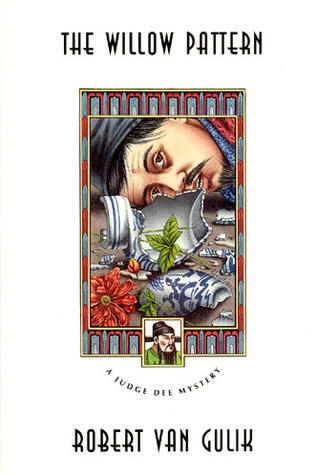
The Willow Pattern
- Автор: ван Гулик Роберт Ханс
- Серия: Judge Dee #11
- Год: 101
- Язык: английский
- Жанр: Другие детективы

Электронная книга - «The Willow Pattern». Краткое содержание книги:
As Judge Dee copes with the administration of the plague-ridden Imperial Capital, he must also bring his skills to bear on the mystery of two seemingly unconnected murders that could mean the extinction of the city's oldest, most aristocratic families.
Hoo came to his feet. Grasping the edge of the bench with his large hairy hands, he rasped:
'Where is she?'
'She is dead,' the judge said soberly. 'After she had made her confession she died right here. Of the plague.'
He pointed at the reed mat.
Hoo turned round and stared at the reed mat with wide eyes, his bushy eyebrows knit in a deep frown. His lips moved but no sound came forth. Again a faint rumble of thunder sounded afar off.
Suddenly Hoo uttered a half-suppressed, nearly animal moan. He stepped up to the reed mat. The captain rushed up to him to hold him back, but Judge Dee shook his head.
A MAN MEETS HIS DEAD MISTRESS
Hoo lifted the edge of the mat, uncovering her arm, and took her slender white hand in his. Having stroked it gently, he then removed with infinite care the ring set with the sapphire, kissed it, and put it on his own little finger. After he had covered the hand again he rose, and resumed his former place in front of the bench. Looking up at the judge, he said in a toneless voice:
'I beg to be allowed to wear this ring on the scaffold. I gave it to her when I had redeemed her.' When Judge Dee nodded his assent, Hoo bent his head and went on slowly, his eyes on the ring: 'She was still a young girl then... . A small, frightened girl. Her name was Sapphire, the same as that of the courtesan my great-grandfather had bought. "This is no coincidence," I told her, "it's the will of Heaven. Your love will make up for all the suffering the Sapphire of old caused my family." ' He shook his large head. 'Why did she change, after our first happy years? Was it because she could not forget that I had bought her over the counter, so to speak? I don't know. When she left me, she did so with only a few words. "Mei is rich and you are poor," she said. "Life still owes me so much... . Brocade dresses, costly jewels, many maids to do my bidding... ." That is what she said.'
Turning the ring round on his finger, he went on: Tet, all the luxury Mei gave her did not make her happy. She had love affairs, many of them. I was sad, because I knew it meant she was unhappy, and lonely. One day, she called me. She said she had not been able to forget me, the man who had redeemed her. Did she mean it? I didn't know. I only knew that I was happy again. Then the sickness came. I told her she should leave, but she said no, for with the servants away, and old Mei gadding about in the market the whole day, we could meet more often. But last week she said: "This can't go on. I must leave this city, a city of death and decay. I want to start anew, in a far-away place." "Can I go with you?" I asked. "I don't know," she replied wearily. "I love you, but you would always remind me of the past. The past I want to forget." '
He fell silent. Judge Dee had been listening, sitting motionless in his armchair. Now he asked:
'What happened exactly on the fatal night?'
Hoo looked up, startled from his thoughts.
'What happened, you say? She had told me to come towards midnight. To the guest-room, as usual. Old Mei had gone up to sleep long before, she said. We had left the bedcurtains drawn back, the only light came from the candle on her dressing-table. Suddenly the moon door opened, and old Mei came inside. He was dressed in his houserobe, his tousled grey head bare. "Kill him!" she told me. "I can't stand the sight of him. Not any longer!" I got up, but old Mei shook his head. "You needn't kill me, Hoo," he said. "Take her away with you. You bought her, she belongs rightfully to you." She jumped up and went to revile him, but he raised his hand. "I know that you have been unhappy here," he said, "and your going away with Hoo is your last chance. Perhaps you'll find what you are looking for, at last." Shaking his head, he added with that sanctimonious air of his: "If you knew how I pity you! " Those words cut me to the quick. He forgive her? Only I had the right to forgive her! In a blind rage I grabbed the ink-slab, struck him down and kicked that miserable thin body of his about. I stopped only when she put her arms round me, and told me to desist'
He passed his hand over his moist face.
'We sat down together on the edge of the bed, without saying a word. What was there to say? At last she spoke up. "I have decided that you shall go with me," she said. "We shall drag the body to the hall, to the foot of the marble staircase. Make it appear that he fell down, earlier in the night. After a few days we shall leave. Together." We dragged the body to the hall and arranged a few clues there to prove that he had indeed had an accident. Then I left, through the garden door. That's all.'
Four black men, their heads covered by hoods, entered the court hall. They rolled the body in the reed mat, with the ease of much practice. Then they wrapped it up in a sheet of canvas. Hoo's eyes followed them as they carried their burden away.
Judge Dee gave a sign to the orderlies. Again the two men read aloud their notes in their high-pitched sing-song voices. They were nearly through when a flash of lightning lit up the high windows. There was a deafening thunderclap, followed by the clatter of rain against the oil-paper of the windowpanes.
The judge turned round in his chair.
'The rain has come,' he said to his lieutenants. 'At last!'
The captain had taken the document drawn up by the orderlies. Now he held it up for Hoo, who put his thumb-mark on it. Judge Dee rose. He straightened his robe and spoke:
'Hoo Pen, there has also been brought forward against you another capital charge. I need not go into that, however, for your confessing to the murder of Mr Mei Liang, a good man and benefactor of the people, amply suffices for your indictment. This court herewith sentences the accused Hoo Pen to death by decapitation. Martial law requires that this sentence is executed forthwith.'
He sat down again, took up his writing-brush and filled in the official form. Having impressed his seal on it, he turned round in his chair and handed it to Chiao Tai. 'You, Colonel, will immediately take the necessary measures, together with Colonel Ma. Tao Gan shall witness the execution on my behalf, and draw up the official report.' He rapped his gavel.
Two soldiers stepped up to Hoo, but he did not see them. His eyes were on the ring on his finger. Slowly he turned it round and round. The large sapphire sparkled with a blue light. One of the soldiers tapped him on his shoulder. He turned round and meekly let them lead him away, his broad shoulders sagging in the wide hunter's cloak.
Judge Dee spoke:
'This court shall convene again early tomorrow morning. Then the accused Doctor Lew shall be sentenced to a long term in prison, for having delivered false testimony, for having suppressed important evidence, and for unprofessional behaviour. The court is adjourned.'
Again he rapped his gavel. He rose and walked to the door, his arms folded in his wide sleeves. All present stood stiffly at attention.
XX
The sentries at the gate of the Military Tribunal had fixed an improvised canvas roofing over the seat of Judge Dee's sedan chair. While the soldiers were carrying him away he leaned back in the pillows, letting his right hand hang outside so that he could feel the cool raindrops.
Suddenly he realized that he was completely worn out. He tried to concentrate on the session of the tribunal, but the hall with the flickering torches seemed as unreal and evasive as a scene from a dream, only half remembered. His thoughts became confused, they turned round and round. While everything grew blurred he had the horrible sensation that he had been carried along in this sedan chair for days on end, and that it would go on and on, in a circle from which there was no escape. A hollow, sick feeling rose from the pit of his stomach. Lifting his hands, he pressed his fingertips hard against his temples. Slowly the dizziness went away. But there remained a feeling of utter fatigue, utter futility. He asked himself whether this was only the normal reaction to the three weeks of mental and physical strain. Or was it a sign that old age was catching up with him?