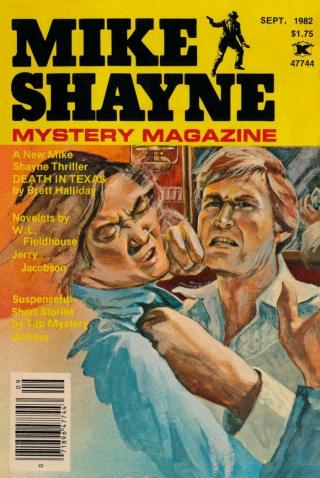
Mike Shayne Mystery Magazine, Vol. 46, No. 9, September 1982
- Автор: Холлидэй Бретт, Moore Arthur
- Год: 1982
- Язык: английский
- Год: Renown Publications
- ISBN: 0026-3621
- Жанр: Криминальные детективы

Электронная книга - «Mike Shayne Mystery Magazine, Vol. 46, No. 9, September 1982». Краткое содержание книги:
“Right,” growled Little John. “It don’t pay to knock ‘em on the noggins.”
“I haven’t finished. We’ll bill you as Robbing, the protector of the poor and downtrodden. It’ll make you famous! Robbing, the friend of the poor.”
“It’ll make us poor,” snarled Little John.
“Famous?” said Robbing. “It’ll really make me famous?”
“Absolutely,” Goodfellow said. He frowned. “That’s not much of a name — Robbing. What if we call you Robin? Robin Hood?”
“Splendid,” Robbing said, giggling. “The famous Robin Hood.” He put the dirk away.
“Wait, there’s more,” Goodfellow said, motioning them to come closer. “We’ll carry it a step farther. I’ll spread it around that you rob from the rich and give to the poor.”
“You’re trying to ruin us!” screamed Little John.
“I don’t much care for the sound of that,” Robin said, looking askance.
“What could it cost?” said Goodfellow. “Besides, the poor folks would be your allies — think of it that way. They’d be allies and spies. The Sheriff couldn’t move without you knowledge — they’d see to it.”
“Hmmmmm,” said Robin.
“Every stew-bum in England would be on our doorstep,” growled Little John. “We’d be running a bread line.”
“Ugh,” said Robin.
“You’re not looking at the broad picture,” Goodfellow pointed out. “With the ‘rob from rich, give to poor’ angle, you couldn’t help becoming famous. No crook in history every thought up such a gimmick.”
Robin brightened. “You’re absolutely positive I’d be famous?”
“I guarantee it. It’s surefire.”
“But,” whined Little John, “couldn’t we keep some of the loot — maybe most of it?”
“Who keeps books?” Goodfellow nudged Little John and chuckled. “Feed the poor slobs — find ‘em jobs... you know.”
Robin clapped his hands. “And I’ll be famous. We’ll do it. It’s a deal we accept.” He shook hands with Goodfellow. “Little John, pass the word. Everyone must know.”
“Excellent,” Goodfellow said, unrolling a document and producing a quill. “Sign here.”
John Goodfellow tied his mount to the battered hitchrack and went inside the largest shanty on the dusty street. In another moment he sat across a desk from the mayor.
“I just closed a deal with the former Robbing — now called Robin Hood,” he said. He displayed the contract for the mayor’s fascinated eyes.
The mayor was a rough-hewn, fat man. “He won’t steal our pigs and sheep anymore?”
“Pish, never,” Goodfellow said, pointing out the correct clause on the foolscap. “He’s agreed not to steal anything in town or from the poor. As of yesterday Robin Hood steals only from the rich and gives to the poor!”
The mayor’s eyes grew round. He read the words again, moving his lips. “The poor. That’s us.”
“Robin Hood is a saint — the paper says so.” Goodfellow put on his spectacles. “Only politicians would steal — oh, pardon me, Your Honor. Only bums would steal from the poor.” He ran his finger down a list of towns. “This is the village of Glenville. Now, for protection from bandits, your fee is fifty pieces of silver per annum. Have you got the money?”
The mayor nodded and opened the desk drawer.
Sherlock Holmes & the Obligatory Love Scene
by Lee Duigon
Conan Doyle was insistent. Holmes was adamant. Dr. Watson was befuddled. H.G. Wells was to blame, as well as modern publishers for whom nothing is too sacred, not even the reputation of the world’s greatest detective!
From the diaries OF Dr. John H. Watson, M.D.:
“Excuse me, Holmes, but it’s almost time for your obligatory love scene.”
In all my years with Sherlock Holmes, I never saw such a look of withering contempt as that which he turned upon our distinguished author, Mr. Conan Doyle.
“You know, Doyle,” he said, his voice dripping with venom, “I think you enjoy this.”
“Holmes, Holmes, how many times must I explain to you it’s not my fault? If you must place blame, place it where it belongs — on the shoulders of the blockhead H.G. Wells and his confounded time machine!”
“He’s right, my dear fellow,” I agreed. “It was all very well for Wells to shoot us a century into the future, but he should have had the decency to tell us how to return.”
Holmes snorted and went back to examining a charred pipe dottle that had been left at the scene of the murder.
“I’m too busy,” he said.
“I’m sorry,” Doyle replied, “but this comes first.”
Holmes slapped the table with his palm, overturning a bottle of Perrier water.
“If I had spent my time in the Hound of the Baskervilles case,” he sneered, “dallying with wenches like a cockney carter, it is very likely Dr. Watson would not be alive today. And you, Doyle would be reduced to ghost writing!”
Doyle gently shook his head.
“Have a little respect for your creator, Holmes,” he remonstrated. “Have I ever let you down?”
“You let Professor Moriarity escape from my clutches more than once,” Holmes reminded him, “and at this rate, he’s more than likely to escape again. You don’t see him bedding some tart when the game’s afoot!”
“You haven’t read Chapter Four,” Doyle said. “The professor, too, has his obligatory scene.”
“Then I am ashamed for him,” Holmes declared.
“I say, Doyle, does that mean I—”
“All in good time, Watson, all in good time!” he cut me off. “Despite the low standards of the current market, I try to preserve a modicum of good taste.”
“With whom do you want Holmes to perform the scene?” I asked. “Do you remember that topless go-go dancer in Chapter Two?”
“Oh, Lord!” Holmes groaned. “Doyle, have you lost your mind? He’s mad, Watson — stark, staring mad!”
I had to admit I was surprised by Doyle’s selection of a partner for my friend. I thought he should at least rate a university professor or a public official.
“She’s a nice girl, Holmes,” our author said.
“She’s a bloody drab!” snarled Holmes. “Who did Moriarity get?”
“Miss Daiworthy, the luggage heiress.”
“Daiworthy?” I cried. “Oh, damn!”
“I don’t care if you offer me a Princess of the Blood!” Holmes growled. “See here, Doyle; a hundred years ago, you wouldn’t allow me so much as a kiss from Irene Adler, a truly fascinating woman. You led me on and on, and nothing ever came of it. Now you want to pair me with a go-go dancer!
“By heaven, it is intolerable! I resign, Doyle. Find yourself another detective. Consult the TV Guide for inspiration.”
“A hundred years ago was a hundred years ago,” Doyle replied, as Holmes jammed his deerstalker cap onto his head. “Do you think I like larding my novels with these puerile scenes? Do you think I enjoy breaking up the narrative flow with sordid little bedroom incidents?”
“Times change, Holmes. This is 1982. No publisher will touch a book unless it includes raw sex. At least allow me to provide it with a certain literary grace.”
“They’re still buying the books you wrote a hundred years ago,” Holmes pointed out.
“Only because they can’t be changed. You can’t write books like that anymore and hope to earn a living.
“Good heavens, Holmes,” he added, “be thankful I didn’t make you gay! That’s what one publisher wanted.”
“Gay?” Holmes cried. He had not yet picked up the slang of the times.
“He means a poof, old fellow,” I whispered.