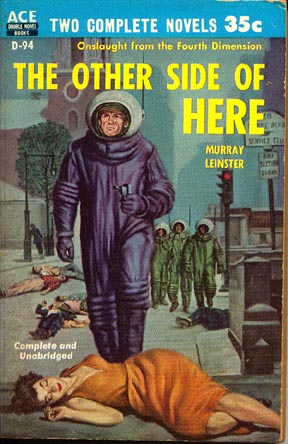
The Other Side of Here
- Автор: Лейнстер Мюррей
- Язык: английский
- Жанр: Научная фантастика

Электронная книга - «The Other Side of Here». Краткое содержание книги:
Newark ... Manhattan ... Baltimore—one by one they went out. A succession of thriving communities suddenly put out like a guttered flame—men, women, children sprawled like grotesque mannikins.
Steve Waldron knew it couldn't be plague. There had to be some connection with the disappearance of the nation's top scientists. And then he plunged to the very center of a dead city and gaped at a truth he could not believe. What could he do against so fearsome a force that threatened to engulf the whole nation?
Here's a spine-tingling science-fiction novel by an old master. It will open up a new dimension of suspense and excitement.
Then, simultaneously, smoke came in thick masses from the hitherto smokeless stacks of the powerhouse. At first thin and white, it thickened and became dense—proof that those who fired it were less than experienced with these particular furnaces. Then smoke arose from the funnels of no less than four of the frozen, immobile ships tied up at the navy yard. Electricians were working in the inwards of those ships while other men got up steam.
Abruptly, one of the moored vessels emitted an exultant bellow from its whistle. Figures stirred upon its decks. Some of them stared incredulously at the stillness of which they had been a part until a few seconds before. A second vessel boomed triumphantly. Signal flags fluttered from its mast. And then figures from the powerhouse began to wigwag to the destroyer.
With startling suddenness, there were noises all about. Bells clanged, whistles shrilled, and voices babbled everywhere. The cities were alive again. Because, with trained men to work, and the problem outlined beforehand, the great arc in the generator room had been reconstituted in a technically stable manner.
That was not all that had to be done, of course. There was more. Much more! Commandeered trucks began to move away from the powerhouse. They were driven by men who very often wore the scaly armor of the invaders—except that it could be noted that most of those suits of armor had bullet-holes in them somewhere or another. Upon the scaly helmets rested the caps of sailors or marines, who were heavily and very efficiently armed.
They whooped derisively at each other as they rode, and also at certain bewildered civilians who could not understand that they had just been revived for the second time by a great arc in the powerhouse.
Those trucks drove here and there. They went to other powerhouses, some in Manhattan and the Bronx and some over in New Jersey. They would build up arcs in each station after zestfully demolishing any invaders who might protest. They would then instruct local electricians and go on to repeat the process farther away.
In hours, cities as far away as Philadelphia would be again normal so far as their citizens were concerned. There would be more trucks moving out of each city, too. And the men in those other trucks would be very, very desirous of being resisted by the men who had come from another world to loot and shatter tills. Washington would be alive again before nightfall. Before tomorrow's dawn, even Niagara Falls would again be awake and its enormous water power diverted to the turning out of high-frequency currents making any repetition of this invasion impossible.
But that last was a precaution. Long before that time the menace of this particular invasion was over. Waldron took measures to bring that about almost at once. He had authority, because he knew more than anybody else. And there were adequate armed parties available for use from the navy yard. Waldron had asked for them.
If any counter-measure, from the world which was the other side of here—if any counter-measures had been planned, the fighting men who came to the powerhouse were ready to handle them. Although they came as landing parties—marines and bluejackets—they had with them those nasty bits of destructive equipment that had been proved in landings on remote islands ... if not on other worlds.
Waldron had the men put in readiness for a counter-invasion. The way led through the helix, whose flickering bluish flame still persisted. From one certain position, which was that which a truck riding up on the ramp would occupy, all the bluish flames seemed to coalesce. Then they formed a single solid picture. And the images on the flames, which elsewhere were fragmentary, combined together so that one looked directly into the world which was the other side of here.
Waldron saw a scene very nearly normal. To be sure, there was no city in the other world corresponding to Brooklyn. He saw green fields and sunshine and clouds, and a long distance away there were the forbidding towers of a stronghold. Nearer, there was a small town—a sprawling small town of little houses. It was not at all modem. Its streets were narrow and its houses mean. And there was fighting going on in it. Men battled with swords and spears, and other men fought savagely with weapons which were noiseless and unfamiliar. It was a quaintly alien city, and yet there were motor trucks of standard make. Men were using them as fighting machines to charge other men.
But the fighting was lessening. It seemed rather the cleaning-up process that followed after street fighting, when defeated men made last stands till they were hunted down.
Waldron watched for a long time before it seemed that he had sufficient force at hand to make a counter-invasion a really practical performance. As fresh detachments of armed men arrived, equipped with high-frequency packs and much more lethal equipment, he repeated his explanations of all he knew about the invaders and their alien world.
Then a motor truck came bumbling toward that portion of the flame through which Waldron looked. It came at a brisk pace to the very entrance, in that other world, to the helix— which was in this. There it stopped. Six men in scaly armor got out. Fran Dutt was one of them.
Fran strode up the other-world ramp to this helix. He spread out his hands to show that he was unarmed. He walked into the helix and appeared here. The other five followed him. Fran looked completely unsurprised at the mass of men making ready for invasion. He nodded grimly at Waldron.
"Steve," he said, unsmiling, "we've had our revolution. Perhaps it's thanks to you for scaring us into it. We've got this town and a few others, already. We'll get the rest. I'm speaking for the Revolutionary Committee."
"We've had a few doings in this world too," said Waldron dryly.
"I know," said Fran. "It scared our Leaders and made our job easier. I'm here to make terms. You're ready to invade us, in your turn. But there's no use fighting. What's happened was our Leaders' fault. We've started the job of chucking them out—it's mostly wiping them out—and we'll finish it. But I want to avoid fighting with you people if I can."
"You've been in this world long enough to know how much authority I don't have," said Waldron, again dryly.
"But people will listen to you," Fran told him, "because you licked our Leaders. Now—we'll return everything that's been looted. We'll pay for everything that's been done. We'll return all prisoners, of course. And we invite settlers from your world. Partly, that'll be to prove we don't intend to lot anything like this happen again. Partly it'll be to stiffen our backbones in case anybody tries to start up that Leader business again. Incidentally, if you people will hang our Leaders for us, we'll be much obliged. We're much too strongly tempted to execute them by their own approved methods."
Waldron was about to speak, when Fran held up his hand.
"Wait! We've less than a million civilized people—if you call us civilized. We need colonists. We'll welcome them, and we'll give them land, and we'll learn from them never to cringe to any other living man—"
Fran's eyes flamed, then. The five behind him nodded. One meditatively tightened a bandage about his arm. Blood was oozing from it. The five nodded again.
"Fran," said Waldron soberly, "it looks to me as if we couldn't ask any other terms. But—for guarantees—"
"March your men through!" said Fran Dutt fiercely. "We ask nothing better! They'll encourage waverers to join us. Only, tell them to grin, Steve, if they see anybody look scared, and everything will be all right."
There was a conference. So complete and bloodless a victory seemed suspicious to the naval officers. One of them begun to stipulate the number of men and arms who should be allowed to pass through the helix.
"Damn it!" cried Fran. "I'm asking you to go through! My people went mad and fought, today. But tomorrow they might be scared and cringe before what Leaders survive, through pure habit. I'm begging you to come through so my people will have the courage to stay free! We've been slaves too long!"