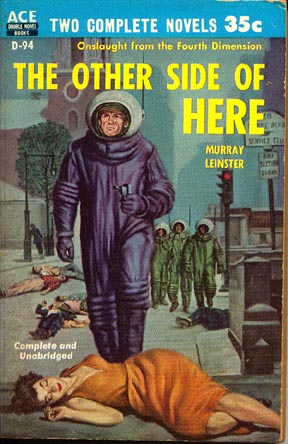
The Other Side of Here
- Автор: Лейнстер Мюррей
- Язык: английский
- Жанр: Научная фантастика

Электронная книга - «The Other Side of Here». Краткое содержание книги:
Newark ... Manhattan ... Baltimore—one by one they went out. A succession of thriving communities suddenly put out like a guttered flame—men, women, children sprawled like grotesque mannikins.
Steve Waldron knew it couldn't be plague. There had to be some connection with the disappearance of the nation's top scientists. And then he plunged to the very center of a dead city and gaped at a truth he could not believe. What could he do against so fearsome a force that threatened to engulf the whole nation?
Here's a spine-tingling science-fiction novel by an old master. It will open up a new dimension of suspense and excitement.
The plane went into a wild sidewise swoop. It hit the water. Something exploded smokily. A large splash arose.
"Carrying dynamite loose in the cockpit," observed Waldron. "A case of it went off, then."
A four-passenger, company-executive type of plane soared upward. Small objects came sprinkling down. From two hundred feet or more, it dropped many sticks of dynamite. Some of them exploded when they hit the water. Some vanished harmlessly.
"If one of them hits our deck, though," said Waldron, "we'll be done for. Let's keep 'em high."
The motor cruiser sped on. The flight of planes swept past, peppering the sea about the water-borne craft with explosions. None of the detonations was comparable to an actual aircraft bomb, but any of them could destroy the motorboat. The invaders simply had not dared secure bombardment or combat training for pilots. So, faced with furious orders from their surviving Leaders, those who had gone to loot Philadelphia had taken what civilian planes their fliers knew how to handle, loaded easily discoverable dynamite in them, and sent them off to kill the only three people in some tens of millions who had attempted to put up resistance.
But their lack of practice in aerial-bombing tactics was evident. The planes which had first dropped dynamite about the fleeing small cruiser did not go smoothly on, to swing in a circle and bomb again after their fellows had done the same. They swung sharply and came diving back without discipline.
Even that was dangerous enough. While Nick fired and fired, to keep the planes high—he got one Cub, which came spinning down and crashed into the sea—Waldron took the wheel again and made a crazy evasive pattern of the small boat's wake. But the inaccuracy of the bombardment almost countered the erratic course. Once a tall column of spray fell across the motor-boat's stern. But save for some hundreds of gallons of water admitted, there was no damage.
Then Lucy called out to Nick, and she kept a gun going while he made a grapnel fast to a line. They were almost at the destroyer.
Waldron came up almost at its stern, on the seaward side. Nick threw the grapnel and swarmed up the rope. In seconds he was hauling at Lucy, to get her up. Waldron himself was just swinging over the destroyer's railing when the planes made a concerted, desperate bombing run and fairly rained dynamite sticks down upon the now-stationary small craft.
Dynamite exploded beside a ventilator and shattered it. A fair hit on the small boat blew off its bow. More dynamite ripped deck planking on the destroyer.
But a destroyer was not as easy to sink as a motorboat One stick of dynamite would tear up planks and dent mild steel. But a destroyer required more than a case of industrial dynamite to produce real damage.
The three fugitives dived behind steel doors. Then they hunted busily. They found the lieutenant-commander in charge of the destroyer. Waldron unloaded a high-frequency pack from the festoons of ammunition and oddments with which he was burdened. He put the pack on the naval officer and turned it on. A little tongue of metal began to vibrate. A tiny blue spark flickered and danced. High-frequency currents, which could not even be felt, coursed through the officer's body.
He had been in the act of drinking a cup of coffee when the "plague" struck his ship. Now he swallowed automatically, stared at the three barbarically armored figures who stood before him. Hearing the crashing sound of dynamite explosions about and upon his ship, he leaped to his feet "Commander," said Waldron sharply, "your ship's being attacked by the gang that's responsible for the so-called plague you've probably heard of. Your crew is under its influence now and you have been. But if you'll help us, Nick and I will get an arc going and—"
From a distance, the destroyer would have seemed to be in a bad way, during the next quarter of an hour. It floated aimlessly upon the sea. Planes darted about and above it, raining down small black sticks which sometimes exploded when they hit the water and sometimes did not, but always blew up when they hit the ship. Flames and smoke arose from each impact.
But suddenly the war vessel awoke. Its commander's voice roared out of the speakers which filled every deck and compartment with sound. Order after order left his lips. And in the Navy men obey orders first and ask questions afterward.
At one instant the destroyer was a helpless, floating hulk with the reek of detonated dynamite about it. The next instant its guns stirred. Men flung themselves across its decks to anti-aircraft stations. And suddenly the ship was spitting flames exclusively its own.
And now the amateurishness of the pilots and their low-speed planes was fatal. Strictly professional anti-aircraft fire blasted the slow-flying planes. When three went down in six seconds, the others tried to flee. One vanished in a sheet of flame when its dynamite cargo was hit.
None of the planes reached shore. It appeared, however, that one of them had reported despairingly by its radio before it hit the ocean. But that discovery was made later.
As of now, the destroyer got up steam. It moved steadily for New York—not at full speed in the beginning. Its electricians worked busily. They had plenty of help.
And presently the destroyer did put on full speed. It was some hours later, mid-morning, when she approached the harbor from the sea. Smoke pouring from her funnels, white water hissing at her bows, she came steaming in the Narrows with a vengeful confidence. The invaders had gotten one great bombing plane aloft. It circled and dived upon the cocky naval ship—and such a storm of anti-aircraft fire poured upon it that it reeled dizzily and crashed into the water not far from Bedloe's Island.
Then there were monstrous detonations on shore. The forts at the Narrows were firing point-blank. But the guns were not designed for such short-range work, and their desperate, improvised gun crews did not know their jobs. The guns did not average two shots apiece. Not one was a hit.
The destroyer disdainfully refused to return such fire. She swept on.
She came up the East River, floating to a stop opposite the great powerhouse. Then small boats dropped from her sides. Each was loaded with men and each man carried contrivances designed by the ship's electricians, but often made by their wearers. They were very simple—merely battery-driven spark-makers. Leads picked up the high-frequency surges made by the sparks and conducted them to the flesh of the men. That was all there was to it.
The boats neared shore and something stirred on land. Machine-gun fire from the boats swept the landing. As the sailors came close, some hand grenades were lobbed ashore. The rifle fire from shore ceased and scale-armored figures fled.
The boats docked. Compact groups of zestful fighters swung into action, and these men were not driven into battle by "Leaders" with whips.
To the cracking of rifles, they went into the powerhouse. Tumultuous gunfire and the explosion of grenades kept up for perhaps five minutes. Then that noise stopped. Other boats put ashore from the destroyer. These were not to reinforce the landing party. They raced for the navy yard. Their crews also landed. Wearing their portable high-frequency packs and carrying extras, they vanished into other naval ships.
Then a strange quiet descended. The two cities—the city on both banks of the river—were utterly still and utterly silent. The ships of the harbor were grounded or sunk or still drifted helplessly with the tides. The streets were empty of all save stiffened, grotesquely posed bodies. Not even rats scurried in the sewers. Not even insects flew.
The only visible signs of life were close together. One was a destroyer of the United States Navy, with smoke pouring from her funnels and her screw turning just fast enough to keep her opposite the powerhouse. The powerhouse itself trickled smoke from only one of its tall stacks. From within it, at long intervals, came perhaps one shot, or two, or perhaps a flurry of three or four.