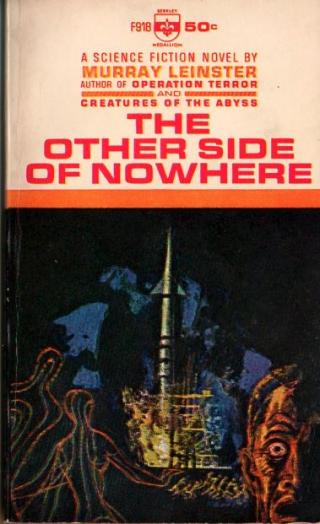
The Other Side of Nowhere
- Автор: Лейнстер Мюррей
- Год: 1964
- Язык: английский
- Год: Berkley Medallion
- Жанр: Научная фантастика

Электронная книга - «The Other Side of Nowhere». Краткое содержание книги:
For centuries space travelers had dreaded a place they called the Other Side of Nowhere — a place in the universe where up was down, where right was wrong, and where all direction was lost...
To save the RIM STAR Braden had to bring the ship to the place of nightmare, the Other Side of Nowhere...
"We... haven't a long schedule of shooting to do on Handel's Planet," said Diane, unhappily. "We may be gone when you get back."
There was silence. Diane seemed to be looking absorbedly at the now much-enlarged image of the planet on the screen. There were seas and landmasses and polar icecaps. There were clouds, and a storm system over an ocean. Over all there was the glamour that all oxygen- atmosphere planets seem to possess.
"I wish..."
"It would be... pleasant if you thought of a way to land," said Diane, almost dolefully. "You always have thought of necessary things..."
"But landing on space-drive..."
"Here's an island!" Diane said.
She pointed, on the screen. And Braden literally started. He stared at her. He took a deep breath.
"Wait here!" he said.
He left the control-room. At this distance from the local sun there should be no danger from trash in space.
He went to the skipper's quarters, where he found the skipper trying to learn to walk with a blast-rifle as a crutch.
"Yes, Mr. Braden?" the skipper asked frostily.
"The ship," said Braden with painstaking precision, "was to land on rockets because landing on space-drive would create a cyclone that would devastate 10,000 square miles, whipping trees to matchwood, and destroying everything men had built, including spaceports and roads to them."
"Quite true," said the skipper as coldly as before. "But what of it?"
"There are islands," said Braden, "that nothing has been built on yet. They're located in oceans that don't grow trees. They're far enough from the continents so a storm thrashing over even 10,000 square miles won't bother anybody. And there'll be some surface ships already built for surface exploration and the like. We can let down the Rim Star by space-drive to an island off a coast, and the storm will not matter. Haul her cargo away and she can take off in the same fashion. It would save several months in getting our cargo aground."
The skipper considered, then frowned.
"A very sound idea, Mr. Braden!" He spoke very deliberately. "Very sound! It has advantages over rocket descent. For one thing, it should be much safer for the ship. So you may put us into orbit around Handel's Planet and we'll work out the idea in detail. We shall have to get in touch with the people ashore, of course. They may need time to make arrangements. But it seems an excellent idea! I have even a personal reason for preferring this landing system, Mr. Braden." His tone became enigmatic. "A long journey with the men who murdered my wife and daughter in my care, Mr. Braden... Did you hear the steward boast?"
Braden went back to Diane. He set about the strictly man-style astrogation which is necesary inside of solar systems. He assigned Fortescue to take care of feeding the prisoners. He advised him to have a blaster ready and to take every possible precaution.
Then he threw himself into the work the new proposal - he thought of it as Diane's - involved. The skipper made no pretense of helping. He stayed in his cabin. Fortescue and Hardy had made makeshift splints for his ankle, but apparently he found it uncomfortable to walk, even with the blast-rifle crutch.
Duckworth was frantically busy. He was changing the script of the epic, The Other Side of Nowhere, to make it an adventure-documentary of the actual attempt to pirate the huge ship Rim Star. Some of the scenes would admittedly be staged, but Derr Carmody had been involved; and if she repeated before the cameras what she had actually experienced, the film could legitimately be called a documentary and would receive incredible publicity and be assured of triumph even before its release. Duckworth and Fortescue and Derr Carmody worked feverishly in preparation. And since all the replayed scenes centered upon Derr Carmody - and all but one scene would be replayed - a second turn of fame and stardom for her was assured.
All this was arranged during the days when the Rim Star slogged sturdily toward Handel's Planet in space-drive - not overdrive, which was not practical for such short distances. There were other arrangements to be made, too. All the details of her landing had to be discussed at irritating length with the construction supervisors in the new colony. This method of landing was a novel idea, and accordingly there was resistance to it. But the Rim Star carried stores that would mean the difference between merely adequate nourishment and really good food for the people aground. She carried cranes and bulldozers and earthmovers and roofing, and reading matter and antibiotics and beverages and ground cars. She had on board all the necessities for civilized life, or at least the means of making them. But if she were to go away to reload her rockets, it would be six months or more before she could return. Whereas if she landed now, the grid would be up and working in three months or less, and Handel's Planet would be part of civilization.
Duckworth was entranced. He set up the cameras to show the ship's descent through her own vision screens. He arranged for shots to be taken of interior scenes which to Braden made no sense whatever, since they were not in chronological order and were to fit between other scenes not yet staged. Braden did observe, though, that Derr Carmody behaved in a highly emotional fashion while the cameras were running. He marveled at it, but it was not his business.
He thought a great deal about Diane, who was busy with the camera work a deplorably large part of the time. He thought much less about the skipper. The skipper stayed in his quarters. Although a blast-rifle could be a substitute crutch, the skipper didn't seem to become proficient in using it. Braden only really saw him once. His expression was strange, then, for a deep and somehow terrible satisfaction lay below an outward impassiveness. But he spoke to Braden in his usual rumbling manner, but Braden was busy.
Plans for the descent involved choosing an island, in agreement with the authorities below. There had to be elaborate discussions of the time and direction of landing, and the fitting of such factors into the weather pattern of the planet. Even then there was delay while the buildings thus far constructed in the colony were battened down. It was a full six days after breakout before Braden turned on the drive and began to match the ship's velocity with that of the planet which seemed to revolve below the ship.
The Rim Star went down slowly. The vast curved surface of a world's hemisphere seemed to rise toward the ship. To the west, where haze and dust particles acted as a filter, the horizon was visibly pinkish. To the east, where the light was reflected from the same kind of ions and dust, the edge of the planet was faintly blue. There was a vast mottled stretch of land surface, with river systems and forests and mountain ranges changing the appearance of the island ever more markedly as the ship descended. There was the peculiar muddy color of the ocean bottom - here deeper, there more shallow - which also became visible in greater detail as it came nearer.
The winds began a hundred miles up. The big ship's drive-field was designed to have an effect on interstellar space itself, where matter existed only in the ratio of one atom per cubic centimeter. As she descended, the thousands and millions and trillions and quadrillions of atmospheric ions per cubic centimeter went mad in the stresses imposed by the field.
Braden, seated at the control-board, saw the storm develop. The water beneath the Rim Star turned white as the winds whipped the sea to waves and seized upon the waves and turned them to spray. Giant billows formed and instantly dissolved into monstrous clouds of mist driven by 500-mile winds. The island on which the ship was to land became invisible under a dome of whiteness as its surface deflected the winds.