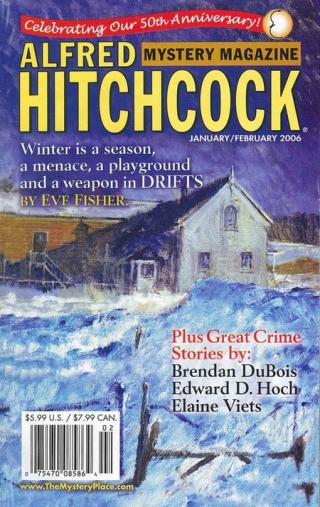
Alfred Hitchcock’s Mystery Magazine. Vol. 51, No. 1 & 2, January/February 2006
- Автор: Бетанкур Джон Грегори, Jr. William J. Carroll,
- Год: 2006
- Язык: английский
- Год: Dell Magazines/Crosstown Publications
- Жанр: Другие детективы

Электронная книга - «Alfred Hitchcock’s Mystery Magazine. Vol. 51, No. 1 & 2, January/February 2006». Краткое содержание книги:
Beau had already interviewed the first officer on the scene, who had knocked on the door, rung the doorbell, and gone inside with the neighbor lady. It took him eleven minutes to find the eighty-year-old victim’s body in the hall closet.
“You said you’re from Homicide. I take it she didn’t die a natural death.”
Beau nodded, still looking in the man’s eyes. Philiber didn’t look away, didn’t even blink.
“Hey!” came a voice from the porch. Crime Lab Technician Ned Howland stood at the top step, evidence case in one hand, keys in the other. “Want me to lock the door?”
Beau raised a hand over his eyes to shield them from the bright sunlight. Although it was early winter and cool in New Orleans, it wasn’t cold yet, especially beneath the strong sun.
“Hold on a second,” Beau called back and crossed the brick walkway to the steps, counting them on the way up. Twenty-one concrete steps led up to the porch, which was actually a gallery with an overhang above supported by wooden columns and decorated with gingerbread trim. White, the entire house was painted white, even the window frames and door trim.
Howland handed the key chain with its two silver keys to Beau.
“Dusted them?”
“Of course.” Howland picked up his camera case with his free hand. “Not a thing.”
They’d found the keys inside the door, sitting in the lock. Beau carefully locked the half glass front door, checking the lock, which worked fine, then followed Howland down the steps.
“Can you leave me some evidence tape?” Beau asked as they moved through the gate. Howland stopped, reached into his evidence case, and tossed a partial roll of yellow-and-black plastic evidence tape, which wasn’t adhesive tape, but an unbroken roll of plastic.
Beau closed the gate, tied the end of the evidence tape to the fence post next to the gate and extended the tape across the gate to the next fence post, leaving the roll next to the fence as he stepped back to Philiber, still standing on the sidewalk.
A streetcar rattled along the neutral ground in the center of St. Charles Avenue, curious faces looking toward Beau and the bright evidence tape. A little girl with a ponytail waved and Beau waved back and smiled. The girl ducked back in shyly.
“I see you have a way with the fairer sex.” Philiber was trying to be friendly.
“Only the ones who don’t know better. Did you see anyone else around this morning?”
“Guy in a red car parked right where your van’s leaving.” Philiber pointed to Howland’s Crime Lab van as it pulled away from the curb. “Opened his hood and worked under it before going up the steps and ringing the bell.”
“He go in?”
“Nope. No answer, so he left. Came straight back to his car, tinkered under the hood for a minute, and got the car started and drove off.”
Beau got a description of the man: white male, late twenties, tall, thin, with short blond hair. Car was a late-model red Olds or Pontiac.
“You see anything else?”
“Nope.”
Beau thanked him and Philiber climbed back up the pole to finish his work, while Beau walked next door to the elderly lady who had gone into the victim’s house with the reporting officer.
Louisa Smith, seventy-one years old, with thinning gray hair and a face lined with deep wrinkles, preferred speaking to Beau through a latched screen door. Her house was only a one-story brick home, looking like a track house from the suburbs, sandwiched between the larger homes along the 7800 block of St. Charles.
Understandably frightened, she spoke in a low voice, Beau having to pull the words from her. She knew the victim, but not well, didn’t even know her last name, just knew her as Lily.
“She has a twin sister in California.”
Beau had found the sister’s name and number in Lily Chauchoin’s address book, had already spoken with the sister, who’d told him about Lily’s life.
“She didn’t come outside,” Louisa said. “She had her groceries delivered.”
“From where?”
“DiMarco’s Grocery. Around the corner.”
Beau knew the place. A neighborhood grocery store still hanging on against the supermarket chains.
“Did you see anyone around Lily’s the last couple days?”
“That big man on the telephone pole.”
“Did he go near Lily’s house?”
“No. I been watchin’ him.”
“You see anyone else?”
“Just the boy with the red car.”
Yes, she saw the blond guy go up the steps to Lily’s front door and saw him come down a minute later, then drive away. No, she knew of no suspicious characters around the neighborhood.
“I wonder who’ll move in there now,” Louisa said, moving to her left to look at the steps next door. “Some people think it’s an antebellum house. But it was built after the Civil War.”
“How do you know that?”
Lily had been talkative once, years ago, long before she became a “recluse,” as Louisa described her.
“Your accent,” Louisa said as Beau closed his notebook. “It isn’t... I thought you were... Mexican.”
“I’m half Oglala.”
“Huh?”
“Lakota.” No way that would register, so he relented, telling her the name the enemies of the Lakota, including the white man, gave to his mother’s tribe. “Sioux. I’m half American Indian.”
He thanked her and turned away.
“What’s the other half?”
“Cajun. That’s the accent you’re hearing.”
She didn’t look like she believed a word.
Beau canvassed both sides of the house with the twenty-one steps, learning nothing of value. Returning to Lily Chauchoin’s gate, Beau was approached by a newspaper reporter and a television reporter who was hurriedly trying to get her cameraman set up.
“No comment,” he said, ignoring their questions as he untied the evidence tape, went in the gate, retied the tape, and climbed the steps, counting them again, like a mantra. He’d already checked the outside of the house with the crime lab technician, finding all windows locked, the back door locked, nothing amiss. He’d checked inside but wanted to take his time in a longer, second search.
Looking down from the gallery, he noted on his notepad, “lawn care.” Someone was taking care of the lawn, which appeared freshly cut. The banana trees and azalea bushes along the sides of the house were well tended, as were the camellia bushes in the front yard.
Beau unlocked the front door and went in. He finally recognized the smell. Vanilla. He’d seen candles dotting the living room, small scented candles in glass cups. Standing in the foyer, he looked at the living room on the left, formal dining room on the right, stairs leading to the bedrooms upstairs.
The walls were lined with cardboard boxes stacked up to three feet, each filled, some with magazines, some with books, some with lampshades and other odds and ends. He followed the narrow path through the boxes into the dining room where the long mahogany table was almost completely covered with boxes. The end nearest the kitchen was bare, enough for one person to sit and eat.
Beau inched his way through the kitchen to the back steps and down into the first floor of the house, which served as a basement — because of its high water table, no one had underground basements in New Orleans, the only major American city built below sea level atop a vast marsh. He could barely make his way through rooms cluttered with old furniture and more boxes.
It took Beau an hour to check out the lower rooms, sifting through the accumulations of the eighty-year life of Lily Chauchoin, who had once been a princess at the Krewe of Momus Mardi Gras Ball, who had also graduated from Newcomb College, long since a part of Tulane University, who had taught at Sacred Heart Academy down St. Charles Avenue for forty-two years, according to Lily’s lone sister.