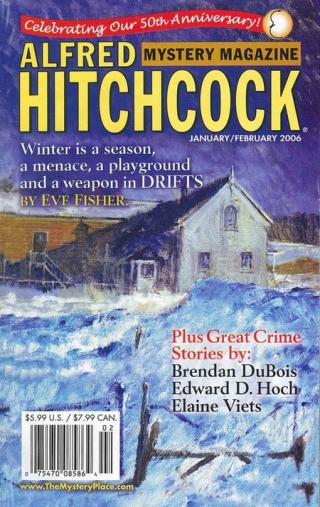
Alfred Hitchcock’s Mystery Magazine. Vol. 51, No. 1 & 2, January/February 2006
- Автор: Бетанкур Джон Грегори, Jr. William J. Carroll,
- Год: 2006
- Язык: английский
- Год: Dell Magazines/Crosstown Publications
- Жанр: Другие детективы

Электронная книга - «Alfred Hitchcock’s Mystery Magazine. Vol. 51, No. 1 & 2, January/February 2006». Краткое содержание книги:
Bobberts reached the guy and grabbed the guy’s back leg. The guy’s front foot slipped. The guy turned and yanked at the same time, sliding on the snow. Bobberts let go.
The guy fell on his belly, and went down the hill like he was on a sled, dropping Sarah. She was crying really hard now. The fall had hurt her too.
Bobberts half ran, half slid down near them.
“Sarah!” Bobberts yelled. “Run away!”
Sarah was stretched out in the snow. She was still crying. Sometimes she could cry so hard she’d forget what she was doing.
Bobberts pointed to the path. “Get Gramps!”
She stumbled. The guy crawled toward her, getting close to Bobberts.
And that’s when Bobberts kicked him.
The guy rolled onto his back. He was really big and really mean looking. Bobberts was never so scared in his whole life, not even when the sixth grade boys ganged up on him.
“Boy or girl,” the man said in an icky voice. “Don’t matter to me.”
He pulled Bobberts to him, but he didn’t knock Bobberts down.
The guy grinned at him, and a shiver went through Bobberts. A shiver, and an ick, and a fear like he’d never had.
So he kicked again. Kicked and kicked in the place Gramps said no boy ever really liked, and the man was squealing and rolling away and holding himself. Sarah was gone — where’d she go? — and there wasn’t sound, except Bobberts’s breathing and the guy squealing and the bam of Bobberts’s boot hitting the guy.
Then the guy’s hand grabbed Bobberts’s foot, and Bobberts went down, just like Sarah did when she was making snow angels. Only he was surprised and the air went right out of his body.
“Don’t make no difference.” The man’s voice sounded airy now, and kinda weird. He sat up. His skin was sickly looking, like he was gonna puke.
The guy was bigger than the sixth grade boys. Bobberts couldn’t stop them from beating him up. This guy would win. This guy would hurt him.
But Momma said when someone gets you, you do what you gotta do to get away.
Bobberts slipped his hand in his pocket. Daddy was already mad at him about the knife. He told Bobberts that Bobberts was too young to use it.
Do what you can, Momma whispered in his ear.
Bobberts dug the knife out, and snicked it open and jabbed it in the guy’s arm. The guy screamed and reached for the knife, but Bobberts remembered to pull it out so that Daddy wouldn’t get mad that it got stolen, and the guy was calling Bobberts bad names, and pulling even harder on Bobberts’s boot. Bobberts stabbed the guy’s arm again, and again, and then Bobberts missed, and the knife slipped and hit the guy in the leg.
The guy really screamed, and far away, Bobberts heard Gramps yelling his name, then yelling for Daddy, and then just yelling.
But the guy was screaming and rolling away from Bobberts and blood was squirting like the guy’s leg was one giant water pistol, and the snow was getting all red.
The guy had let go of Bobberts’s ankle, but it took him a minute to realize it because his ankle still hurt. His whole body hurt from falling and running out of air. The guy was still screaming, and Daddy was yelling now, and Bobberts got up and tripped his way over Sarah’s snow angels to the path.
Gramps took his arm, and Daddy was running down from the woods, and Sarah was crying, and the tree guy was yelling into his phone about police and help, and the weirdo couple behind him wanted to use the chainsaw to scare the guy. Then Gramps said it wouldn’t be necessary because he’d be dead soon anyway.
At first Bobberts thought Gramps meant the guy would be dead because Gramps would see to it, but Gramps didn’t mean that at all. The guy had stopped screaming and the blood wasn’t squirting any more, and the snow was so red it didn’t look like snow, and the blood was dripping down the footprints into Sarah’s snow angels, decorating them like Momma decorated her Christmas cookies, with a touch of red over the white.
Then Daddy reached them and grabbed Sarah and looked at Bobberts, and Gramps said, “The kid saved them both,” and Daddy looked like he was gonna cry, and Bobberts knew exactly why.
He held out the knife. It was bent funny and covered with gunk. He said, “I’m sorry, Daddy. I think I broke it.”
And Daddy took the knife from him, dropped it onto the path, and pulled Bobberts to his other side.
Bobberts clung onto Daddy’s jeans, feeling Daddy’s leg shake, or maybe Bobberts was shaking, and Sarah was crying, and Gramps was telling everybody to stay on the path, and Daddy said, “It’s okay,” but they all knew it really wasn’t.
The tree guy couldn’t wait and he had to go see if the mean guy was all right, and Gramps kept shaking his head. Bobberts wanted to get out of there, but he knew they couldn’t go yet.
“Daddy,” Bobberts said. “You forgot the tree.”
And Daddy laughed, only it didn’t sound like a Daddy-laugh. It sounded kinda shaky and weird, and he looked at Gramps and said, “I think we’re gonna get a tree from the store.” Bobberts didn’t know what that meant, but he nodded anyway.
Sarah wiped her face off and lifted her head and said, “I was just making angels, Daddy.”
“I know,” Daddy said. “I know. And they protected you, honey.”
“Uh-uh,” Sarah said. “That was Bobberts.”
And Bobberts smiled, even though he was shaking. He smiled and reached for his sister, and hugged her, even though it was a baby thing to do.
And nobody said nothing, nobody except Gramps, who said, “We got hot cocoa in the car,” like it was a reward.
And maybe it was.
Like smiling against his dad’s leg, and hugging his sister, and being really, really glad that nobody said nothing about the knife, lying bloody and broken in the snow.
21 Steps
by O’Neil De Noux
Detective John Raven Beau watched two coroner’s assistants carry the black body bag down the steps from the victim’s front porch, down the brick walkway, through the black wrought-iron gate, to the white Coroner’s Office van parked against the curb. They slid the body bag into the back and slammed the door.
Beau, standing six two, a lean one-eighty pounds, was thirty, a square-jawed man with dark brown hair and light brown eyes. The long sleeves of his white dress shirt were rolled up on his muscular forearms, his light blue tie loosened, and his nine-millimeter Beretta Model 92-F was snug in its black canvas holster on his right hip. A gold star-and-crescent New Orleans Police badge was clipped to his belt above the left front pocket of his navy blue suit pants.
“I was up on the pole all morning,” said the man standing next to Beau. His name was Jerol Philiber, forty-eight years old with short black hair, skin as dark as oak bark, standing six feet even, weighing two-twenty, and wearing a blue denim work jacket and denim pants.
Beau copied Philiber’s pertinent information in his notes, taking it from Philiber’s driver’s license and Community Cable-TV ID card, before handing them back to the cable installer.
“We’re rewiring this whole part of St. Charles Avenue,” Philiber volunteered. “I’m still not finished. Been here since six A.M.”
Beau looked at the telephone pole ten feet from the victim’s front gate, then up at the wires above, green metal box open where Philiber was working.
“Noticed her front door was cracked open,” the cableman went on, Beau jotting quickly to keep up, letting the man talk. “When I came down for lunch, I saw the next-door neighbor in her front yard and started to ask about the house, but she ran inside like I was the bogeyman.”
Beau looked into Philiber’s eyes. Neither man said it, but the elderly woman neighbor was probably frightened by the large black man.
“She called y’all, and I told the uniformed officer about the door.”