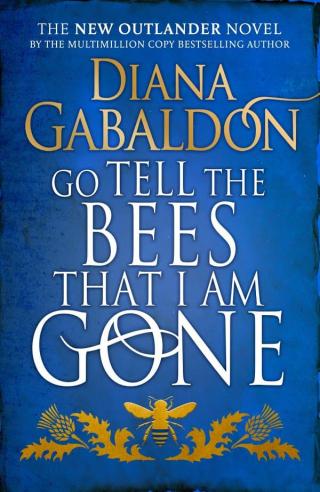
Go Tell the Bees That I Am Gone
- Автор: Гэблдон Диана
- Серия: Outlander #9
- Год: 2021
- Язык: английский
- Год: Delacorte Press
- ISBN: 978-1-473-51900-8
- Жанр: Исторические приключения

Электронная книга - «Go Tell the Bees That I Am Gone». Краткое содержание книги:
The past may seem the safest place to be . . . but it is the most dangerous time to be alive. . . .
Jamie Fraser and Claire Randall were torn apart by the Jacobite Rising in 1746, and it took them twenty years to find each other again. Now the American Revolution threatens to do the same. It is 1779 and Claire and Jamie are at last reunited with their daughter, Brianna, her husband, Roger, and their children on Fraser’s Ridge. Having the family together is a dream the Frasers had thought impossible. Yet even in the North Carolina backcountry, the effects of war are being felt. Tensions in the Colonies are great and local feelings run hot enough to boil Hell’s teakettle. Jamie knows loyalties among his tenants are split and it won’t be long until the war is on his doorstep. Brianna and Roger have their own worry: that the dangers that provoked their escape from the twentieth century might catch up to them. Sometimes they question whether risking the perils of the 1700s—among them disease, starvation, and an impending war—was indeed the safer choice for their family. Not so far away, young William Ransom is still coming to terms with the discovery of his true father’s identity—and thus his own—and Lord John Grey has reconciliations to make, and dangers to meet . . . on his son’s behalf, and his own. Meanwhile, the Revolutionary War creeps ever closer to Fraser’s Ridge. And with the family finally together, Jamie and Claire have more at stake than ever before.
Lachlan had seen him, too, and was directing a wide-eyed look of terror at him.
He hesitated, but not more than a few seconds.
“Stop!” he shouted, as loud as he could, and Young Ian backed him up.
“This man—” Jamie said, pointing at Hunt. “He’s one of my tenants.”
“He’s a hell-bound Tory, is what he is!” Cleveland riposted smartly, and lunging forward, dropped a noose over Lachlan Hunt’s head. Jamie flexed his shoulders and felt Young Ian draw up close behind him.
Before he could carry out his plan of butting Cleveland in his massive belly and knocking him over, then jumping on him and enduring whatever Cleveland might do to him long enough for Young Ian to get Hunt away into the darkness, another voice rang out in anguish.
“Locky!” it called. “That’s my brother!” A young man was elbowing his way through the crowd, which was beginning to be amused by this second interruption.
“And I s’pose that’un is somebody’s grandpa, eh?” some wag shouted, pitching a wet pine cone that hit the youngest prisoner in the chest. That caused laughter, and Jamie managed a breath.
“Don’t matter who they are!” someone else yelled. “They’re Tories and they’re gonna die!”
“Not without a trial!”
“Please, please—let me say goodbye to him!” Lachlan’s brother was pushing urgently through the crowd—which, Jamie saw, was letting him. There was even a murmur of sympathy; both prisoner and brother were young men, no more than twenty.
Jamie didn’t wait; he elbowed Ian and slid sideways through the crowd.
The clouds had closed again, and the light beneath the chosen hanging-tree was no more than scattered patches of lighter dark. The tiny fire expired in a final puff of smoke, and Young Ian let fly with the sort of Indian yips and howls that were calculated to startle and freeze the blood of all who heard them. Jamie dived under the tree and grabbed Hunt by his bound arms, propelling him violently away into the nearby forest.
Lachlan staggered, off-balance, but lunged along as well as he could, and within moments they were out of sight of the fire and the stramash that was starting there.
Jamie drew his dirk and sawed at the rope.
“D’ye ken where we are?” he asked Hunt. There was a great deal of racket back by the tree.
“No.” Locky Hunt’s face was no more than a dark oval, but the fear in his voice was clear as day. “Please, sir … please. My—my wife …”
“Shut your gob,” Jamie said, grunting as he wrenched and sawed. “Listen. That way”—he pointed, his finger directly under the man’s nose—“is west. Medway Plantation is maybe three miles in that direction. It belongs to a nephew of Francis Marion; he’ll help ye. I dinna ken where ye live these days, but my advice is to go do it somewhere else. Send for your wife when you’re safe away.”
“She—but she—the big man fired our cabin,” Hunt said, beginning to weep from nerves, relief, and renewed fear.
“She’s no dead,” Jamie said, with a certainty he hoped was justified. Cleveland was a brute, but so far as Jamie knew, he’d never killed a woman, save perhaps by crushing her to death by lying on her. Not on purpose, anyway … “She’ll have taken refuge wi’ someone nearby. Send a note to your nearest neighbor, they’ll find her. Now go!” The last fibers parted and the strands of the rope fell away.
Lachlan Hunt made more noises, babbling thanks, but Jamie turned him and gave him a solid push in the middle of the back that sent him staggering on his way. He didn’t watch to see how the man fared but hared back toward the hanging-tree, where a good bit of what Claire called argy-bargy was going on.
To his great relief, a good bit of the shouting was being done by Isaac Shelby and Captain Larkin, who were taking vigorous issue with Cleveland’s notion of sport. It had also commenced to rain again, which further dampened enthusiasm for the prospect of hanging the Tory prisoners; the crowd was beginning to melt away.
Jamie was beginning to feel that wee bit soluble himself, and when Young Ian turned up at his elbow, he merely nodded, patted Ian’s shoulder in thanks, and walked back through the dark to Claire, feeling very tired.
145
The Mirror Crack’d
FOUR DAYS LATER, THE mountain came in sight, and with its appearance, a jolt of expectation ran through the men. Jamie felt his own blood rise and knew every other man felt it, too. It had been a long time since he’d fought with an army, but he recognized the surge of strength and heat that burned away tiredness and hunger. Thoughts of pain and loss were still with him, but now seemed insubstantial. God willing, they’d reach the point in battle where death ran with you and sometimes you could ride it. His mouth was dry; he took a swig of tepid water and glanced at Claire, offering the canteen.
She was white to the lips, but she managed a smile and reached for the canteen. The horses had felt that charge of energy among the men, though, and were snorting and jostling, tossing their heads, and she dropped the canteen. It vanished at once in a trampling of muddy hooves. He thought for a moment she meant to dive after it and grabbed her arm, holding on.
“Dinna fash,” he said, though he knew she couldn’t hear him through the rising noise of the men. There was no advantage to silence, and many of the younger ones were whooping and shouting incoherent threats at an enemy too far distant to hear them. She nodded, nonetheless, and patted his hand.
He heard Cleveland’s hoarse bellowing up ahead, and the body of men began to slow. Time to fall out and check weapons, have a quick piss, and fettle themselves.
Jamie pulled up, raised his rifle to summon his own band, and swung down from the saddle. Roger Mac was there; he lifted Claire down, her long, bare legs a flash of white in the muddy ruins of her petticoats. Young Ian appeared at Jamie’s shoulder. He’d painted his face at dawn, and Jamie saw Roger Mac notice it and blink. He wanted to laugh but didn’t, just clapped Young Ian on the shoulder and jerked his head at the men, saying, “See to them, aye?
“Keep Claire with ye,” he said to Roger, and went to confer with the other colonels.
They’d drawn up and dismounted near Campbell, who still sat his big black gelding. John Sevier’s younger brother, Robert, and two other young men had left camp in the dark to scout the situation, and Jamie had a brief sense of falling, hearing them say the words that painted in Frank Randall’s account and brought it vividly to life.
“You can tell Major Ferguson right off,” Robert Sevier was saying, swiping a hand down his chest in illustration. “He’s got on a red-and-white-check shirt and he wasn’t wearin’ a coat when we saw him. Shows up right well amongst all those green Provincials.” He cocked his thumb and finger in the semblance of a gun, closed one eye, and pretended to aim.
John Sevier frowned at him, but said nothing, and Campbell merely nodded.
“All Provincials, are they?”
“No, sir,” said another young scout, quickly so as to keep Sevier from sticking his neb in. “Near on half of ’em don’t have uniforms, at least.”
“But they do all have guns. Sir,” said the third scout, not to be left out.
“How many?” Jamie asked, and felt the words strange in his throat.
“A few more’n us, but not enough to make a difference,” Sevier replied, but in Jamie’s mind there echoed another voice: Frank Randall’s.
The forces were nearly equal, though Ferguson’s troops numbered over a thousand, as compared with the nine hundred Patriots attacking him.