Esperanto Revolutionaries and Geeks: Language Politics, Digital Media and the Making of an International Community
- Автор: Fians Guilherme
- Год: 2022
- Язык: русский
- Жанр: Культурология

Электронная книга - «Esperanto Revolutionaries and Geeks: Language Politics, Digital Media and the Making of an International Community». Краткое содержание книги:
This set of cosmopolitan principles present in Zamenhof's speeches and writings is aimed towards reclaiming the human and downplaying differences. Yet, it does not explicitly entail a Kantian political call for a supranational state encompassing all the peoples of the world. Immanuel
Kant's conceptions of cosmopolitan right (Waldron 2000: 229—231) and political cosmopolitanism are concerned with a universalist morality and with an understanding of the Earth's surface as belonging to the human race and being for common use (Kant 2010: 21—24). Zamenhof, in turn, was proposing a set of cosmopolitan principles, to be enacted as humanist openness to one's Other. Although Esperantists occasion- ally use the terms civitanoj de la mondo or mondcivitanoj (citizens of the world) when referring to such openness, this world citizenship is rarely formulated as a claim for an effective citizenship of the kind to be recognised by nation-states.
Fig. 4.1 Postcard, produced by Raphael Tuck & Sons, in 1922, in the United Kingdom, praising the rapprochement of peoples through Esperanto. It reads, in Esperanto: 'Friendly Salutations. Oh, Let us sing a song/ About the language Esperanto/ By writers and poets/ In poems and odes' (Source Hector Hodler Library, UEA, Rotterdam)
E R
A N T O
FOR ALL
Zamenhof's Homaranismo, as a child of its time, justified the need for this humanist cosmopolitanism to be carried out through Esperanto by presenting language, nationality and ethnicity as closely connected and interdependent features. In this way, Homaranismo would consti- tute the political and philosophical basis upon which Esperantists wouldsee each other as samideanoj (fellow thinkers, those who share not only a language, but also the same set of ideals), a term still in use among supporters of the neutral Esperanto movement. Despite Zamenhof's attempts to strengthen Homaranismo, the language's dissemination in Western Europe, particularly in France, boosted a shift from these initial claims for openness to an instrumental use of the language for cross- border knowledge production and commerce. As a consequence, this initial humanist cosmopolitan approach gave way to several other sets of principles, which have been adopted, refused and adapted by Esperantos diversifying and growing speech community.
A remarkable change in this regard came with the dissemination of Esperanto among the working classes and left-leaning activists, which gained prominence with the First World War. The war created a scenario in which proletarians fought against each other, for their countries, for reasons that were overall perceived as not concerning them. This strengthened a left-leaning notion of cosmopolitanism, fuelled by a war- led perception of the destructive potential of nationalism. Driven by SAT and strongly influenced by Eugene Lanti, the growing left-wing, workers' Esperanto movement advanced what I call a non-nationalist cosmopoli- tanism, a way to foster unity through refusing everything connected to nations, nationalities and nationalisms. As Lanti (2013: 84) argued, one cannot simply deny the existence of nations, just as one cannot deny the occurrence of diseases. However, their very existence should encourage people to fight against their endurance. In his view, internationalism would not provide a solution, since it could not bring equality and peace to the world:
Paraphrasing a saying of Francis Bacon, 'a little philosophy inclineth man's mind to atheism; but depth in philosophy bringeth men's minds about to religion,' Jaures concluded his argument as follows: 'A little internation- alism weakens patriotism; much internationalism strengthens it.' That very clearly means that internationalism in no way aims at the aboli- tion of nationality in the world. Further, all congresses of the various Internationals have declared themselves for the independence of nations, for the autonomy of all countries. Internationalism, therefore, is only a system which aims at the setting up of a juridical organisation among the nations in order to avoid conflicts and wars, but which in no way pretends to abolish the national peculiarities constituted by languages, customs, tradition, and so forth. (Lanti 2013: 65-66; translation from Esperanto retrieved from SAT's website)
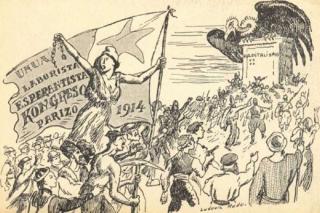
Lanti's perspective, extensively supported by SAT members and left-wing Esperantists in general, called for a non-nationalist approach, which was more pragmatic than the one advanced by Zamenhof and the neutral Esperanto movement. Lanti's ideas can be summarised by his call, which later became SAT's motto: 'members of SAT, get used to a beyond-national feeling, way of thinking and attitude!' From this stand- point, rather than fostering common humanity, proletarian and left-wing Esperantists should fight not only against borders and language barriers, but also more widely against wars, social inequality and capitalism, using Esperanto as a tool to organise their political struggle alongside Esperantists worldwide (Fig. 4.2).
Fig. 4.2 Postcard related to the First Workers' Esperantist Congress, which would be held in Paris, in 1914, but never took place due to the First World War. The image, by Ludovic-Rodo Pissarro circa 1914, portrays Esperanto guiding the people's fight against capitalism, the latter being depicted as a vulture (Source Department of Planned Languages, Austrian National Library, Vienna)
After the Second World War, the political and philosophical programme linked to Esperanto became closer to the internationalism promoted by the UN, in what I call internationalist cosmopolitanism. The emergence of non-state political actors (Beck and Sznaider 2010: 390) characterised by an internationalist orientation, such as the UN, UNESCO and UNICEF, was read as a source of potential support for Esperanto. This motivated Ivo Lapenna (who later became the president of UEA), as well as other prominent figures of the neutral Esperanto movement, to reformulate Esperantos programme in interna- tionalist terms. This emerging UN-like form of internationalism marked a shift from a world beyond nations to a world as a family of nations and from a world community of people to an international commu- nity of countries, with nations playing the role of mediators between persons, peoples and humanity (Malkki 1994: 56). In this vein, the interplay of nationality, language and ethnicity that characterised the humanist cosmopolitanism was partially taken up again, with close links connecting nationality, language and, this time, culture. People's nation- alities and cultural backgrounds took centre stage in Esperanto settings from this moment onwards: once the 'Esperanto discourse recognized the role of the nation-state, it became normal to say "Dutch Esperantists" or "Italian Esperantists"' (Gobbo 2017: 43).
As outlined in the previous chapter, this shift towards the UN goals and ideas led Esperantists to an increasing appreciation of national, linguistic and cultural diversity and to the defence of human rights, in an outlook that prevails to date. Such internationalist cosmopolitanism equates internationalism, multilingualism and multiculturalism, with cultural and linguistic differences between Esperantists being expressed as differences in nationality—despite these elements not necessarily over- lapping. The centrality given to this nation-language-culture paradigm is illustrated by how websites of international Esperanto associations, such as UEA, TEJO and SAT, have been translated from their original Esperanto version into seven, twelve and nineteen languages, respectively. By the same token, UEA prides itself on its internationality, stating that it has members in 120 countries, and stresses the role of linguistic justice for the development of a sense of solidarity and respect among peoples and cultures, as presented in the English language version of UEA's website: