Esperanto Revolutionaries and Geeks: Language Politics, Digital Media and the Making of an International Community
- Автор: Fians Guilherme
- Год: 2022
- Язык: русский
- Жанр: Культурология

Электронная книга - «Esperanto Revolutionaries and Geeks: Language Politics, Digital Media and the Making of an International Community». Краткое содержание книги:
Given that Esperantists materialise cosmopolitan principles through cosmopolitan sociabilities, this calls for a dialogue with what scholars refer to as ordinary cosmopolitanisms (Lamont and Aksartova 2002), cosmopolitanism in practice (Nowicka and Rovisco 2009) or everyday cosmopolitanism (Bayat 2008). Nowicka and Rovisco explain how cosmopolitanism in practice is concerned with:
(1) cosmopolitanism as a practice which is apparent in things that people do and say to positively engage with 'the otherness of the other' and the oneness of the world; (2) cosmopolitanism as a moral ideal that empha- sizes both tolerance towards difference and the possibility of a more just world order. (2009: 2)
In a separate approach, Hannerz's formulations about cultural cosmopolitanism (1990, 2005: 200) posit cosmopolitanism as an upper- middle-class openness towards different cultural experiences, an ability to make one's way into other cultures. This instance of cosmopolitanism, showcased by frequent travellers, does not involve any real commitment to other peoples or cultures since, as a tourist, one always keeps in mind that at some point one will go back home and leave the realm of the Other's culture behind.
Contrastingly, Lamont and Aksartova (2002: 1) examine not tourists, but non-college-educated white and black workers in the United States and white and North African workers in France. The authors argue that ordinary cosmopolitanism is not best understood as a short-lived appre- ciation of varied lifestyles. Instead, it consists of a broader strategy used also by ordinary people to bridge boundaries with Others in everyday relations. Among Esperantists, cosmopolitanism is neither a matter of one-off cosmopolitan sociabilities carried out by tourists in contact with 'exotic cultures', nor of neighbours and co-workers performing strate- gies to address cultural and racial issues on a daily basis. Encounters at an international Esperanto meeting bring together features of both: the contacts that Esperantists establish can either be ephemeral or can come to form long-term friendship ties; they can be superficial and stereotype- based or can go beyond cliches and lead to meaningful conversations. These characteristics establish the cosmopolitan sociabilities enacted by Esperantists as practices that combine elements of both Hannerz's and Lamont and Aksartovas approaches to cosmopolitanism.
International Esperanto meetings establish a particular frame in which participants are tuned into a specific, Esperantist frequency and in which communication across (certain) boundaries gains centrality. In metalinguistic terms, speaking in Esperanto about Esperanto itself and about where people come from frequently work as icebreakers to estab- lish initial contacts between fellow Esperantists. In metacommunicative terms, drawing on Gregory Bateson (1972: 177—193), communicating in Esperanto is what sets the frame of international Esperanto meetings, in which specific sets of actions and sociabilities are expected to take place. Bateson states that certain messages (such as 'this is play', 'let's be serious now' or 'time to work') define a frame and provide the receiver of the message with instructions or hints that will help them understand the messages conveyed within that frame. Here, the very use of Esperanto to communicate sets the frame, steering the concerned participants to tune into an Esperantist wavelength. On this frequency, some kinds of difference—namely those related to nationality—are made salient and legitimised, being conveyed as positive. When such celebration and openness are enacted through cosmopolitan sociabilities and when this togetherness, composed of the congress' participants, is materialised, a sense of belonging to Esperantujo becomes manifest. This tuning into an Esperantist frequency creates the image of a community where virtu- ally everyone can feel welcome and can value (certain) differences. Being no one's language implies that Esperanto can be potentially everyone's, adding one more element to the feeling of having this language, as well as this community, as one's own—this being the main reason why the use of languages other than Esperanto would compromise the construc- tion of this frame. In short, the fine-tuning and togetherness that these meetings produce, enabled by enactments of cosmopolitan sociabilities, engender a sense of belonging to Esperantujo.
Thus, inter-nationality resides at the core of the making of this community and also takes centre stage in the cosmopolitan principles that form the political and philosophical programme behind Esperanto. However, the way in which nationality plays out in Esperantujo has changed over time, resulting in shifting approaches that build on each other and complicate the present-day cosmopolitan principles that nurture the Esperanto community.
4.4 From Humanism to Internationalism, with Many Differences in Between
Had Esperanto been a language alone, it may have died out, as was the case with many other planned languages created between the eighteenth and the twentieth centuries. By contrast, the cosmopolitan principles often associated with it helped to establish Esperanto as a broader project focused on consciously addressing the relationship between nationalism and internationalism (Nagai 2010: 49). Over time, these principles have evolved according to the prevailing values of each histor- ical period, in what I identify as the three major Esperantist approaches to national diversity marked by humanist, non-nationalist and interna- tionalist outlooks.
The programme behind Esperanto has produced 'different social modalities of dealing with difference' (Beck and Sznaider 2010: 399) since the early days of this language. In the late nineteenth century, Zamenhof was highly influenced by the intellectual movement known as Haskalah or Jewish Enlightenment and by ideas of bringing people together on the grounds of political and religious tolerance—which was also motivated by his Jewishness (Schor 2016; O'Keeffe 2019). As Zamenhof himself emphasised, his programme, formalised under the name Homaranismo (1929[1906]), was inspired by the idea of the de- ethnicisation of social relations (Garvfa 2015: 84). With Homaranismo, he expected Esperanto to encourage individuals to affirm their human- ness and underplay their nationalities and ethnicities, inspiring Esperan- tists to see themselves as part of a brotherhood of peoples who share a common humanity. Zamenhof foresaw Esperanto as a tool both to enable more egalitarian international communication and to convey his political and philosophical programme, as he expressed in his opening speech at the First Universal Congress of Esperanto, in 1905:
And now, for the first time, the dream of thousands of years begins to become true. In this small town on the French coast, people have come together from the most diverse countries and nations, and they meet each other not as mute and deaf people, but they understand each other, they talk to each other as brothers, as members of one nation. [...] For the first time in human history, members of the most different peoples stand side by side not as strangers, not as competitors, but as brothers who do not impose their own language on one another, who understand each other, and who are not suspicious of each other for the darkness that divides them. As brothers who love each other and who shake each others hands not hypocritically, as foreigner with foreigner, but sincerely, as person with person. Let us be aware of the importance of this day, since today, among the hospitable walls of Boulogne-sur-Mer, we meet, not as Frenchmen meeting Britons, or as Russians meeting Poles, but as persons meeting persons. (Zamenhof 2001: 6-7, my translation from Esperanto)
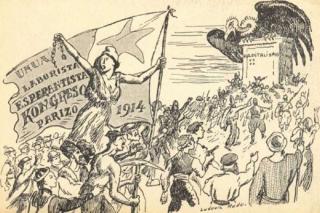
This outlook—which I call humanist cosmopolitanism—is in accordance with universalist values of the time, seeing the underplay of national, ethnic and religious belongings as a first step towards a reunion of humankind. The claim for a universal language was based on the need for bringing peoples together through the commonalities that we all share as human beings. Thus, apart from sharing the same humanity, we would also share a common language, making it possible for us to be one, despite differences. This role that Esperanto was to assume was also present in postcards produced in the early twentieth century (Fig. 4.1).