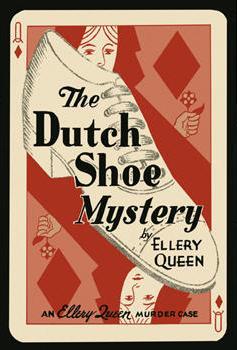
The Dutch Shoe Mystery
- Автор: Куин (Квин) Эллери
- Серия: Ellery Queen #3
- Год: 1931
- Язык: английский
- Год: Frederick A. Stokes
- Жанр: Классические детективы

Электронная книга - «The Dutch Shoe Mystery». Краткое содержание книги:
“That is... what?” prompted Ellery. He had lost his severity and was smiling.
“Well — you see — I did make derogatory remarks about Dr. Janney some time ago,” she explained stiffly, “but they weren’t threats, and they certainly weren’t directed against Mrs. Doorn. I can’t see, anyway—”
“Good!” Ellery beamed. “It was Dr. Janney, not Mrs. Doorn. Very well, Dr. Pennini. What have you against Janney?”
“Nothing terribly personal. I suppose you’ve heard” — she glanced sidewise at Dr. Minchen once more; he flushed and avoided her eyes — “that I was demoted through the interference of Mrs. Doorn from the position of Head of the Obstetrical Department. I was naturally resentful, and I am still resentful. I feel that it was Dr. Janney’s propaganda in the ear of the old lady which was responsible. In the heat of the moment I suppose I said some nasty things, and Dr. Minchen and a few others heard me. But what all this has to do with—”
“Very natural, very natural,” said Ellery sympathetically. “I quite understand.” She sniffed. “Now, Doctor, a little routine matter... Please account to me for your movements in the Hospital this morning.”
“My dear sir,” she returned coldly, “you’re so obvious! I’ve nothing at all to conceal. I had an early confinement this morning, operating at eight o’clock. Twins, if it interests you. Caesarian, and one died. Mother will probably go soon, too... I had breakfast and then made my regular rounds in the Maternity Ward. Dr. Janney, you know,” she said with sarcasm, “doesn’t bother with routine. His title is purely honorary. I visited about thirty-five patients and an army of squealing brats. I was on the go most of the morning.”
“And you weren’t in one place long enough to provide you with an alibi.”
“If I had needed an alibi I might have been careful to provide myself with one,” she retorted.
“Not in a certain eventuality,” murmured Ellery. “Did you leave the building at all up to noon?”
“No.”
“So helpful, Doctor... And you can’t offer a plausible explanation of this hideous business?”
“No again.”
“You’re positive?”
“If I could, I should.”
“I’ll bear that in mind.” Ellery rose. “Thank you.”
Dr. Minchen got to his feet awkwardly and they stood silently until the door slammed shut behind the woman. Minchen sank back into his swivel-chair and grinned feebly. “Quite a woman, isn’t she?”
“Quite!” Ellery lit another cigarette. “By the way, John, do you know if Edith Dunning is in the Hospital? I haven’t talked with her since she left this morning to take Hulda Doorn home.”
“See in a moment.” Minchen busied himself with his telephone. “She isn’t in. Went out on a Service call not long ago.”
“It doesn’t matter now.” Ellery inhaled hugely. “Interesting woman...” He expelled a nimbus of smoke. “Come to think of it, John — Euripides wasn’t so far wrong when he said, ‘I hate a learned woman.’ And don’t think, either, that the Grecian remark was so unallied to that classic statement of Byron’s...”[3]
“In heaven’s name,” groaned Minchen, “of which one are you talking — Miss Dunning or Dr. Pennini?”
“That doesn’t matter either.” Ellery reached for his coat, sighing.
Chapter Seventeen
Mystification
The peculiar relationship between Inspector Queen and his son — comradely rather than paternal-filial — was never more marked than at meal-times. The hour of sustenance, whether breakfast or dinner, was a period of jest, of reminiscence, of lively and good-natured chaffing. With young Djuna serving, the fire crackling, the wind howling through the canyons of West 87th Street and rattling the window panes, the Queens-at-home-of-a-wintry-evening was a spectacle famed in story and song throughout the vestries of the Police Department.[4]
But the tradition was shattered on the evening of the January day on which Abigail Doorn went to her reward.
Here was neither laughter nor peace. Ellery sat absorbed in thought and wrapped in gloom, cigarette smoldering above a half-empty coffee-cup. The Inspector shivered and wheezed as he sat hunched in his great armchair before the fire; his teeth chattered despite an armor of three old dressing-gowns. Djuna, ever the interpreter of moods, removed the dinner-dishes in a silence inhumanly complete.
The first real search had failed ignobly. Swanson, the wraith, was still at large. Sergeant Velie’s myrmidons had failed to find the faintest trace of him, despite a thorough canvass of all the Swansons in the borough directories. Headquarters was in an uproar, the Inspector tied to his chambers by a suddenly developed coryza. Preliminary reports from the detectives scouring hospitals and other institutions brought no word about the original source of the surgical clothing found in the telephone booth. The quest for the establishment which sold the picture-wire seemed hopeless, and chemical analysis of the wire revealed nothing. A scrutiny of Abigail Doorn’s financial rivals had as yet borne no fruit. The murdered woman’s private papers were as innocent, it seemed, as a child’s primary notebook. And, to complicate matters further, District Attorney Sampson had just telephoned to transmit the news of two hurried conferences with the Mayor and another long-distance call from the Governor at Albany. City and State officials were harried, anxious, clamorous for police action. The newspapermen hounded headquarters, besieged the closely guarded scene of the crime.
It was this state of affairs which had the Inspector, helpless in his chair, half hysterical with impotent rage. Ellery persisted in maintaining silence, sunk in a sea of speculation...
Djuna leaped out of his kitchen at the shrill br-r-ring of the telephone bell. “For you, Dad Queen.”
The old man hurried across the room, shaking with ague and licking his parched lips. “Hello. Who? Thomas? Well...” His voice sharpened, became eager. “Oh. Oh. WHAT? Oh, good glory. Hold the wire a moment.”
His face was parchment-ivory as he turned to Ellery. “The rottenest luck, son. It’s happened. Janney has given Ritter the slip!”
Ellery got to his feet, startled. “Stupid!” he muttered. “Find out more about it, dad.”
“Hello! Hello!” Inspector Queen wheezed viciously into the mouthpiece. “Thomas. You tell Ritter for me that he has some tall explaining to do or back he goes on a beat... No news on Swanson yet, eh?.... Well, you’ll have to work all night... WHAT? Good for Hesse... Yes, I know. He was backstairs in the house this afternoon while we were there... All right, Thomas. Have Ritter go back to Janney’s hotel and stay there... He’d better!”
“What’s up?” demanded Ellery as the old man trundled back to his chair and warmed his hands at the fire.
“Plenty. Janney lives at the Tareyton, on Madison Avenue. Ritter tailed him all day. He hung about watching the place and at 5:30 Janney came out in a hurry, took a cab at the door, which headed north. Ritter got a bad break, I’ll say that for him — he couldn’t get a cab for several moments — it all happened so fast he was paralyzed...
“When he located a hack he followed, picked up the trail, then lost it in traffic. Picked it up again near 42nd Street and was just in time to see Janney jump out of the cab at Grand Central, pay off his driver, and disappear into the terminal... And that’s the last of Janney, blast the luck!”
Ellery looked thoughtful. “Deliberately disobeyed instructions, eh? Skipped town. Of course, it’s only one thing...”
3
The allusion becomes intelligible when it is understood to which quotation Mr. Queen was referring. We asked Mr. J. J. McC. to clear up this point, which he was able to do only with difficulty. He discovered it to spring from a little-known quotation, “I hate a dumpy woman.” Undoubtedly Mr. Queen referred to Dr. Pennini. She was both “learned” and “dumpy,” to judge from his own description. — The Editor
4
Detective stories should concern themselves with relevancies. No description of the more or less well-known Queen domicile on West 87th Street is furnished here for the good and sufficient reason that it was fully described in an adventure post-dating The Dutch Shoe Mystery in time, but antedating it in appearance as a novel. I refer to The Roman Hat Mystery (Frederick A. Stokes Company, ’29). — Author’s Note