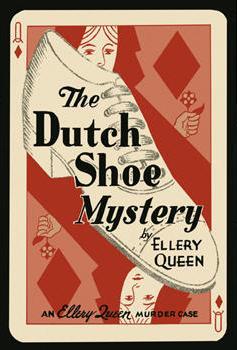
The Dutch Shoe Mystery
- Автор: Куин (Квин) Эллери
- Серия: Ellery Queen #3
- Год: 1931
- Язык: английский
- Год: Frederick A. Stokes
- Жанр: Классические детективы

Электронная книга - «The Dutch Shoe Mystery». Краткое содержание книги:
“I don’t want to discuss marriage. Oh, how can you even think...”
“But, Hulda. Hulda! Oh, darling. I’m a beast to make you cry...”
Chapter Fifteen
Complication
The police car rolled to the curb and stopped before the massive iron gates of the Doorn estate. Mansion and grounds covered the entire Fifth Avenue frontage between two streets in the Sixties. A high stone wall, weather-beaten and moss-grown, surrounded the house and gardens like an old granite cloak. It concealed the lower floors of the structure nestled deeply beyond the lawns.
One might, by stopping his ears to the automotive sounds of the flanking avenues, imagine himself in an old-world realm of châteaus and parks, of marble garden figures, stone benches and winding walks.
Across the street lay Central Park. Up Fifth Avenue the white dome and severe walls of the Metropolitan Museum gleamed. Beyond the bare branches of the park’s trees, in the crystal air, the tiny turrets and box-like façades of Central Park West could be seen, small and delicate as toys.
Inspector Queen, District Attorney Sampson and Ellery Queen left three smoking detectives in the police car and tramped unhurriedly through the gates, along the stone approach, toiling up the steep ramp. It led to a portico, a classical structure supported by fluted marble columns.
A lanky old man in livery opened the outer door. Inspector Queen brushed him aside and found himself in a vaulted room of vast dimensions. “Mr. Doorn,” he said with a snarl. “And don’t stop to ask me questions.”
The butler opened his mouth to protest, hesitated. “But who shall I say is—?”
“Inspector Queen. Mr. Queen. District Attorney Sampson.”
“Yes, sir!... If you’ll step this way, gentlemen.” They followed him through rich rooms, tapestried halls. He stopped at a double-door, pushed them apart.
“If you will please wait with the other gentleman...” He bowed and slowly walked off in the direction from which they had come.
“The other gentleman, hey?” muttered the Inspector. “Who... why, Harper!”
They stared across the brown somber room to a corner, where Pete Harper, ensconced in the leathery depths of a club-chair, grinned up at them.
“Say,” demanded the Inspector, “I thought you said you were going back to your paper. Trying to steal a march on us?”
“Fortunes of war, Inspector.” The old reporter waved gayly. “Tried to see Hendrik the playboy, but couldn’t — so I waited for you. Sit down, fellers.”
Ellery wandered thoughtfully about, examining the library. On all the walls, from floor to the lofty old-fashioned ceiling, were books — thousands of them. Reverently he ran his eye over some titles. The reverence banished and a peculiar smile appeared on his face as he plucked one volume from its shelf. It was a heavy, richly bound tome in golden calfskin. He flipped its pages experimentally. The sheets fell together, in sections.
“Well,” he commented dryly, “we, seem to have encountered another secret vice of our millionaires. Lovely books with neither fathers nor mothers.”
“What do you mean?” asked Sampson, who was following with curiosity.
“Here’s a copy of Voltaire in a perfectly magnificent format, specially designed, specially printed, specially bound — and specially unread. Poor Arouet! The leaves aren’t even cut. I’ll wager ninety-eight per cent of these volumes haven’t been referred to since they were purchased.”
The Inspector had sunk, groaning, into a Morris chair. “I wish that fat old fool...”
The fat old fool was genie to the wish: he appeared suddenly between the double-door in the bulky flesh, a wide nervous smile creasing his cheeks.
“Wery nice!” he squeaked. “Gladt to see you, gentlemans. Sidt down, sidt down!”
He oozed forward, like a seal.
The District Attorney obeyed slowly, regarding Abigail Doorn’s brother with a scowl of disgust. Ellery paid not the least attention to their host; he kept wandering about the room, looking at the books.
Hendrik Doorn collapsed on a broad divan and folded his fat hands moistly together. His smile vanished as he caught sight of the sprawling figure of Harper across the room.
“Iss that the reporter?” he shrilled. “I will nodt speak before a reporter, Inspector. Raus, you!”
“Raus yourself,” said Harper. He continued soothingly, “Now, keep your shirt on, Mr. Doorn. I’m not here as a newspaperman — am I, Mr. Sampson? The District Attorney will tell you, Mr. Doorn. I’m just helping along with the case. Friendly, sort of.”
“Harper’s all right, Mr. Doorn,” said the District Attorney sharply. “You can speak as freely before him as before us.”[2]
“Well...” Doorn eyed the reporter askance. “And he wouldn’t prindt anythings I say nodt to?”
“Who... me?” Harper looked scandalized. “Listen, Mr. Doorn, you’re insulting me. I’m the original clam.”
“You told us at the Hospital,” interrupted the Inspector, “about a story. You hinted it was as much as your life is worth to breathe a word about it. Well, sir?”
Doorn settled himself with painful fussiness on the protesting divan. He said carefully, not looking up, “Budt first you gentlemans must promise me somethings.” He lowered his voice. “Secrecy!” He regarded them quickly, in turn, like an arch-conspirator.
Inspector Queen closed his eyes. He dipped his fingers into the old brown snuff-box which was his constant companion. He seemed to have lost his ill-temper. “Are you making us a proposition?” he murmured. “A pact with the police, eh? Well, Mr. Doorn,” he opened his eyes and sat erect suddenly, “you’ll tell us that story and you’ll do it without bargains, too.”
Doorn wagged his bald head cunningly. “Ah, budt no,” he said in his thin falsetto. “You cannodt intimidate me, Mynheer Inspektor. You promise, I speak. Otherwise — no.”
“I’ll tell you what,” said the Inspector suddenly. “You’re evidently afraid for your hide, Mr. Doorn. Suppose we assure you that, if you need protection, we’ll give it to you.”
“You will give me police, detectives?” demanded Doorn eagerly.
“If your safety demands it, yes.”
“Wery well.” Doorn leaned forward, began to whisper rapidly. “I am in debt to — to a bloodt-sucker. For years I have been borrowing money from him. Large sums!”
“Here, here!” put in Inspector Queen. “This requires a little explaining. I’ve been given to understand that you have a tidy little income.”
The fat man brushed the remark aside with a ponderous wave of his hand. “Nothings. Nothings. I play at cardts, horses. I am — what you call — a spordtsman. My luck has been badt — wery badt. So! This man — he lendts me the money. Then he says, ‘I want back my money.’ And I cannodt pay. I talk, and he lendts me more. I give I.O.U.’s. How much — Gott! One hundred and ten thousands of dollars, gentlemans!”
Sampson whistled. Harper’s eyes flamed. The Inspector’s expression grew grim. “What security did you offer?” he asked. “After all, Mr. Doorn, you are not independently wealthy, as all the world knows.”
Doorn’s eyes narrowed. “Securidty? The besdt in the worldt!” He smirked all over his fat face. “My sister’s fordtune!”
“Do you mean,” demanded Sampson, “that Mrs. Doorn endorsed your I.O.U.’s, okayed your notes?”
“Oh, no!” He gasped audibly. “Budt as the brother of Abigail Doorn, I wass naturally known as the heir to greadt wealth. My sister knew nothings of this affair.”
“Isn’t that interesting,” murmured the Inspector. “Shylock loans you the money knowing that when Abby Doorn died you’d come into most of the fortune. A pretty arrangement, Mr. Doorn!”
2
In the whole history of reporter-police relations there has never been a more interesting chapter than that written by Peter Harper. To credit the unique privileges he enjoyed, it is essential to understand that the police never found him an abuser of confidences. In addition, he had been instrumental “in tracking down through his independent efforts several notorious criminals sought by the police. He may be remembered for his inspired journalistic efforts in the nation-wide hunt for Chicago Jack Murphy, in the Barnaby-Ross revelations, and in the case that has come to be known throughout the world as the “Mimic Murders.” — The Editor