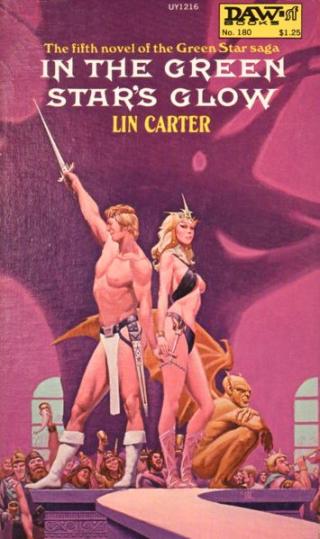
In the Green Star's Glow
- Автор: Картер Лин Спрэг
- Серия: Green Star Rises #5
- Язык: английский
- Жанр: Научная фантастика

Электронная книга - «In the Green Star's Glow». Краткое содержание книги:
But he was also an Earthling, whose helpless body lay in suspended animation in a guarded mansion in New England. It was his alien mind that drove Karn through perils that no other wold dare...
In the Green Star's Glow is a science fantasy novel in the tradition of Edgar Rice Burroughs. Written by American author Lin Carter, it is the final book in his Green Star series. It was first published in 1976.
In the center of the horde stood Delgan, a smile of aloof amusement on his thin lips, as he watched the invasion. All of this he had carefully foreseen, and thus far it was going according to his plans. Beside him crouched the gigantic figure of the ant monarch, Rkhith, his immense and many-legged form glittering with bejeweled trappings.
The battle progressed. Despite everything the aerial knights of Phaolon could do to prevent them, the forefront of the insect invasion poured into the streets of the city.
Before long it would be all over, Delgan knew. And he smiled at the thought.
Then something happened which Delgan had not foreseen. Down through the morning sky hurtled a gleaming metallic craft bearing a boy and a girl. The girl Delgan did not know, but the boy he knew all too well, and he ground his teeth together in rage at his untimely appearance.
It was Karn, with Varda beside him, on the skysled.
The ant warriors recoiled at the sudden appearance of this strange flying vehicle, and while they hesitated in their advance, a second sky craft materialized above the crowded streets of Phaolon. This one was piloted by a young woman who was also known to Delgan—Niamh the Fair!
The two aerial vessels skimmed low over the streets, and the ant horde cringed beneath the shadows of their keels, and became disorganized and jammed together so that they could hardly move, as the kraan behind pressed forward into the ranks of those in the forefront of the assault.
While this momentary congestion lasted, while the advancing warrior ants hesitated to eye these flying vehicles with trepidation and alarm, the archers of Phaolon seized the moment to pour their feathered shafts into the packed mass of ants. The barbed hail swept through the horde and took a ghastly toll of the attackers, for so tightly were the kraan jammed together that virtually every shaft loosed from the bows of Phaolon transfixed the head or thorax of an ant warrior.
As soon as the attackers managed to overcome their momentary hesitation, and began to disentangle themselves and to press forward again, yet a third flying enemy appeared in the air above the beleaguered city. This one was the most peculiar of them all—a batwinged, naked, golden man with a burly warrior in his arms. It was none other than Zarqa the Kalood, with Zorak of Tharkoon.
The Tharkoonian had recovered his bow and quiver of arrows from the Opal Tower, for Quoron had stored the weapon away when he had relieved Niamh of it in her dungeon cell while she slept. And the mighty bow soon wreaked a fearful toll of kraan. Flying above the host of swarming scarlet insects, Zarqa and Zorak fought as a team, the telepathic Kalood discerning the officers of the horde by mental means, and calling Zorak’s attention to these. The bowman then slew them one by one, while Zarqa flew high above, well out of reach of the weapons of the kraan.
The social system under which the insect-creatures toiled exposed its most crippling flaw then.
True, Zorak had guessed the identity of that innate weakness in the kraan civilization early on, but now it became obvious to all.
With their superiors and commanders slain by Zorak’s bow, the ant warriors milled about, dazed and bewildered, unable to adjust to a change in the situation of the moment, and unwilling to act on their own initiative.
Without their officers to tell them what to do, the warrior ants were confused and helpless.
Sensing this, both Karn and Niamh landed their flying vehicles atop the tall buildings and took aboard as many of the Phaolonese archers as their craft could carry.
Then they flew out over the thronged streets again, firing a deadly storm of arrows down into the staggering, entangled, befuddled kraan.
Taking heart, the armored chivalry of Phaolon, the princess and warriors and nobles, the yeomen and the guardsmen, too, charged down the streets of the city to hew a crimson path deep into the heart of the ant invasion.
Simultaneously under attack from above and from their fore, the warrior kraan could think of nothing else but to turn back, and regroup, and await new orders. Put the ant warriors in the rear continued to crawl forward in obedience to the last orders they had been given. In no time they were hopelessly jammed together, as the front ranks tried to retreat. Soon, they were so closely packed together, that they could not move in either direction.
The archers in the skysled and the other craft, and Zorak’s mighty bow, and the flying cavalry of Phaolon, swept them with a barbed storm of death, again and again.
They died in their hundreds, and in their thousands.
And even Xikchaka saw the evidence of Zorak’s arguments, and knew the human had spoken the truth.
Sensing the inevitability of defeat, Rkhith wheeled about and commanded his retinue of advisers and senior officers and his personal guards to retreat. Delgan, however, refused. The blue-skinned man was in a frenzy, his lean, aristocratic features distorted in a feral snarl, his skin glistening with cold perspiration, the glint of maniacal fury in his eyes. In one hand he brandished the zoukar, the death-flash, which he had stolen from the boy Karn long ago, and to which he had clung all this while.
“Do not flee,” he panted. “All is not lost. Listen to me, you crawling fool! With this I can bring down the aerial warriors, and the day is yet ours—”
But Rkhith was beyond the reach of argument or reason. The giant kraan had never before known the acrid taste of fear, but he knew it now, and he did not care for the taste of it. Cold logical thinking had deserted him, and the most primal of the emotions now reigned in its stead. The insect monster, in his frenzied haste to be gone from this scene of incredible carnage, did not recognize the wily human who had insidiously worked his way into Rkhith’s inner councils. He knew only that a despised human blocked his path.
The many-jointed limbs of Rkhith were armed with terrible claws and pincers. These reached out and seized upon the wild-eyed man. Cruelly sinking their saw-teeth into his flesh, they lifted his writhing, kicking form high into the air, and cast him to one side. Then Rkhith crawled hastily farther down the vast bough, at whose base the sparkling spires and domes of Phaolon were built, and fled.
But not very far.
Streaming with gore from his many wounds, Delgan levered himself up into a sitting position from where he had been flung, and with shaking hands aimed the zoukar after the fleeing form of his one-time master.
The bolt of lightning struck Rkhith from behind, with a sizzling flash of electric fire that momentarily lighted the air to intolerable brilliance.
A wriggling mass of seething flames, the king-ant died. Crisped and blackened, his corpse rolled down the steep side of the branch and feel to the unknown floor of the forest far below.
Sagging back, Delgan uttered one wry, croaking laugh. Then blood gushed from between his grinning jaws and his eyes went dead and empty, and he sprawled lifeless, the zoukar still clutched tight in his hand.
They had to pry his fingers apart to recover the death-flash, when they found the body …
In this manner the invasion of Phaolon was ended.
And so—almost—is my tale.