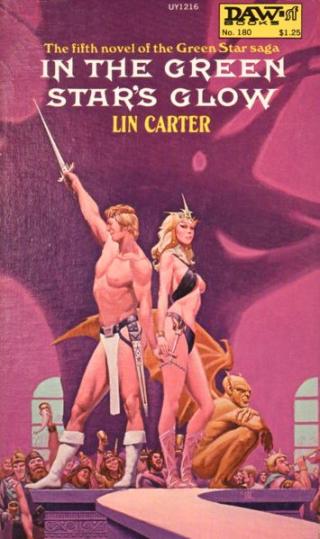
In the Green Star's Glow
- Автор: Картер Лин Спрэг
- Серия: Green Star Rises #5
- Язык: английский
- Жанр: Научная фантастика

Электронная книга - «In the Green Star's Glow». Краткое содержание книги:
But he was also an Earthling, whose helpless body lay in suspended animation in a guarded mansion in New England. It was his alien mind that drove Karn through perils that no other wold dare...
In the Green Star's Glow is a science fantasy novel in the tradition of Edgar Rice Burroughs. Written by American author Lin Carter, it is the final book in his Green Star series. It was first published in 1976.
During the period of his imprisonment by the kraan, it had so chanced that Zorak had enjoyed no occasion to converse privately with his former comrade, the great ant, Xikchaka. But as the last day of the march on Phaolon drew near, Xargo, the forger-of-weapons, who had been put in charge of Zorak by the ant-king, had cause to dispatch the bowman on an errand. This errand, as it happened, took the Tharkoonian near the squadron commanded by Xikchaka.
Thus the two met again, for the first time since Xikchaka had betrayed the human into the hands of his fellow ants, after Zorak had helped the ant warrior to escape from the cannibal blossom, and tended his needs when Xikchaka was too feeble to tend to himself.
The two confronted each other. Zorak drew himself up to his full height, crossing his massive arms upon his broad chest, and regarding the monster insect with a level, expressionless look.
The warrior ant returned his gaze. Since his head was armored in tough scarlet chitin, the features of Xikchaka were incapable of any display of emotion or alteration of expression, and the glitter of his ink-black eyes was similarly devoid of any sign of feeling or remorse.
“Greetings, Zorak,” he hailed the human warrior in his buzzing, clicking, rasping imitation of man-speech. “How has Zorak adjusted to his new condition in life? Has he been mistreated at the mandibles of Xikchaka’s kind?”
“I return your greetings, Xikchaka,” replied the bowman in a calm, dignified tone. “Xikchaka will perhaps be gratified to hear that Zorak has been treated well, and is comfortable in all ways, save one alone.”
“And what is that?” inquired the insect-creature solemnly.
“I am not free,” said Zorak. The warrior ant regarded him in silence for a time.
Then; “What is ‘free’?”
Zorak could not restrain the slight smile which touched his grim lips. It was, after all, a question which might give pause to the most learned of philosophers.
“To be free is to be one’s own master,” he said feelingly. “To come and go at one’s will, and as one wishes, without the permission of any other individual. This is the one quality of life which Zorak lacks. And, lacking it, all other things have lost their savor and are meaningless.”
The giant kraan considered this for a time, his knobbed antennae jerking and twitching.
“Is one ever truly free, whether kraan or human?” the emotionless creature questioned in return.
“Some of us are freer than others, at any rate,” said Zorak stoutly. “In the wilderness we were free, you and I.”
“Free, yes—to starve, to perish from thirst, to fall beneath the rending fangs of the first predator which came upon us,” commented Xikchaka. “In the horde, all of the difficulties of life are made simple; all decisions are made for us, all wishes are anticipated and answered before they can be articulated. There is no question of what to do or how to do it; one but follows the directions given by one’s superior. Surely, Zorak will admit that one is more comfortable when there are no decisions to be made, no problems to be solved, and when one has only to follow orders.”
“More comfortable, perhaps; but not more healthy. For to rely upon another for instruction in every act is to starve and stifle the initiative, to blunt and sap the will, and to reduce all of one’s faculties. Suppose Xikchaka more clearly perceives the necessities of the moment than does his nominal superior? Suppose Xikchaka has yearnings, aspirations, and intellectual interests for which his superior has neither understanding nor patience. Will not, then, the heart of Xikchaka go unsatisfied? If he has but no other purpose in life than to obey instructions, he limits himself to a role which is purely mechanical. It is no wonder to Zorak that Xikchaka’s kind have lost or submerged the gentler and more humane emotions love, kindness, mercy, and that very noble and precious quality we term ‘friendship.’ When one ceases to be personally responsible for the outcome of one’s actions, one becomes an emotionless robot. In Zorak’s society, each individual bears innumerable responsibilities toward one’s family and friends. A kindness must be repaid with a kindness, or the balance of civilized society turns to either indifference or selfishness.”
Xikchaka absorbed this, his antennae twitching as if in agitation of mind. Finally he spoke, and when he did the words came slowly.
“To accept personal responsibility for all one’s actions is to assume a frightful burden,” the warrior ant observed. “It is to accept responsibility for one’s own fate…”
Zorak nodded somberly. “That is true, Xikchaka, my friend. It is far easier to shrug off personal responsibility by saying you but followed the commands of your superior. But he may be your superior in rank, while remaining your inferior in intellect. It is in the nature of intelligent beings to desire to be the masters of their own fate. Any other condition, such as the servitude in which both Xikchaka and Zorak now toil, is slavery. And slavery is death to the will, to the mind, and to the spirit.”
The insect warrior said slowly, “Is it not more comfortable to be protected, and to belong to a vast common purpose? The thing which Zorak calls ‘freedom’ sounds dangerous and lonely.”
“It is,” Zorak admitted firmly. “But there is more to life than merely to be comfortable. A baby in its mother’s arms is comfortable and protected—or a grub, in the nesting place of a female. But to be a man, or a mature kraan, is better; and to be a man, in the truest sense of the word, is to be free. Which includes the freedom to be in danger or in discomfort.”
“Xikchaka will never understand the ways of men,” said the insect with a very human shaking of its immense, gleaming head.
They parted, then, without further words, and each pursued his own route.
That evening the ant horde halted in its march, for now it was only a branch-length away from the fork of the neighboring arboreal monarch in which Phaolon was built.
A kraan scouting party was sent out under Xikchaka from the parent body to investigate a small, artificial structure which was suspected to be of human workmanship. After a time, a scout returned to requisition a human captive, in order that the man might be questioned on the nature and purpose of the structure, as to whether or not it was an outpost of Phaolon, something in the nature of a watchtower, and perhaps inhabited by a body of armed human warriors.
As luck would have it, the man chosen for this purpose was Zorak the Bowman.
Under close guard, he ventured down the night-black branch until he came within sight of the artifact. It was a tower, the color of opals, which glowed softly with a gentle, all-pervasive luminance whose many hues were constantly shifting and changing, one color melting into another, like a ray of light directed to pass through a revolving prism.
From a forward vantage point, the scout ants observed the strange building while themselves remaining hidden behind a screen of foliage. Zorak was led forward until he, too, could observe the building unseen.
He found it curious and puzzling. It was patently obvious to the brawny bowman that the spire was not the work of human hands, or at least not the work of any civilization remotely akin to his own, for the design and fabrication of the tower, and the material from which it had been erected, was a complete mystery to him. Moreover, the building looked somehow deserted, although had you asked Zorak why he felt so, he could not have given you a reason.
“Is this a watchtower, guarding the approaches to Phaolon?” Xikchaka inquired in a rasping simulacrum of human speech.
Zorak was on the horns of a dilemma. In fact, he knew, or very strongly believed, that the Opal Tower was an artifact of one of the prehuman races which had formerly been the inhabitants of this planet. Since these races were known to be long extinct, he did not question that the tower was empty. However, he spoke up in equivocal terms, urging that the war party explore the structure, and did not give voice to his opinion as to its origin and history. From Zorak’s point of view, every conceivable excuse to delay the advance of the horde in its march against Phaolon was legitimate and most desirable. Every hour that the horde remained stationary gave the folk of Niamh’s city an extra margin of safety, and the opportunity to discover the kraan army before it attacked the outskirts of the city.