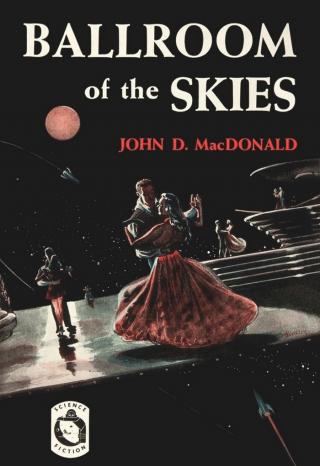
Ballroom of the Skies
- Автор: Макдональд Джон Данн
- Год: 1952
- Язык: английский
- Год: Greenberg
- Жанр: Научная фантастика

Электронная книга - «Ballroom of the Skies». Краткое содержание книги:
There was a dim light in the hallway. He pressed the button, heard a distant ringing. Across the street, shirt-sleeved men and weary women sat on front steps, their voices slow in the warm night, their laughter oddly dreary.
Dr. Oliver Krindle came down the stairs. Dake saw the thick naked ankles, the worn slippers, the battered robe, the deceptive face of a shaven Santa. Krindle turned on the light over the door and peered through, then made a great rattling of chains and bolts.
“Come in, Lorin. Come in! Damn careful these days. Hoodlums, cretins. Violence for its own sake. That’s the kind that frightens you. For profit, that is understandable. Too many people like to look at blood. Maybe it’s always been that way. Come on up. I’ve been listening to music. Choral stuff tonight. Lots of voices in my room, eh?”
Dake followed the man up the stairs, to the quiet room he remembered. Dr. Krindle waved him to a chair, said, “I’ll start this one again from the beginning. No one is in too much of a hurry for this, Lorin.” He turned on the player again.
Dake leaned back in the chair, let the music sweep over him like a vast warm tide. Krindle moved slowly, making two drinks, setting one down at Dake’s elbow. The music was a rich sanity, a reaffirmation of faith in man, a denial of the things he had learned.
The music stopped and Krindle turned it off. They sat in the silence for a time. Ice tinkled in Dake’s glass as he raised it to his lips.
“I have read about you, Lorin. You’ve been busy. Disservice, sentence, escape. I knew you would be a fugitive someday. I did not know when or how.”
“But you knew why?”
“Of course. You meet environment in too direct a manner. So your environment is embarrassed. It doesn’t like defects pointed out. So it destroys you.”
“Martyr?”
“Yes. Without purpose. Your defeat does not add impetus to any creed or group or movement. The solitary man. The flaw, possibly, is in believing too much in yourself. If that is a flaw. I don’t know. Once upon a time I told myself I would never compromise. Oh, I was young and brave. Now I look back on life. A life of listening to the anxious daydreams of neurotic women. Little minds so shallow that they present but one surface, Lorin.”
“What is normalcy, Oliver? Stability?”
“It doesn’t exist. Just a convenient line you draw. Everybody overlaps that line at some point, and deviates widely at another. Add up all the aspects of an individual, and you can only classify him as an individual. No two men have ever been mentally sick or mentally well in the same way — with the exception of physiological mental illness. We are all, unfortunately, unique. How simple my profession would be if I could type people, safely and accurately!”
“Suppose it were your function to drive a man mad. How would you go about it?”
“First I would change your terminology. How would I go about creating a mental illness? The classic way is to present him with an insoluble problem, and make it necessary for survival for him to solve that problem. The rat in a maze with no exit.”
“Suppose you could make his senses give him... nonsense messages.”
“Wouldn’t that be another aspect of the same classic problem, Dake Lorin? To survive, it is necessary to be able to trust what your eyes and ears and touch and smell tell you. If the data they present to the brain are patently impossible, then the subject has a classic problem. I must trust my senses in order to survive. My senses cannot be trusted. What do I do? But aren’t you thinking of a result rather than a cause. A patient will hallucinate when he can no longer stand the sane messages his senses give him. A wife is unfaithful. So he hears a voice coming out of the fireplace. It says to kill her.”
“What happens if the cart is before the horse?”
“Will he kill her, you mean? That depends on how dependent he is on his ears and eyes and sense of touch. Roughly, I would say the more meager the intelligence, the more likely the patient is to obey a false message. What have your false messages been?”
Dake studied his thick hard knuckles. “I looked into a mirror. The left side of my face was a naked skull. I touched it. It was hard and cold. Two persons with me saw it, too. One went mad and one fainted.”
“I would say that you had subconsciously recognized the duality of your life, recognized a death wish.”
“If two others saw it?”
“Once I had a patient who resented the way people on the street would stop and pet his three-headed purple dog. It followed him everywhere.”
“Suppose I told you, Oliver, that I can make you stand up against your will, pick up that record off the turntable and break it on the hearth.”
“Perhaps you could, if I were willing to submit to hypnosis.”
“Suppose I tell you that I can create a... three-headed purple dog right here and that you will be able to see it. Or tell you that I can project words into your mind, so that you can know what I am saying without my speaking.”
Oliver Krindle took a slow sip of his drink. “I would say that you have had much strain lately. You were trying to help the world. The world destroyed your effectiveness. You cannot admit that you are ineffective. The struggle is too important to you. You compensate by endowing yourself with strange psychic gifts which seem to restore your effectiveness.”
“Why have you always been interested in psychic research?”
“For the same reason that a man who is trying to grow an orchard will be interested in a thick dark woods next door.”
“Then you believe, Oliver, that there is much that you do not know.”
“Do I look that arrogant? Of course there is much I do not know.”
“Have you ever wondered if all the mystery in our world might come from one special source?”
“God, Martians, Irish visions?”
“What if the world we know is a test tube? A culture dish? A continuous bacterial conflict?”
Oliver half closed his eyes. “Interesting from a speculative point of view. But it has been done too many times before. Show me the agency.”
“I’m one of them.”
Oliver opened his eyes wide. “It would please me, Dake Lorin, if you would stay here tonight.”
“I’m one of them, but I don’t want to be one of them. They’re after me. They’ll kill me, and mankind will never know what... opposes it. I can’t demonstrate talents, because they are sensitive to that. They can find me.”
“Lorin, I...”
Dake leaned forward. “Shut up a minute. I’m going to take a chance. But I am going to make it very quick. You’ll have to get whatever you can get from it in a very few seconds.”
“Have you thought what you would do if your... mysterious powers fail?”
“That’s why I came here. If they fail, I’ve been mad for months on end. But they won’t fail. Do you see that corner of the table, directly under the lamp. There is nothing there, Oliver, is there?”
“Of course not, but...”
“And you are resisting any attempt at hypnosis, are you not?”
“Yes, but...”
“Watch the corner of the table,” Dake said softly. He did the simplest illusion he could think of. A featureless white cube, about three inches on a side. He let it remain there on the corner of the table for no longer than two seconds, and then erased it utterly.
He had watched the cube. He turned his eyes to Oliver Krindle’s face. Under the cheerful red cheeks the flesh tone had gone chalky gray. The glass trembled violently as he lifted it to his lips. Some of the drink sloshed out onto the ancient dressing gown. The glass chattered as he set it back down on the broad arm of his chair.
“I may not have much time, Oliver. They may come for me. I want you to know...”
“One of the most startling demonstrations of hypnosis,” Krindle said, too loudly, “that I have ever seen.”