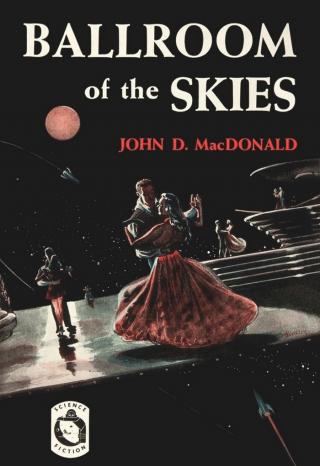
Ballroom of the Skies
- Автор: Макдональд Джон Данн
- Год: 1952
- Язык: английский
- Год: Greenberg
- Жанр: Научная фантастика

Электронная книга - «Ballroom of the Skies». Краткое содержание книги:
“You’re going too quickly, Karen. I don’t...”
“Don’t try. We’ll just have a little stroll.”
He held his screens firm, so that there was no possibility of her catching any fragment of his plan. He casually slipped his hand into his pocket, built up a powerful visualization of the hotel room where he had last stayed in New York. He worked the small wheels with his thumbnail. The shift to the hotel room was instantaneous. A puffy white-haired man in a dressing gown gaped at him. “How did you get in here, sir?” A pretty vacant-eyed girl wearing very little of anything came to the bathroom door and stared at him.
“Wrong room,” Dake said. “Sorry.”
“Couldn’t you knock, dammit?”
“Sorry,” Dake said. He moved to the door, unlocked it, hurried out into the corridor.
He went down the hallway, conscious of his conspicuous height. He went down the stairs and out into the warm June evening. He was painfully aware of how the months of Training T had heightened all his perceptions. Sounds seemed too loud, impressions too vivid. The world was a swarming mass of lurid, confusing detail. He had to get away from it, get away to some quiet place where he could think and plan.
He went to another hotel, gave illusion money to the clerk, pocketed his real change, tipped the bellhop with some of it. The room was small, depressingly dingy. He turned off the lights, put a chair over by the window and sat in it, looking out at the skyline.
Funny how this was supposed to be home, yet he felt a strangeness here. As though he were no longer a part of it. He remembered his original resolve, that resolve that had never weakened — learn everything you can and come home and use it to expose them. Let the guy in the street know that he was being pushed around.
And the men in the street would ask WHY?
Dake did not know why. The thing seemed planless. Another extension of the games field.
Now be coherent with yourself. Collate the data. Set up an operating plan. Through the use of illusion you could land a space ship in New Times Square, march a goggle-headed crew of Martians down Broadway. That, perhaps, would start men thinking about interference — on an extra-terrestrial basis.
“You’re a hard man to find,” Karen said, behind him.
He turned quickly, almost relieved at momentarily escaping the necessity of making a plan.
She said, “That illusion with the money did it. I caught the direction of that. You can’t use anything you’ve learned, Dake, without it being detectable.”
The meager light of the night city touched her face, her cool alien eyes. She looked at him with that remote speculation of an entomologist awaiting an emergence from the cocoon.
He tried to project, to probe her mind. The screen was like metallic rock.
“All your tricks,” he said, almost incoherently. “All your dirty little inhuman devices. They—”
“All our tricks, Dake.”
“Not mine. I didn’t ask for it. I went along with it. No choice at all.” He stood up, towering over her, his back to the light. “Now the tricks make me ashamed. They make me a... mutation. They destroy the meaning of being a man.”
“How noble!”
“You can’t trace me if I don’t use them, can you?”
“Can a man will himself to stop using his arms?”
He half turned from her to conceal the hand he slipped into his pocket. He thought of a ruse. Phone booths have a cookie-cutter similarity. He visualized quickly, flipping the wheels, feeling the surge of sickening nothingness, the sudden recapitulation of himself staring at the black phone a foot from his eyes. He stepped out of the booth, saw that he was in the hotel lobby downstairs, that the Pack B had selected the most immediate target visualization.
He walked out onto the street. Just as he tried to lose himself in the crowd, the thought arrowed faintly into his mind. Dake! Run and we will kill you. We will have to. If you can hear me, come back.
His stride faltered for a moment, and then he moved on to lose himself in the crowd. He instinctively hunched his shoulders, walked with knees slightly bent to reduce his towering height.
Learn what they can give you and use it against them. He had spent his life fighting. The equation was clear. The logic was impeccable. If they had the abilities he had learned, then they could put an end to the conflict on earth. They did not. Thus they were unfriendly to mankind. And man would have to know and learn. Man would have to recognize the enemy within the gates.
He remembered the one who had injured Karen, injured that previous, more understandable Karen. They seemed to fight among themselves, but with grotesquely gallant little rules. So Earth was an extension of the games field. A place where you could be aware of your own superiority. Make the silly little creatures jump. They had made him jump, had killed Branson, had driven Patrice mad. They were like cruel children let loose in a zoo with loaded rifles.
A slow-moving prowl car slid a spotlight beam across him, went on. He could hear the metallic chatter of its radio. There would be danger from two sources. According to Karen, Martin Merman had arranged it so that the authorities would not be too eager to recapture him after his supposed escape. Merman could easily reverse that. His great height made him feel naked on the streets. He knew that through his newly acquired talent of control, of illusioning, or para-voice, he could make any attempt to take him a heartbreaking matter to any federal officer. But his escape attempts would, as Karen had told him, enable them to find him easily. As long as he used none of his new abilities, they could only recognize him visually, and confirm it by projecting against the first screen in his mind.
The faces of the people on the night streets depressed him. The months on Training T seemed to have given him a heightened susceptibility to mood. He could feel the waves of tension, and despair, and aimless discontent. Cold taffy faces and metronome eyes and life-broken mouths. An animal walking the city, with the tired inviting flex and clench of buttocks, with soupy opacity of eye. He walked through futility, drowning in it. And then, slowly, began to see other things. Small things. A young boy with a rapt, dedicated face, eyes of a stricken angel, looking upward at one of the pre-war buildings, at the simple perfect beauty of structural integrity. A couple, hand in hand, who would have been alone on the busiest street in the world. An old man shuffling along — the light slanting against a face that had been twisted and torn and broken by life, leaving nothing but a look of calm and peace, a look in which there was that beauty which is sometimes the by-product of torture. Pride made his eyes smart. Try to smash them utterly, and there was always something left in the ruins. Something priceless, eternal.
As he walked, wondering where he should hide, he remembered a column in a lighter vein that he had done long ago, in, it seemed, someone else’s lifetime. Dr. Oliver Krindle, psychiatrist, whose hobby was psychic research. He remembered Krindle as one of those rare, warm men not damaged by too much knowledge of the human soul. The column had been about Krindle’s endless and skeptical effort to track down psychic phenomena, about the two incidents out of all those years which Krindle felt did not lend themselves to any satisfactory explanation — except the obvious one that the persons reporting them lied.
He looked up Krindle’s address in a phone book, walked fifteen blocks to the narrow lightless street. He had remembered that Krindle lived alone over his office. He remembered the good and ancient brandy Krindle had served, making a ceremony of the little ritual. Brandy in a room lined with books — as though Krindle had found some special way to preserve the good things in a world in which good things were no longer understood.