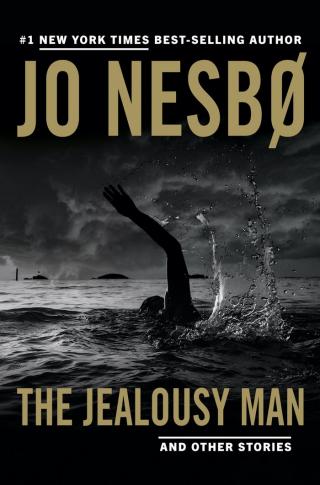
The Jealousy Man and Other Stories
- Автор: Несбё Ю
- Год: 2021
- Язык: английский
- Год: Alfred A. Knopf
- ISBN: 978-0-593-32100-3
- Переводчик: Robert Ferguson
- Жанр: Криминальные детективы

Электронная книга - «The Jealousy Man and Other Stories». Краткое содержание книги:
A detective with a nose for jealousy is on the trail of a man suspected of murdering his twin; a bereaved father must decide whether vengeance has a place in the new world order after a pandemic brings about the collapse of society; a garbage man fresh off a bender tries to piece together what happened the night before; a hired assassin matches wits against his greatest adversary in a dangerous game for survival; and an instantly electric connection between passengers on a flight to London may spell romance, or something more sinister.
With Nesbø’s characteristic gift for outstanding atmosphere and gut-wrenching revelations, The Jealousy Man confirms that he is at the peak of his abilities.
I walked Victoria back to her hotel, her departure was at the crack of dawn next day. Then I headed back home. Athens is what the English call an acquired taste. But I took a long detour through neighbourhoods rougher than Kolonaki because I knew I wouldn’t be able to sleep.
Maybe Monique suspected all along. Maybe the remark she passed about the stain on my thigh when the seat warmers had caused the Elizabeth Arden cream to smell so strongly was just her way of letting me know. That she knew, and that she also knew that, on account of her betrayal, in some way she shared the guilt, and that our ways must part here.
But now, late in life, it could be that we had actually found our way back to that crossroads where we had took leave of one another. Now — if we wanted to, if we dared — we could take that other road. Me, a murderer. But I had served my time, hadn’t I? I was able to feel good about Franz and about his happiness. Might I also be able to feel good about my own?
At a corner I couldn’t recall ever having passed before a stray dog sauntered across the street, glancing neither to right nor left. It looked as though it had caught the scent of something.
The Line
I hate people who cut in lines.
Must be because I’ve spent far too many of my thirty-nine years standing in lines.
So even though there are only two people in my 7-Eleven, and the old lady is having trouble finding her purse, I stare coldly at the boy who has just pushed in front of her. He’s wearing a quilted jacket which I recognise as a Moncler because I’ve looked at one myself and realised I’m never going to be able to afford it. The coat I bought at the Salvation Army shop just before the winter came is fine. But I can’t seem to get rid of the smell of the woman who owned it before me. Who was ahead of me in the line.
It isn’t often people sneak in lines here, unless it’s at night, and they’re drunk. In the main the people in this country are polite. The last time someone did so as blatantly as this was two months ago. A stylishly dressed woman who denied it when I accused her of cutting in line threatened to speak to my boss and get me sacked.
The boy meets my eyes. I see the hint of a smile. He feels no shame. And he’s not wearing a mask either.
‘I only want a tin of General snuff,’ he says, as though the ‘only’ justified cutting in line.
‘You’ll have to wait your turn,’ I say into my mask.
‘It’s right behind you. It’ll only take five seconds.’ He points.
‘You’ll have to wait your turn,’ I say again.
‘If you’d just given it to me I would have been out of here by now.’
‘You’ll have to wait your turn.’
‘You’ll have to wait your turn,’ he imitates, exaggerating my accent. ‘Come on, bitch.’ His smile broadens, as though it’s a joke. Maybe he thinks he can talk to me like that because I’m a woman, I’m in a low-paid job, an immigrant with a different skin colour from his chalky white. Maybe he’s borrowing from a tribal language he thinks I speak. Or maybe he’s being ironic and this is his parody of being a bad boy. After a closer look at him I reject this last possibility. It’s too complex for him.
‘Move aside,’ I say.
‘I’ve got a train to catch. Come on.’
‘Maybe if you’d asked the person in front of you if it was OK?’
‘My train...’
‘The trains run all day,’ I say to the accompaniment of the steady rumbling from the metro two staircases below. When I started working here my little sister asked if I wasn’t worried about terrorists and sarin. In the civil war, before we got out, sarin was what everyone was afraid of. Afraid that the guerrillas would release the poison gas the way we’d heard a Japanese sect had done in the Tokyo underground sometime back in the nineties. My sister was nine years old and had nightmares every night about poison gas and underground stations.
‘There’s only one every fifteen minutes on my line,’ he hisses. ‘I’ve got a meeting, OK?’
‘All the more reason to ask her nicely,’ I say, with a nod in the direction of the lady behind him who has finally found her credit card and is ready to pay for the three items lying on the counter in front of me. The boy — I’d put his age in the mid-twenties and guess he’s a regular at the training centre, mostly weights and explosive workouts — loses the patience he clearly feels he’s been showing.
‘Now, you nignog!’
My heart starts beating faster, but not so much because he’s trying to offend me. I don’t know whether the guy’s a racist or is just trying to get at me in the way he thinks will hurt and provoke me most, the way he would have called me dwarf if I was short, or porkie if I was fat. I don’t care what his prejudices are; my heart is beating faster because I’m afraid. Because in the course of just a few seconds this overgrown child standing in my shop has crossed a line, meaning probably he has problems with his self-control. I can’t see anything in his pupils or his body language to indicate that he’s high on something, the way the soldiers often were, although of course anabolic steroids could be in there somewhere. My ex-husband says that, because I’m a chemist, I’m always trying to explain the world by reference to chemistry. Like that proverb about the man with the hammer who sees every problem in terms of nails.
So, yes, I’m scared, but I’ve been more scared. And I’m angry, but I’ve been angrier.
‘No,’ I say calmly.
‘You sure?’
He takes something from the pocket of his nice, warm Moncler jacket.
A red Swiss Army knife. Flips out the big blade. No, it’s the nail file. Raises his hand, sticks his middle finger up in the air and starts to file a nail, laughing in my direction. One of his front teeth has a big dark stain on it. Could be from methamphetamine, which contains chemicals such as anhydrous ammonia and red phosphorous that eat up the enamel. But of course it could just be a case of bad dental hygiene.
He turns to the woman behind him. ‘Hey, missus — OK by you if I do a bit of shopping?’
The woman stares open-mouthed at the knife and looks as though she’s trying to say something, but not a sound comes out. Instead she nods, quick as a woodpecker, and makes noises like she’s having trouble breathing. Above the mask her glasses mist over.
The boy turns back to me. ‘There, see? Come on.’
I take a deep breath. Maybe I’ve underestimated the boy. At least he’s street-smart enough to know that the CCTV cameras in 7-Eleven shops record pictures but not sound, so that in a court case there would be no indisputable proof that he’d actually said ‘nignog’ or anything like it that could be called hate speech. Unless the elderly lady behind him has better hearing than I think. And there’s no law against filing your nails.
I turn slowly and take down the packet of snuff, thinking the situation over.
As I say, I’ve been standing in lines since I was born and I can remember them all. The food lines I stood in with Mamma when I was little. The line around the UN lorries when the fighting first started. The line at the health station where my sister was diagnosed with tuberculosis. The staff line at the university toilets because the chemistry department didn’t have separate toilets for female students. The line of refugees leaving town when the war broke out. My sister and me in the line to board the boat and take the places for which Mamma had sold everything we owned. More food lines in a refugee camp where the chances of being raped were about as high as they were back home in the war zone. The line and the waiting to be sent to another country, to a refugee centre that held out hopes of a better life. The line to be allowed to leave the centre, get a job and contribute to this country that has taken us in and that I love. I love it so much that one of the three pictures hanging above the bed in the little flat my sister and I share was of the king and queen, along with Mamma and Madame Curie, my two other heroes.