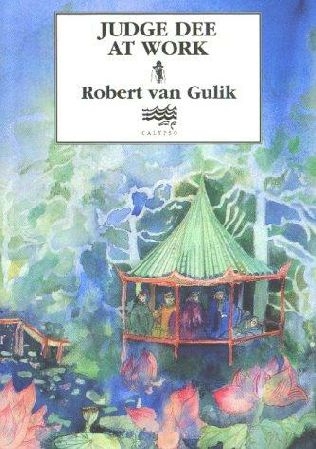
Judge Dee at Work
- Автор: ван Гулик Роберт Ханс
- Серия: Judge Dee #14
- Язык: английский
- Жанр: Другие детективы

Электронная книга - «Judge Dee at Work». Краткое содержание книги:
The eight short stories in Judge Dee at Work cover a decade during which the judge served in four different provinces of the T’ang Empire. From the suspected treason of a general in the Chinese army to the murder of a lonely poet in his garden pavilion, the cases here are among the most memorable in the Judge Dee series.
'You must be mistaken!' the maid interrupted crossly. 'I accompanied her when she went from the side room to the pavilion, and I didn't notice that she was upset!’
The steward was about to make an angry retort, but Judge Dee held up his hand and said curtly to him: 'Go to the gatehouse, and ask the gatekeeper what persons he admitted to the house after your master and Mr Hwa had left — why they came and how long they stayed. Hurry up!’
When the steward had scurried away, Judge Dee sat down at the table. Slowly caressing his sidewhiskers, he silently studied the woman who was standing in front of him with downcast eyes. Then he spoke: 'Your mistress is dead. It is your duty to tell us everything that might help to find the person who either directly or indirectly caused her death. Speak up, why did the arrival of Mr Hwa distress her?'
The maid darted a frightened look at him. She replied diffidently: 'I really don't know, sir! I only know that in the past two weeks she went twice to visit Mr Hwa, without Mr Ho knowing it. I wanted to go with her, but Mr Fung said ...' She suddenly broke off. Growing red in the face, she angrily bit her lip.
'Who is Mr Fung?' Judge Dee asked sharply.
She deliberated for a while, her forehead creased in a deep frown. Then she shrugged her shoulders and answered, 'Well, it's bound to come out, and they didn't do anything wrong anyway! Mr Fung is a painter, sir, very poor and in bad health. He used to live in a small hovel near our house. Six years ago the father of my mistress, the retired prefect, engaged Mr Fung to teach my mistress to paint flowers. She was only twenty-two then, and he was such a handsome young man. ... No wonder they fell in love with each other. Mr Fung is such a nice man, Your Honour, and his father was a famous scholar. But he lost all his money, and ...'
'Never mind that! Were they lovers?'
The maid shook her head emphatically and replied quickly, 'Never, sir! Mr Fung had planned to ask somebody to approach the old prefect regarding a marriage. It's true that he was desperately poor, but since he belonged to such an illustrious family there was hope that the prefect would consent. Just at that time, however, Mr Fung's cough grew worse. He consulted a physician and was told that he was suffering from an incurable lung disease, and would die young. ... Mr Fung told her that they could never marry, it had all been but a brief dream of spring. He would go away to a distant place. But she implored him to stay; she said they could still remain friends, and that she wanted to be near him should the disease grow worse... .'
'Did they continue to meet after Mr Ho had married your mistress?'
'Yes, sir. Here in the pavilion. But only during the daytime, and I was always there. I swear that he never even touched her hand, sir!'
'Did Mr Ho know about those visits?' 'No, of course not! We would wait till the master was away for the day, then I would take a note from my mistress to Mr Fung, and he would slip inside by the garden door and have a cup of tea with her here in the pavilion. I know these occasional visits were the only thing that kept Mr Fung going, all through the last three years, after my mistress married. And she enjoyed their talks so much! And I was there, always... .'
'You connived at clandestine meetings,' the judge said harshly. 'And probably at murder. For your mistress did not commit suicide, she was killed. At half past four, to be precise.'
'But how could Mr Fung have anything to do with that, Your Honour?' the maid wailed.
'That's what I am going to find out,' the judge said grimly. He turned to the coroner. 'Let's go to the gatehouse!'
The headman and his two constables were sitting on the stone bench in the front courtyard. Springing to attention, the headman saluted and asked, 'Shall I tell my men to fetch a temporary coffin, sir?'
'No, not yet,' the judge said gruffly, and walked on.
In the doorkeeper's lodge the small steward was cursing a wizened old man in a long blue gown. Two grinning palankeen-bearers were looking inside through the window, and listening with relish.
'This man maintains that nobody came to the house, Your Honour,' the steward said angrily. 'But the old fool confessed that he took a nap between three and four. Disgraceful!'
Disregarding this remark, the judge asked abruptly: 'Do you know a painter called Fung?'
The astonished steward shook his head, but the elder coolie called out, 'I know Mr Fung, Excellency! He often buys a bowl of noodles at my father's stall round the corner. He rents an attic over the grocery, behind this house. I saw him standing about near our garden gate an hour or so ago.'
Judge Dee turned to the coroner and said: 'Let this coolie take you to Mr Fung's place, and bring him here. On no account let Mr Fung know about Mrs Ho's demise!' Then he ordered the steward: 'Lead me to the reception room. I shall see Mr Fung there.'
The reception room proved to be rather small, but the simple furniture was of good quality. The steward offered the judge a comfortable armchair at the centre table, and poured him a cup of tea. Then he discreetly withdrew.
Slowly sipping the tea, Judge Dee reflected with satisfaction that the murderer had now been traced. He hoped the coroner would find the painter in, so that he could interrogate him at once.
Sooner than he had expected the coroner entered with a tall, thin man of about thirty, clad in a threadbare but clean blue robe, fastened with a black cotton sash. He had a rather distinguished face, with a short black moustache. A few locks of hair came out from under the faded black cap he was wearing. The judge took in his large, rather too brilliant eyes, and the red spots on the hollow cheeks. He motioned him to take the chair on the other side of the table. The coroner poured a cup of tea for the guest, then remained standing behind his chair.
'I have heard about your work, Mr Fung,' the judge began affably. 'I have been looking forward to making your acquaintance.'
The painter straightened his robe with a long, sensitive hand. Then he spoke in a cultured voice: 'I feel most flattered by your interest, sir. Yet I find it hard to believe that Your Honour urgently summoned me here to Mr Ho's house just to engage in a leisurely talk about artistic matters.'
'Not in the first place, no. An accident has occurred in the garden here, Mr Fung, and I am looking for witnesses.'
Fung sat up in his chair. He asked worriedly: 'An accident? Not involving Mrs Ho, I trust?'
'It did indeed involve her, Mr Fung. It occurred between four and five, in the pavilion. And you came to see her at that time.'
'What has happened to her?' the painter burst out.
'You ought to know the answer to that yourself!' Judge Dee said coldly. 'For it was you who murdered her!’
'She is dead!' Fung exclaimed. He buried his face in his hands. His narrow shoulders were shaking. When after a long time he looked up, he had himself under control again. He asked in a measured voice: 'Would you kindly inform me, sir, why I should have murdered the woman I loved more than anything else in the world?'
'Your motive was fear of exposure. After her marriage you continued to force your attentions on her. She grew tired of it and told you that if you didn't stop seeing her she would inform her husband. Today you two had a violent quarrel, and you killed her.'
The painter nodded slowly. 'Yes,' he said resignedly, 'that would be a plausible explanation, I suppose. And I was indeed at the garden gate at the time you mentioned.'
'Did she know you were coming?'
'Yes. This morning a street urchin brought me a note from her. It said that she had to see me, on an urgent matter. If I would come at about half past four to the garden gate, and knock four times as usual, the maid would let me in.'
'What happened after you had gone inside?'
'I didn't go inside. I knocked several times, but the gate remained closed. I walked up and down there for a while, and having made one more fruitless attempt, I went back home.'