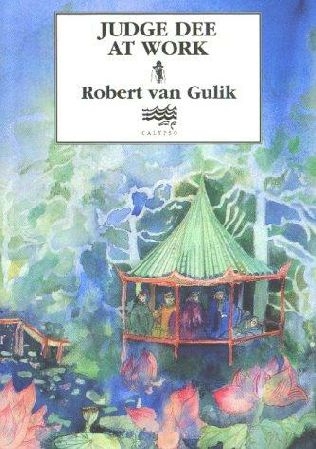
Judge Dee at Work
- Автор: ван Гулик Роберт Ханс
- Серия: Judge Dee #14
- Язык: английский
- Жанр: Другие детективы

Электронная книга - «Judge Dee at Work». Краткое содержание книги:
The eight short stories in Judge Dee at Work cover a decade during which the judge served in four different provinces of the T’ang Empire. From the suspected treason of a general in the Chinese army to the murder of a lonely poet in his garden pavilion, the cases here are among the most memorable in the Judge Dee series.
Wang paused. He bit his lips and swallowed. 'I knew then what an utter fool I had been. Shen had not dropped the handkerchief there; it was one he had ordered from her, and on which she was still working. ... I went out to look for my wife. I went to her sister's home, but nobody was there. Then I walked to Shen's shop; I wanted to pawn my jacket and buy something nice for my wife. But Shen said he owed me a string of coppers for a set of twenty handkerchiefs he had ordered from her. The last one had not been quite finished when he had looked in at our house in the afternoon, but his concubine had been very pleased with the ones he had given her. And since it was New Year's eve, he said, he would pay me anyway. I bought a package of noodles, and a paper flower for my wife, and came here.' Gazing at the judge, he burst out: 'Tell me, what has happened to her? Where is she?'
The headman guffawed. He shouted: 'What a string of stupid lies the dog is telling! The bastard hopes to gain time!' Lifting the handle of his whip, he asked the judge: 'Shall I knock his teeth in, Your Honour, to make the truth come out a bit easier?'
Judge Dee shook his head. Slowly stroking his long sidewhiskers, he looked fixedly at the drawn face of the pedlar kneeling before him. Then he ordered the headman: 'See whether he has a paper flower on him!'
The headman put his hand in the pedlar's bosom, and brought out a red paper flower. He held it up for the judge to see, then threw it disdainfully on the floor and put his foot on it.
Judge Dee rose. He walked over to the bedstead, picked up the handkerchief and looked it over carefully. Then he went to the table and stood there for a while, staring down at the dirty noodles on the piece of oil paper. The only sound heard was the heavy breathing of the kneeling man.
Suddenly the uproar of voices on the floor above burst out again. Judge Dee looked up at the ceiling. Then he turned to the headman and ordered: 'Bring those two down here!’
As soon as the pedlar saw his wife and his son, his mouth opened in astonished delight. He cried out: 'Heaven be praised, you are safe!' He would have jumped up, but the constables roughly pressed him down again.
His wife threw herself down on the floor in front of the kneeling man. She moaned, 'Forgive me, forgive me! I was such a fool, I only wanted to tease you! What have I done, what have I done! Now you have ... They will take you away and ...'
'Rise, you two!' the stern voice of the judge interrupted her. At his peremptory gesture the two constables let go of Wang's shoulders.
Take the chains off him!’ Judge Dee ordered. As the dumb-founded headman carried out this order, the judge continued to Wang, 'Tonight your foolish jealousy nearly made you lose your wife. It is your son who averted a terrible tragedy, he came to warn me just in time. Let tonight be a lesson to you — to both of you, man and wife. New Year's eve is a time to remember. To remember the blessings Heaven has bestowed on you, the gifts we are wont to take too much for granted and forget too soon. You love each other, you are in good health, and you have a fine son. That is more than many can say! Make the resolution that henceforward you shall try to prove yourselves worthy of those blessings!' Turning to the small boy, he patted him on his head and added: 'Lest you forget, I order you to change this boy's name into Ta-pao. That means "Big Treasure"!'
AS SOON AS THE PEDLAR SAW HIS WIFE AND SON ...
He signalled to his three men and went to the door.
'But ... Your Honour, that murder ...' the woman faltered.
Pausing in the open doorway, the judge said with a bleak smile: 'There was no murder. When the people upstairs had killed a pig, the tailor's wife overturned the bowl in which they had poured the blood, and she was too drunk to wipe it up at once. It leaked through the cracks in the ceiling on to the table and the floor in this room. Good-bye!'
The woman put her hand over her mouth to suppress a cry of joy. Her husband smiled a little foolishly at her, then stooped and picked up the paper flower. Having clumsily smoothed out its petals, he stepped up to her, and stuck the flower in her hair. The boy looked up at his parents, a broad smile on his small round face.
The headman had led Judge Dee's horse in front of the door. Only after the judge had jumped into the saddle did he suddenly realize that his rheumatism was gone.
The gong of the nightwatch announced midnight. Firecrackers started an uproar in the market place. As the judge urged on his horse he turned round in his saddle and called out:
'Happy New Year!'
He doubted whether the three people in the doorway had heard him. It didn't really matter.
COLOPHON
JUDGE DEE was a historical person. His full name was Dee Jen-djieh and he lived from a.d. 630 to 700. In the latter half of his career he became a Minister of State, and through his wise counsels exercised a beneficial influence on the internal and external affairs of the T'ang empire.
However, it is chiefly because of his reputation as a detector of crimes, acquired while serving as district magistrate, that his name lives on among the Chinese people. Today the Chinese still consider him their master-detective, and his name is as popular with them as that of Sherlock Holmes with us.
Although the stories told in the present volume are entirely fictional, I utilized some data from old Chinese crime literature, especially a thirteenth-century manual of jurisprudence and detection which I published ten years ago in an English translation (T'ang-yin-pi-shih, Sinica Leidensia vol. X, E. J. Brill, Leiden 1956). The final passage of 'The Murder on the Lotus Pond' was suggested by Cases 33A and B recorded in that book, and the weighing of the sarcophagus described in 'The Coffins of the Emperor' by a note added to Case 35B.
The design of the incense-clock utilized in 'Five Auspicious Clouds' I copied from the Hsiamg-yin-t'u-k'ao, a collection of such patterns published in 1878; I used the same source for the pattern of the maze in The Chinese Maze Murders.
Note that in China the surname precedes the personal name. Also that in Judge Dee's time the Chinese wore no pig-tails; that custom was imposed upon them in A.D. 1644 by the Manchu conquerors. Men did their long hair up in a top-knot, they wore caps both inside and outside the house. They didn't smoke, tobacco and opium were introduced into China only many centuries later.
Tokyo: 1967 Robert van Gulik