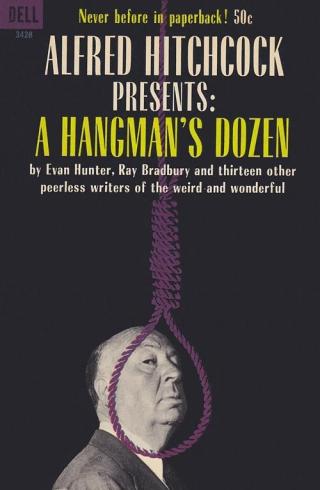
Alfred Hitchcock’s A Hangman’s Dozen
- Автор: Артур Роберт, Брэдбери Рэй Дуглас
- Год: 1962
- Язык: английский
- Год: Dell Publishing
- Жанр: Другие детективы

Электронная книга - «Alfred Hitchcock’s A Hangman’s Dozen». Краткое содержание книги:
He looked at me uncertainly. “I didn’t know you could do that.”
“You know it now. Go ahead, Sam.”
Sam was moving toward the door when the man said, “Wait a minute.”
Sam halted to look at him. We both waited.
The man said, “I wouldn’t want my wife to know about this.”
We continued to wait.
“All right,” he said with an air of resignation. “My name’s George Cooper.”
I asked, “Where do you live?”
He gave me an address on Lindell Boulevard. While I was writing it down, Sam tossed the key ring back on the table and returned to his previous spot.
I said, “Now let’s get back to the important question. Why’d you come to Homicide?”
“I told you,” Cooper said. “It was the first door I saw.”
The phone rang and Sam answered it. “Homicide. Wiggens.”
After listening a moment, he said, “Yeah, he made it. Thanks for checking.”
He hung up, glanced at Cooper, then at me. “Information desk downstairs,” he said. “Just checking up.”
“On what?” I asked.
“Fellow asked where to find Homicide. They wondered if he ever got there. They thought he might have been too drunk to find his way.”
We both looked at George Cooper, who tapped ashes from his cigarette in an elaborate pretense that he didn’t know what Sam was talking about.
I said to Sam, “See if he has a record.”
Sam went over to pick up the phone. I gazed at George Cooper steadily while Sam was giving his name and description to Records. Avoiding my eyes, the man butted his cigarette.
While waiting for Records to phone back, we continued to question Cooper, but he still refused to say why he had turned himself into Homicide instead of downstairs. When Records finally phoned back that there was no package on the man, we gave up. We decided to take him down to Central District and book him.
Rising, I said, “Okay, Cooper. Let’s go.”
“Where?” he inquired.
“Downstairs. You wanted jail, didn’t you?”
Getting to his feet, Cooper began putting his possessions back in his pockets. “Well, finally,” he said. “It’s certainly hard to get arrested around here.” Then he paused with his key ring in his hands. “It’s all right to take my things back, isn’t it?”
“For now,” Sam said. “They’ll check them for you downstairs.”
Cooper returned the rest of the items to his pockets. He emitted a relieved sigh.
“Now I won’t have to worry any more,” he said.
“About what?” I asked.
“Getting in trouble.”
“What kind of trouble?”
“You know,” he said vaguely. “I forget things when I black out. Later people tell me I’ve done things I shouldn’t.”
“Like what?” I asked.
“Oh, different things. Get belligerent, maybe. Start a fight.”
“You have a fight somewhere?”
“No, no,” he said quickly. “I was just giving an example.”
I said, “You turned in here to keep from getting in a fight?”
He pursed his lips. “Well, you might say that.”
“With who?”
“A friend of mine,” he said reluctantly.
“He got a name?”
“Henry Marks,” he said even more reluctantly. “My next-door neighbor.”
Sam asked, “You have some trouble with this Marks?”
“Not trouble,” Cooper said with a shake of his head. “He’s been hanging around my wife, is all. I just told him to stay away.”
Sam looked at me. “That name ring a bell, Sod?”
I shook my head. “Not to me.”
Sam puzzled over it for a moment then walked over to the bulletin board. After glancing it over, he nodded with satisfaction.
“Thought I’d seen it,” he announced. “On the M.P. bulletin. Henry Marks has been missing since last Friday.”
We both stared at George Cooper, who suddenly looked uncomfortable.
“You better sit back down again, Mr. Cooper,” I said. “We’ve got a lot more talking to do.”
It took us another half hour to get about half a story out of Cooper. At first he insisted he knew nothing of Henry Marks’s whereabouts. But eventually he began to change his story. He admitted having a fight with Henry Marks when he discovered him in his home. But he insisted that it hadn’t been much of a fight and that the missing man was all right when he left Cooper’s home immediately after the fight. He further insisted that the fight had taken place only the previous night. According to the M.P. report, at that time Marks had been missing three days.
I said, “Last night was Monday. You sure this fight didn’t take place Friday?”
“Of course I’m sure,” he said in a sullen voice.
“Maybe you had one of your blackouts,” Sam suggested. “Maybe you lost a couple of days.”
Cooper said, “Listen, it was last night. I was blacked out, but the fight sobered me up. When I saw what I’d done—”
He stopped abruptly and stared from one to the other of us, appalled at his slip of the tongue.
“Go on,” I said quietly.
“I mean — you see, I don’t remember the fight at all. Don’t remember coming home — anything about it. My wife had to tell me.”
“Tell you what?” I asked.
Cooper looked from me to Sam with a trapped expression on his face. He opened and closed his mouth twice before he finally got anything out.
“I may as well tell you,” he finally managed. “I meant to when I came in.”
“Go ahead,” I told him.
“I got cold feet. I meant to tell the whole thing when I came here. Then I got scared.”
Sam and I waited.
After a long pause, he said in a bare whisper, “I killed him.”
The man dropped his face in his hands. We sat watching him and after a moment he listlessly dropped his hands to his sides and sat in a dejected attitude, his head down.
“Want to tell us about it?” I inquired.
He told us then. Once he had brought himself to admit the crime, he answered everything we asked willingly, but without spirit. He said he had left his home in a mildly intoxicated condition about 8:00 p.m. the previous Friday. After a round of taverns and night clubs, he had checked into a hotel and continued drinking in his room. Saturday, Sunday and Monday were largely blank. Except for brief periods he recalled nothing until he was awakened on his front-room couch by his wife shaking him. Henry Marks lay on the floor dead, his skull crushed by a pair of fire tongs.
I said, “You remember nothing at all about the fight?”
“Just what Helen told me,” he said dully. “She saw it.”
“What’s her story?”
“I came staggering in, found Henry there and accused him of chasing Helen. One thing led to another, and finally he hit me.” He felt of his jaw. “Ought to remember that. Still hurts. But I don’t.”
“Then what happened?” I asked.
“Helen says I fell near the fireplace. When I got up, I had the tongs in my hand. I swung them and George dropped.” His voice grew tired. “That’s all there is to it.”
“Not quite,” I said. “There’s still one small item you haven’t covered. What did you do with the body?”
“Oh, that,” he said almost with indifference. “I buried him in the back yard.” After a pause, he offered, “I’ll show you right where, if you’d like.”
We told him we’d like. Booking him on suspicion of homicide, we had him checked out in our custody. Before leaving headquarters, we called the lab and asked for a technician to meet us at Cooper’s home. We suggested he bring along a pair of strong-backed rookies with shovels. Then we drove out to Cooper’s home on Lindell Boulevard.
Cooper lived right across from Forest Park, in one of the richest sections in St. Louis. He, therefore, might very well have been as socially prominent as he had claimed. His home, a two-story affair of tan brick, was set fifty feet back from the street and had about a hundred feet between it and the houses either side.