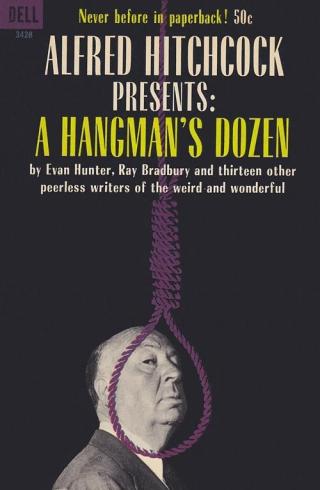
Alfred Hitchcock’s A Hangman’s Dozen
- Автор: Артур Роберт, Брэдбери Рэй Дуглас
- Год: 1962
- Язык: английский
- Год: Dell Publishing
- Жанр: Другие детективы

Электронная книга - «Alfred Hitchcock’s A Hangman’s Dozen». Краткое содержание книги:
“... so, at approximately half-past three, having finished your work at the Century Club, you were sitting on a bench at the bus stop waiting for transportation to take you home. Where do you live, Mr. Babcock?”
It was an innocent question. Henry Babcock answered without hesitation.
“In Inglewood,” he said. “I’ve got a three-room apartment.”
“And do you live alone?”
“Yes, sir. Since my wife died three years ago.”
“Since your wife died,” Arnold repeated. “My sympathies, Mr. Babcock. It must be lonely, coming home to an empty apartment.”
The prosecutor stirred uneasily. He seemed to sense some ulterior motivation behind the question. Before he could object, Henry Babcock, who sensed nothing but the discomfort of the witness box, had answered.
“Yes, sir, it is,” he said.
“But you do have friends.”
“Friends?”
“At your place of employment. I believe the Century Club employs entertainers, including several very attractive young ladies. I understand that you do little favors for them, such as bringing coffee to the dressing rooms—”
The prosecutor leaped to his feet.
“Your Honor, I object to this line of questioning. We aren’t here to ascertain the witness’s sociability, or to delve into his personal life.”
Arnold turned toward him, smiling.
“And why aren’t we?” he asked. “The witness has testified in direct contradiction to the sworn statement of my client. Obviously, one of these two men is either mistaken or an outright liar. I see nothing objectionable, in attempting to establish the character of the witness. For that matter, I see nothing objectionable — although the learned prosecutor seems to differ with me on this point — in a lonely widower bringing coffee to a ladies’ dressing room.”
There was something diabolical about Arnold in action. Naomi was beginning to realize that. In a few words, he’d turned the prosecutor into an unwitting counsel for the defense. The man sat down, chastened and confused.
Arnold turned back to Henry Babcock.
“Agnes Thompson approached the intersection from the east,” he resumed. “That means that she came from behind you, doesn’t it?”
“Yes, sir,” Babcock answered.
“Yes, because you sat on a bench parallel to a street running north and south. The bench” — Arnold referred to the blackboard again — “is on the southeast corner of the intersection. The signal, which you have testified was red when my client’s automobile struck Mrs. Thompson, is approximately ten feet north of the bench, which would have been to your right as you sat facing the street. Correct?”
Henry Babcock adjusted his glasses and leaned forward to follow Arnold’s indications on the blackboard map.
“Yes, that’s correct,” he agreed.
“And so, you were sitting on the bench, tired after the night’s work.”
“Yes, sir.”
“And alone?”
“Yes, sir.”
“Waiting for a bus to take you home to your apartment where you live alone.”
Babcock’s forehead had corrugated into a puzzled frown, but he answered.
“Yes, sir.”
“You looked at the signal, and saw that it was red.”
“Yes, sir.”
“And before it changed to green, my client’s automobile raced past the intersection, striking down Mrs. Thompson, whom you hadn’t noticed prior to the accident—” Arnold paused, as if only at that instant discovering a flaw in the testimony. “Now, that does seem strange,” he mused aloud. “You turned your head to the right and saw that the signal was red. Why didn’t you also see Mrs. Thompson preparing to step down into the cross-walk?”
There was a slight murmur in the courtroom. Arnold’s strategy was beginning to take hold.
“I don’t know,” Babcock answered. “I guess she wasn’t there yet when I looked.”
“Then you must have looked away from the light for a time.”
Babcock hesitated, sensing a trap.
“The light was red!” he insisted.
“But you didn’t see Mrs. Thompson.”
“It was dark.”
“Isn’t there a street lamp at that intersection? Think, Mr. Babcock.”
“There’s a street lamp, but it only shines so far. After that, it’s dark.”
“And yet Mrs. Thompson would have had to come into that arc of light, wouldn’t she?”
“Maybe she came too fast for me to see her. Maybe she was running.”
“Running?” Arnold caught up the word and dangled it before the ears of the court. “Now, why would she have been running, Mr. Babcock? Haven’t we already established that it was late, very late, and that she must have been weary from sitting up with a sick grandchild?”
Henry Babcock was an uncomplicated man who, very likely, had never sat in a witness box before in his life. He’d come to do his duty, and yet, by answering extemporaneously a few minor questions he hadn’t thought through, he’d gotten himself into trouble. He glanced pleadingly at the prosecutor, who was helpless at the moment, and then got himself into worse trouble.
“Maybe she was afraid.”
“But why should she have been afraid?” Arnold demanded.
“Because it was so late. It’s not safe for a woman out alone at that hour. Things happen. You read about it in the paper all the time.”
Arnold listened carefully to Henry Babcock, so carefully that he caught up the entire courtroom in his attitude and everyone listened, carefully.
“I read about it?” he echoed. “What do I read about?”
The accentuated pronoun forced Henry Babcock to a correction.
“I mean, people do,” he explained. “Anybody.”
“I think what you mean,” Arnold interpolated, “is that you read about it all the time. Now, just what do you read?”
Henry Babcock was perspiring freely. He didn’t bother to wipe his brow.
“Things that happen,” he said. “Robberies, attacks—”
“And you always read about these things, is that right, Mr. Babcock? When you’re all finished bringing coffee to the ladies’ dressing room, and cleaning up the deserted club, you go home to your apartment, alone, and read about terrible things that happen to women who go out on the streets at night—”
Arnold’s voice was an instrument played with professional skill. It was impossible not to be drawn along with it. But he got no farther before the prosecutor was on his feet shouting an objection. Arnold smiled at him with an expression of tolerant patience, and only Naomi understood what was happening. The innocent must always be made to appear guilty. This was Arnold’s secret of success.
“... I don’t want a scene, Naomi. This woman need never have come between us if you hadn’t insisted on a showdown. I’m not planning to divorce you, or to allow you to divorce me. I can’t afford a scandal, and you have the children to consider even if my career means nothing to you...”
The innocent must always be made to appear guilty.
“Your Honor,” Arnold continued, with mock humility, “I’m deeply sorry if my remarks have caused prejudice in the minds of the jury. It wasn’t my intention to infer that the witness has socially undesirable tendencies. Nevertheless, I’m still curious as to how he could have turned his head to observe the traffic signal and not have seen a woman about to step out into the crosswalk. If he was tired, he might have been dozing; but then, he wouldn’t have seen the signal. If, however, he was alert enough to notice the signal, why didn’t he see Mrs. Thompson?”
With these words, Arnold swung back to Henry Babcock.
“Or did you see her, Mr. Babcock?”
Henry Babcock drew back in the box.
“No,” he said.
“Are you sure, Mr. Babcock? A few moments ago you were positive that you didn’t see her; a few moments later you thought that you might have heard her. Now you can’t seem to explain why you didn’t see her. Isn’t it possible that you did see her? That perhaps you spoke to her?”