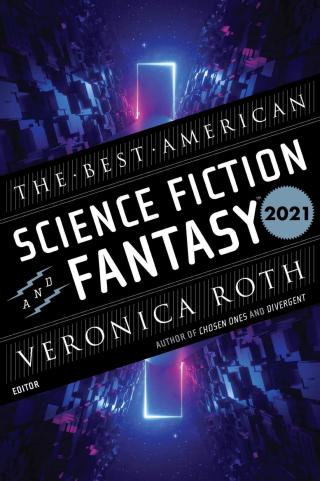
The Best American Science Fiction and Fantasy 2021
- Автор: Рот Вероника, Адамс Джон Джозеф
- Год: 2021
- Язык: английский
- Год: HMH Books : Mariner
- ISBN: 9780358470076
- Жанр: Малые литературные формы прозы

Электронная книга - «The Best American Science Fiction and Fantasy 2021». Краткое содержание книги:
This year’s selection of science fiction and fantasy stories, chosen by series editor John Joseph Adams and bestselling author of the Divergent series Veronica Roth, showcases a crop of authors that are willing to experiment and tantalize readers with new takes on classic themes and by exchanging the ordinary for the avant-garde. Folktales and lore come alive, the dead rise, the depths of space are traversed, and magic threads itself through singular moments of love and loss, illuminating the circulatory nature of life, death, the in-between, and the hereafter.
The Best American Science Fiction and Fantasy 2021 captures the all-too-real cataclysm of human nature, claiming its place in the series with compelling prose, lyrical composition, and curiosity’s never-ending pursuit of discovering the unknown.
PERKINS: Except, you couldn’t tell anyone at the office why you had to take a sabbatical to do it.
DISANTO: Because it was [air quotes] top secret. But, yeah, I got brought in because whatever was being worked on needed to be founded on solid legal footing. Now, granted, I hadn’t taken a peek at the Constitution since 1L, so I wasn’t nearly the most qualified on that count, but Richie and I go back. What was it, that mixer they had all the students of color go to that one summer?
PERKINS: Yeah, the POC mixer. What were you even doing there? Your parents are from fucking Argentina.
DISANTO [laughing]: Anyway, all I know when I say yes is that there’s some social justice thing going on and there are scientists involved or whatever. Now, get this. I tell him, I tell Richie: “I hate fucking math. Don’t make me do math.” And he tells me, “Don’t worry, I won’t make you do any math.” [Pause] I did so much fucking math.
They both burst out into laughter. But they turn away from each other to keep from spreading droplets.
Open on a darkened room. Cloaked in shadows. Against the far wall, the silhouette of a potted plant. The leaves are moving. There is an overhead fan at work. A dark shape sits in an armchair.
REDACTED, AGE 28, DATA SCIENTIST, MEMBER OF REPAIR PROJECT TEAM: I mean, it’s kind of simplistic to call it the Reparations Algorithm, which is what everyone called it after the story blew up—because, of course. If you had an AI built to detect which moles on a body were evidence of malignant cancer cells, you wouldn’t call that the Cancer Algorithm, would you? Okay, maybe you would. Bad example. But people think it’s just like you have this static E=mc2-type equation and you throw as much information at it as possible so that it, like, learns or whatever, then it spits out some intelligent decision. So they hear about the Reparations Algorithm and they immediately think, oh of course, a formula for figuring out reparations! Then they ask, well, what did you feed the formula? And then they expect you to say something like “racism. We fed the formula four hundred-plus years of racism.” Like it’s that simple. There’s nothing simple about racism.
VOICE OF WENDY GUAN, AGE 27, STATISTICIAN, MEMBER OF REPAIR PROJECT TEAM: I don’t know if I joined the project at a late stage or early on, but I do know that our viability was tied directly to the release of funds resulting from the abolition of the city police department. During my interview, they were very vague about what exactly I would be doing, and they kept emphasizing the project’s interdisciplinary nature. I think if they’d been a bit more forthcoming, I might’ve been too excited to be coherent. There was a real sea change happening throughout the country. Every industry, every locale, was experiencing a reckoning. I even saw in my own community the new ways in which anti-Blackness was being discussed and reckoned with. So to have the chance to be on the forefront of this new effort, this pilot project, and hopefully provide an example of what truly restorative justice looks like, I mean, who majors in statistics and expects to wind up there? Should we have expected what happened after? Maybe. But you have to understand the moment. It felt unprecedented. And, to be honest, I wouldn’t take any of it back.
On a porch of a two-story house in the _____ suburb, northwest of _____, there are two rocking chairs that allow their occupants to look out over a recently manicured lawn. Flanking the porch are plots of recently turned dirt and the beginnings of a garden.
BILLY [LAST NAME WITHHELD], 52, NURSE: Where’d that money come from? Came from us cops. That’s where it came from. They abolished the fucking police department, fired everybody. No job assistance, no more pension, nothing. The whole fucking thing was drained dry. And our union. Strength in numbers, right? It’s all bullshit. Once the protests started, it was open season on us. Get this, you know those robot dogs that company out of Boston was making? You remember those, right? Well, they were gonna start mass-producing them to replace us. Fake dogs. Union didn’t have any pull because those tech wizards were already angling for our jobs on the cheap and we lost all our bargaining power. And the way the defunding was set up, it was reverse seniority, so the younger, more diverse force got clipped first. Then when it was all us white devils left, we were easy pickings, far as the court of public opinion was concerned. I’m just over fifty. Spent my life on the force. What the hell am I gonna do with the time I got left? Far as work, things had dried up, but with the virus, folks in hospitals were droppin’ like flies. So I decided that was where I could help. Had to go to nursing school and everything. Paid out the ass to sit in a classroom with fuckin’ kids my daughter’s age. [Laughs.] But I did it. Got my degree, got my license. Now, I push a cart in a hospital. Social justice, right? I hope it’s fuckin’ bedlam over there without us.
On the corner of Willow and Main Street stand a group of antiviolence activists handing out cards listing candidates for an upcoming municipal election. On the back of each is a Know Your Rights checklist. Down Willow, grill smoke billows out from behind a church while older residents eat fried fish by the front entrance. Shaneika Thomas wears a mask with a clear mouth panel to enable the hard of hearing to lip-read.
SHANEIKA THOMAS, AGE 27, CRISIS MANAGEMENT SYSTEMS WORKER: This corner, right here? We used to practically sit on top of cops basically. Plainclothes cops would yoke up some kids here or across the street, and folks would get it on video. It would go viral, and we’d get on the cop’s ass. But then he’d be back out as a white-shirt, terrorizing folks. You walk around this community and you have credibility just from having been here for long enough and from people seeing your face, so you can walk up to a group of dudes and be like, hey, “if you’re out here, and he’s out here”—meaning the cop—“call this number.”
Two mechanical, jet-black greyhounds with backward-jointed legs prance down the middle of the street. At each stop, they gather the nearest residents and eject thermometers that the residents use to take their temperatures. Some of the residents glance at their results. Another shakes the thermometer as if it’s broken before trying again. Afterward, they all deposit the thermometers, coated in their saliva and DNA, into an attached pouch and drop the contained thermometer into an opening on the greyhounds’ backs.
When the REPAIR Act went into effect, we got an infusion of cash because of where we were headquartered. But we weren’t ready for that. We weren’t nearly ready for that. All of a sudden, money was showing up, and people just figured it was City Hall redistributing what got freed up when they abolished the police department. At some point, I started doing the math and I realized, as big as the PD’s budget was, this was more money than that. But we didn’t have too much time to think on where exactly this money came from. We just knew that we got lucky and we had work to do.
Of course, it didn’t last, but I’m pretty proud of what we were able to do with what we had. I just wish some of that money went toward painting those dogs a different fucking color.
Inside a Dunkin’ Donuts on the corner of Arcade Street and Pine Street. Just outside the entrance is a waste bin and, above it, a one-time-use mask dispenser. At the top of the doorframe is a scanner, taking note of the biorhythms and temperature of each entering and exiting customer.
DENAUN SMITH, AGE 63, RESIDENT OF _____: Hell, I couldn’t believe it. At first, we didn’t know what the fuck was going on. But suddenly, they announce that [Redacted] High’s getting what?! Millions of dollars just pouring in. Where did that money come from? How can I get a piece of it?