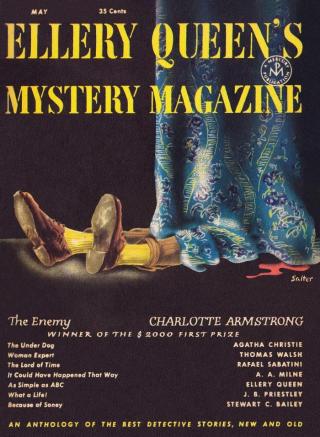
Ellery Queen’s Mystery Magazine. Vol. 17, No. 90, May 1951
- Автор: Кристи Агата, Куин (Квин) Эллери
- Год: 1951
- Язык: английский
- Год: Mercury Publications
- Жанр: Другие детективы

Электронная книга - «Ellery Queen’s Mystery Magazine. Vol. 17, No. 90, May 1951». Краткое содержание книги:
Suddenly, Mr. Cronk knew what he must do. Setting his teeth, and nerving himself to the horrid deed, he flung his weight backwards. The chair swayed, hung precariously on a dead centre, and toppled over with a reverberating crash. Mr. Cronk saw some more constellations, followed by complete darkness.
When he came to, he was lying on the floor. His bonds and the gag were gone, and he was being contemplated with interest by a young man in flowing white draperies and a halo.
“Wh-what are you?” gasped Mr. Cronk, horrified.
“I’m an archangel,” said the young man. “What are you?”
But Mr. Cronk only closed his eyes.
“Here — I say — hold up!” said the archangel. He raised his voice. “Hurry up with that water, Joyce!”
“In a minute,” said a pleasant contralto from outside. “I’ve found two more in the bedroom.”
“Good God!” said the archangel. And though it was more or less the kind of thing a real archangel might be expected to say, there was something unarchangelic in the tone. Mr. Cronk decided that he was not dead after all, and opened his eyes.
“Here they are,” said the rich contralto. And a young woman in the robes of ancient Greece entered, ushering Philip and Pat, both looking exhausted and bedraggled.
Astonishment gave Mr. Cronk his tongue.
“Aren’t you — aren’t you robbing the hotel?” he asked.
Philip in his turn looked amazed.
“Why should we?”
“I thought you were,” explained Mr. Cronk weakly.
“Well, we weren’t.”
“Excuse me,” said the archangel politely. “But do you mind telling me what you were doing? My name’s Leconbridge, by the way. The little bit of old Greece is my wife. It’s our house.”
Mr. Cronk gave another groan. Events were moving too fast for him in his half-dazed condition.
Lord Leconbridge looked from Pat to Philip.
“We’re having a honeymoon,” said Philip doggedly.
“What — all of you?”
“No — us,” said Pat, with an explanatory gesture. She addressed herself to Lady Leconbridge. “I know it’s awful, and you can put us in prison if you like. But we knew the house was empty, and we’ve been awfully careful of your things.”
“But why did you do it?” asked his wife.
“Partly economy. Partly for fun. We couldn’t afford to stay at the hotel more than a week, and we didn’t want to be branded everywhere as newly-married. And besides,” continued Pat, taking heart of grace from the fact that the Leconbridges seemed interested rather than angry, “I wanted a chance to get used to my funny name.”
“Meaning?”
“It’s Palk, you see. Pat Palk. Mrs. Philip Palk. It’s a fine old family, and all that. But I didn’t want to have to spend my time while I was new to it, and all self-conscious, explaining to people that it isn’t spelt P-O-R-K.”
Lady Leconbridge gurgled suddenly.
“Palk?” she said. “Then haven’t we been staying with your aunt?”
“Yes,” said Philip simply. “That’s how we knew your house was empty.”
“And him?” The archangel indicated Mr. Cronk, who had lapsed into a sort of coma.
“Oh, that’s Mr. Cronk, the famous detective.”
“That?”
“Yes. You know. The man who found out that smuggling business.”
“Good Lord! Who’d have thought it? And who tied you up?”
“I don’t know. Some men. Hotel robbers, it looks like. Ask him.”
But no sense could for the moment be got out of Mr. Cronk. When asked who had attacked him, he shook his head.
“Nobody,” he groaned. “I don’t know. It’s all a mistake.”
They looked at each other in perplexity.
“One thing’s clear,” said Lord Leconbridge at last. “There’s some funny business planned for this ball, and I must get across at once and stop it if I can. Got anything on worth stealing, Joyce?”
“No, darling.”
“Then come on.”
“I say — you must take us,” implored Pat.
“But you aren’t dressed.”
“It won’t take us a minute. I’m Cinderella and he’s a sort of student.”
“Well, hurry up. And we ought to take old what’s-his-name, in case he’s fit to give evidence. Isn’t there a fancy dress that’ll do for him?”
“There’s your old Pierrot kit, Freddy. It’s put away on the top of my wardrobe,” said Lady Leconbridge. “Come along, Mr. Cronk.”
She went out. And Mr. Cronk, still too dazed to protest, followed her.
Mr. Cronk had seldom felt less gay than when he followed the other members of his party down the passage leading to the Hotel Splendide’s magnificent ballroom.
He was still half dazed, and his head ached dismally. He was wearing fancy dress for the first time in his life, and it did not fit him. And somewhere at the back of his mind was the dull conviction that he had just made a fool of himself, and was now going to be forced into doing so again in public.
Just outside the ballroom these mixed feelings culminated in a wave of actual physical nausea. Mr. Cronk dropped into a chair and put his head into his hands. Consequently, he did not see his companions pause in astonishment at the doorway, nor hear Lord Leconbridge’s exclamation:
“Good Lord! The police! We’re too late.”
For the dance was in a state of suspended animation. Gendarmes were on guard at the doors. The dancers, with their masks off, were standing about in groups.
Two groups caught Lord Leconbridge’s eye. In one, which consisted of the famous Mrs. Harrison and her gilded following, half a dozen millionairesses were holding an agitated census of their own and each other’s jewelry. The other group contained no face that he knew, but was noticeable because of the odd assortment of people that it contained. Some were in fancy dress, some in ordinary clothes. One wore a green baize apron, and one the resplendent uniform of a hall-porter. And suddenly he noticed that the members of this group were all handcuffed together in pairs.
“I wonder if the thieves got away?” said the clear, resonant voice of Pat, on whom the handcuffs had not yet made an impression.
At the words a little Frenchman — the spade-bearded kind — swung round and came towards them.
“Who are you?” he said sharply. “And what you know of t’ieves, yes?”
Obeying his gesture the party unmasked. The Frenchman glanced at them with suspicion, and addressed himself to the leader.
“You tell, please, yes?”
“I am Lord Leconbridge, I have just found an English detective, Mr. Cronk, gagged and bound in my villa.”
The Frenchman’s face showed lively concern.
“Is he blest, the good Cronk?”
“Blest?” repeated Lady Leconbridge.
“Blessé — hurt!” her husband translated in a swift undertone. “Yes, monsieur. He is a little blest in the head. But he’ll be all right.”
The Frenchman bowed.
“I am glad,” he said formally, then suddenly burst into enthusiastic speech. “Ah! But ’e is clevaire, zis Cronk! Figure yourself, Mister, I am pretend to be one of ze robbaires. Zey tell me zat ze so famous Cronk is what you call on ze job. I tip ’im ze vink and make a sign when we meet, but ’e look along ze nose, and I t’ink ’e not understand. Like all ze English, ’e pretend to be more stupider zan ’e is not. But ’e understand ver’ well. ’E make ze mystere. ’E make it zat zese bandits zey give attention to ’im, and leave me to make my little plans. I salute Cronk, me. ’E ’as dragged across my traces what you call ze crimson kipper!”
“I don’t,” murmured Philip Palk. “But I always will in future.”
“Et voila — I capture ze lot.”