The Russian challenge and the year 2000
- Автор: Янов Александр Львович
- Год: 1987
- Язык: русский
- Жанр: История

Электронная книга - «The Russian challenge and the year 2000». Краткое содержание книги:
' here is no doubt that the generation which replaced the one to whose lot it fell to live under the quarter-century terroristic dictatorship of Ivan the Terrible came to power with 'new expectations and experiences' and was 'more educated and competent' than its predecessors. It too truly did make an effort to reform the Russian political system, just as Khrushchev's generation tried to. Yet it was defeated, and the generation which succeeded it, still more educated and competent one must assume, none the less landed the country in a political quagmire, as did Brezhnev's generation The same scenario was almost totally re-enacted after the generation that lived under the dictatorship of Peter the Great,14 and after Paul I and Nicholas I, This pattern has continued to operate right up until the end of Stalin's dictators!: p — and beyond.
Hence, we would seem to be dealing with a model of political change n Russia that includes two further patterns. According to one of them, generational change does not influence the archetypc of this change. Accord ig to the second, the political history of Russia over the last eighteen to twenty generations has in effect been a story of faded and reversed reforms. Each of these either gave way to political stagnation or provoked a terroristic counter-reform. Even if everything else did in fact radically alter in Russia with the change of generations, the patterns of political change did not — either before or after the Revolution. That is the answer to the first argument of liberal sovietology.
An ahistorical approach
We recall that, according to the second liberal argument, Russia must gradually liberalize because of the imperative of economic modernization and the growing complexity of administering its economic system. The most optimistic representalivc of liberal sov otology, Jerry Hough, devoted a sigi ''.cant portion of his textbook, How the Soviet Union is Governed, wrnten during the Brezhnev era to offering evidence that Russia was taking serious steps in the ( reciion of liberalization.15 Unfortunately, the most cursory glance at Russian economic history is enough to convince us that such opumism is groundless. Over the course of the 400 years that separate Ivan the Terrible's terror from Josef Stalin's, the complexity of administering Russia's economic system ncreased without interruption — yet с d not lead to political modernization. Among the nations of Europe, Russia alone underwent three consecutive and tortuous attempts at industrialization and economic modernization — under Peter I, Alexander III and Stalin. According to the classic textbook on European economic history, Russia after the first of its modernizations, was economically the most advanced country ш eighteenth-century Europe.16 This, however, did not preclude the counter-reforms of Paul I or Nicholas I from again steering her into an era of historical and economic decline.
Hough would have had far greater grounds for optimism had he been a contemporary of Sharapov in 1901, after Russia's second economic modernization (although Sharapov, of course, himself drew very different conclusions.) Even so, the second birth of heavy industry in Russia in the 1880s and '90s did not by any means bring liberalization, but rather two cruel counter-reforms which landed the country in a new era of historical and economic decline, ' hus, it would seem that the inability of economic modernization to .nfluence the archetype of political change in Russia is another of the fundamental patterns of her political behaviour.
Our analysis of the arguments of liberal sovietology therefore leads us to the same conclusion as our analysis of the conservatives' theses in America's Soviet debate that the argument lacks an historical dimension To put it more precisely, the novelty of the Soviet political phenomenon causes it to lose sight of all earlier Russian history as a source of information for judging Russia's present-day political potentialities. Liberal sovietology has deprived itself of the opportunity to register the long-established patterns of Russia's past political behaviour and cannot therefore offer a prognosis for her behaviour in the future. This is how the metaphor of the black box would seem to have arisen.
A new crisis
For these reasons, participants 11 the Western debate are helpless when it comes to explaining the phenomenon of the Russian Idea's rebirth in the 1960s While conservatives are inclined to view it as an alternative to Communism, liberals tend to neglect it as irrelevant to Russia's political future. For conservatives, it offers a solution to the fateful question: what would happen to Russia (and the world) if cheir policies were successful and the Soviet government fell? Liberals, on the other hand, cannot take the Russian Idea seriously because its very existence contradicts their postulate about the 'nevitabil'ty of Russia's gradual liberalization.
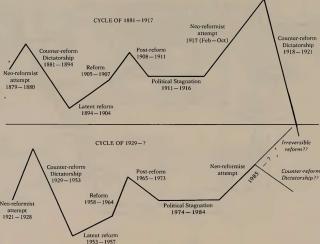
Suppose at the turn of the century America s Russian debate had been where it is now, would either conservatives or 1 berals of the nine have believed that Russian tsarism s calamity would turn out to be Russian Marxism's triumph? For the same reasons they cannot beheve in Dunlop's scenario today, with ;ts threat of transforming Russian Marxism's catastrophe into Russian fascism's tnumph Neither the ideological approach of conservatives nor the liberate' geopolitical one can foresee and explain such a turn of events. It could, perhaps, be explained by conceiving of the Russian political dynamic, over the whole length of Russia's imperial existence, as a series of histoncal disasters. I call them counter-reforms; others may refer to them differently. But no matter what we call them, Dunlop's scenario would be quite at home within such a concept (just as the metamorphosis of Russian tsarism into a Marxist state would be). And this is by no means the only problem that cannot be solved by e-.rher of the two approaches that dominate the Western debate on how to deal w h Russia. They cannot, for example, explain the reason for the — at first glance totally unexpected — renaissance of the Russian Idea in the Communist USSR. Only a concept of periodic imperial decline (as clearly seen on Figure 1), which no economic modernization or genera .onal change can avert and which renders Russia particularly susceptible to counter-reform, is capable of explaining this rebirth, as a sympiom of new decline.
Why has Russia proved to be the sole country in Europe where, over the course of centui es, not one reformist attempt (and among these were some truly great reforms) has led to political modernization? Why have all Russ an reforms, without exception, been sooner or later reversed? Why was Russia the sole coni nental empire in Europe to remain intact after World War I, when all the others fell apart? Why, after World War II, when all the colonial empires in the world disintegrated, did Russia agЈ n prove to be the sole exception? How do the ideological or geopolitical approaches respond to these questions? They do not. These questions, central to an understanding of the Russian ponbcal system, it would seem, do not figure in the Western debate at all. Only Russian po tical history that poses these questions can answer them — if properly asked. Its answer puts the Russian challenge of the twen 'eth century into a grim and frightful relief.