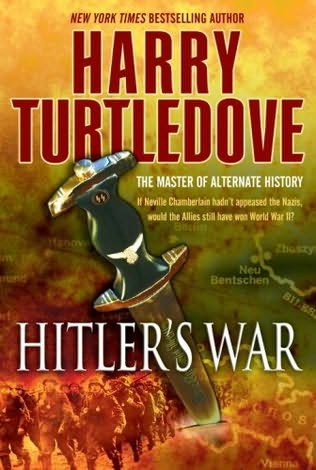
Hitler's war
- Автор: Тертлдав Гарри Норман
- Серия: The War that came early #1
- Язык: английский
- Жанр: Альтернативная история

Электронная книга - «Hitler's war». Краткое содержание книги:
Now, in this thrilling, provocative, and fascinating alternate history by Harry Turtledove, another scenario is played out: What if Chamberlain had not signed the accord? What if Hitler had acted rashly, before his army was ready-would such impatience have helped him or doomed him faster? Here is an action-packed, blow-by-blow chronicle of the war that might have been-and the repercussions that might have echoed through history-had Hitler reached too far, too soon, and too fast.
Turtledove uses dozens of points of view to tell this story: from American marines serving in Japanese-occupied China to members of a Jewish German family with a proud history of war service to their nation, from ragtag volunteers fighting in the Abraham Lincoln Battalion in Spain to an American woman desperately trying to escape Nazi-occupied territory-and witnessing the war from within the belly of the beast.
A novel that reveals the human face of war while simultaneously riding the twists and turns that make up the great acts of history, Hitler's War is the beginning of an exciting new alternate history saga. Here is a tale of powerful leaders and ordinary people, of spies, soldiers, and traitors, of the shifting alliances that draw some together while tearing others apart. At once authoritative, brilliantly imaginative, and hugely entertaining, Hitler's War captures the beginning of a very different World War II-with a very different fate for our world today.
But the armored forces and machine-gun units in the Condor Legion had never got a name for cutting and running, the way the Italians had. Maybe courage wasn’t what kept them in the field. Maybe it was just professional self-respect. Whatever it was, you had to admire it. This might not have been the Germans’ fight, but they performed as if it were.
Now the Germans in Spain had the same enemies as the ones back in Germany: Communists, freethinkers, republicans, liberals of every stripe. And they, and the Italians, and Marshal Sanjurjo, were doing everything they could to crush the enemy here before the aid flooding in from France and England let the Red Republic seize the initiative.
Those Italian tanks kept rattling forward. Vinaroz, on the eastern coast, lay a few kilometers to the north. Sanjurjo’s men had already taken the town once, when they cut the Republic in half. Now an enemy drive down from Catalonia, one backed by French armor and aircraft, had recaptured it.
“What do you think?” Delgadillo asked his sergeant. “Can we get it back?”
Miguel Carrasquel shrugged. “That’s what our orders are,” he answered, which meant, We’ll keep trying till we’re all dead, or till the orders change-and don’t expect the orders to change. Carrasquel had bad teeth and was missing half his left ear. His grin, then, looked most unpleasant. “What’s the matter, Prettyboy? Don’t want to get messed up?”
Joaquin didn’t think he was especially handsome. But the sergeant called anybody who hadn’t been wounded Prettyboy. You didn’t want to get mad about it. Carrasquel was a good man with a knife.
Machine-gun bullets spanged off the Italian tanks and tankettes. The commanders in the impressive black coveralls ducked down behind the shelter of their armor. One or two of them waited too long, and got hit before they could. The armored fighting vehicles clattered forward anyhow. Joaquin nodded to himself. He didn’t mind people ducking when the enemy shot at them. He did it himself-who didn’t? As long as you carried on regardless, you earned your pay.
Tanks were magnets for machine-gun fire. He’d seen that before. Fewer bullets fought the Nationalist foot soldiers who loped along with the mechanical monsters. Since Joaquin was one of those soldiers, he approved of that. One bullet hitting you was one too many.
Most of the men up ahead didn’t wear uniforms at alclass="underline" not what he thought of as uniforms, anyhow. They had on overalls instead, as if they were factory workers. That made them Catalan Communists or anarchists. Up till the war started, they had been factory workers. The ones still alive after two and a half years of fighting knew their business as well as any other veterans.
Clang! That cry of metal against tortured metal wasn’t a machine-gun bullet. That was an AP shell from a cannon striking home. Sure as the devil, a tankette came to an abrupt halt. Smoke and then fire poured from it. Ammunition inside started cooking off. Joaquin didn’t think either Italian got out.
“Tanks!” Somebody pointed ahead. The man’s voice wasn’t panicked, but it wasn’t far removed, either. More often than not, the Nationalists had had tanks and the Republicans hadn’t. With aid flooding over the Pyrenees from France, the miserable Reds were getting more of their own.
These machines were French, all right. By the look of them, they’d been around since the last war. But they had turrets and treads and cannon and enough steel to keep out small-arms fire. If they weren’t exactly swift…well, so what?
One of them fired at an Italian tank. Clang! There was that horrible bell-like sound again. The Italian machine’s armor wasn’t thick enough to hold out an armor-piercing round. Somebody got out of an escape hatch in the turret before the tank brewed up. It didn’t do him much good-a burst from a machine gun cut him down before he’d run ten meters.
Tanks on both sides stopped to fire at foes, then got moving again to make themselves harder to hit. The Italian tankettes kept on moving and shooting. They mounted only machine guns, and weren’t dangerous to real tanks. They could do horrible things to infantry, though.
As the tanks slowed, so did the rest of the Nationalist advance. Joaquin flopped onto his belly behind a pile of rubble that had been a stone barn. Every so often, he rose up enough to fire. Then he crawled somewhere else before squeezing off another round. No sniper would draw an easy bead on him. Veterans learned things like that. The guys who didn’t…didn’t get to be veterans.
Sergeant Carrasquel crouched behind a fence not far away. Delgadillo waited for the sergeant to order him forward again. But the squad leader stayed where he was, firing every now and then. He kept his mouth shut. Maybe he’d decided the attack wouldn’t get much farther no matter what.
Joaquin Delgadillo sure felt that way. The Republicans had been tough even while outnumbered and outgunned. This push, plainly, aimed to take back as much as possible from them while they still were.
It also seemed designed to get a lot of Nationalist soldiers killed. Mortar bombs started whispering down around Joaquin and Sergeant Carrasquel. Both men dug like moles. Joaquin hated mortars. The Republicans had been using a Russian model for a long time. Now they also had French tubes, and those were just as good or maybe even better.
Somebody yowled like a wildcat, which meant a jagged steel fragment had bitten him. Joaquin hoped it was no one he knew. You always hated to hear a buddy get it. That reminded you how easily you might stop something yourself.
“Ave Maria,” Joaquin whispered. As he went through the Hail Mary in Latin, his left hand found the rosary in his tunic pocket. Keep me safe, he thought. Let Marshal Sanjurjo win, but please, God, keep me safe.
* * *
The North Sea in November was nowhere a skipper wanted to go. It was even less pleasant in a U-boat than it would have been in a larger surface warship. Lieutenant Julius Lemp guided U-30 north and east. He had to get around the British Isles to take up his assigned position in the mid-Atlantic.
He liked everything about his boat except the way it rolled and pitched in the heavy seas. Type VII U-boats made everything that had come before them seem like children’s toys by comparison. They had outstanding range. They could make seventeen knots on the surface and eight submerged, and could go eighteen hours at four knots underwater.
During the last war, the British mined the northern reaches of the North Sea, trying to bottle up the U-boats. With hundreds and hundreds of kilometers between Scotland and Norway, they couldn’t sew things up tight there the way they did in the Channel. But they could make life difficult, and they did.
They were supposed to be trying the same thing this time around. Lemp had orders to sink any minelayers he spotted. Odds against spying any were long: it was a big ocean, and he couldn’t see very much of it, even with the Zeiss binoculars hanging around his neck. But his superiors were thorough. They wouldn’t have got those wide gold stripes on their sleeves if they weren’t.
Gray clouds scudded low overhead, driven by a strong west wind. In clear weather, Lemp would have scanned sky as well as sea with his binoculars. One thing had changed from the last war: airplanes were much more dangerous than they had been. They could carry bigger bombs, and carry them farther. And they all had radio sets, so they could guide enemy warships to a U-boat’s path.
In this weather, though, a plane would have a devil of a time spotting the U-30. Lemp thought a pilot would have to be nuts even to take off, but he also thought pilots were nuts. Maybe it evened out.
About the most interesting thing he saw on his watch was a puffin that landed on the conning tower for a moment. With its plump, dignified body and the big beak in bright crayon colors, the bird looked as if a talented but strange child had drawn it. It also looked confused, as if wondering how this convenient little island had popped up in the middle of the sea. Then it noticed Julius Lemp-and then it was flying away again, as fast as it could.