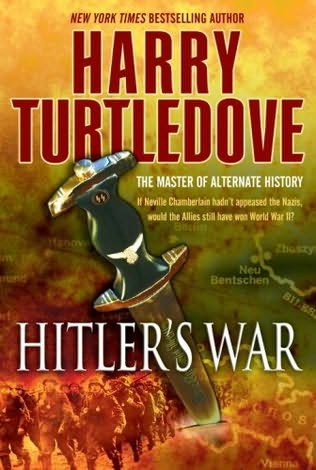
Hitler's war
- Автор: Тертлдав Гарри Норман
- Серия: The War that came early #1
- Язык: английский
- Жанр: Альтернативная история

Электронная книга - «Hitler's war». Краткое содержание книги:
Now, in this thrilling, provocative, and fascinating alternate history by Harry Turtledove, another scenario is played out: What if Chamberlain had not signed the accord? What if Hitler had acted rashly, before his army was ready-would such impatience have helped him or doomed him faster? Here is an action-packed, blow-by-blow chronicle of the war that might have been-and the repercussions that might have echoed through history-had Hitler reached too far, too soon, and too fast.
Turtledove uses dozens of points of view to tell this story: from American marines serving in Japanese-occupied China to members of a Jewish German family with a proud history of war service to their nation, from ragtag volunteers fighting in the Abraham Lincoln Battalion in Spain to an American woman desperately trying to escape Nazi-occupied territory-and witnessing the war from within the belly of the beast.
A novel that reveals the human face of war while simultaneously riding the twists and turns that make up the great acts of history, Hitler's War is the beginning of an exciting new alternate history saga. Here is a tale of powerful leaders and ordinary people, of spies, soldiers, and traitors, of the shifting alliances that draw some together while tearing others apart. At once authoritative, brilliantly imaginative, and hugely entertaining, Hitler's War captures the beginning of a very different World War II-with a very different fate for our world today.
Ever since 1933, though, Jews had had to take whatever scraps of comfort and pleasure they could find. Even a soccer match on a horrible excuse for a pitch was better than none. It gave people an excuse to get out of the house, an excuse to get together and see one another and gab.
Yes, a couple of policemen were also watching the game and the little crowd in the stands. What could you do about that? Nothing, as Sarah knew too well. If you were a Jew in the Reich, somebody was going to keep an eye on you.
She leaned over to her father and asked, “What do they think we’re going to do? Roll up the chalk lines and carry them home in our handbags and pockets?”
Samuel Goldman shrugged. “Maybe they do. Maybe they think we can turn the lines into bombs or something, and use them to blow up NSDAP headquarters.”
“Would you blow up Nazi headquarters if you could?” Sarah asked.
“Of course not!” Father’s reply was too loud and too quick. “The National Socialists have done wonderful things for the Reich. They’ve made Germany wake up.” Deutschland erwache! was a favorite Nazi slogan.
As Father spoke, his eyes told Sarah she’d been foolish. After a moment’s thought, she knew just how, too. Father couldn’t hope to give her a straight answer, not where anyone else could hear him talking. Yes, the only people in earshot were other Jews. But did that mean they wouldn’t betray one of their own? Fat chance, Sarah thought bitterly. If ratting on fellow Jews would give them a moment’s advantage, plenty of people would do it in a heartbeat.
Sarah hoped she would never stoop to anything as vile as that. She hoped so, yes, but she admitted to herself that she wasn’t sure. Times kept getting harder and harder. If not for Father’s gentile friends who gave him articles to write, she didn’t know what the family would have done.
Mercifully, the match ended. The teams lined up and shook hands with each other. Players tousled one another’s sweaty hair. The goalkeeper on the other side mimed chipping the ball the way Saul had, then threw up his hands in mock-or maybe not mock-despair.
The sparse crowd came down onto the pitch. Practically everybody there was related to one player or another. “You were great, Saul!” Sarah made herself sound enthusiastic, even if she knew her brother wouldn’t be.
And he wasn’t. “Big deal,” he said. “These guys try, but I feel like a grown-up playing against kindergarten kids.” He sighed. “Any soccer is better than none-I guess.” He didn’t sound sure; not even close.
“If the Foresters would let you come back-” Sarah began.
Saul cut her off with a sharp, chopping motion of his right hand. “The Foresters would. They’d take me back like that.” He snapped his fingers. “But if the SS says no…What are you going to do?” His wave took in the sorry excuse for a pitch, the fumbling opponents, and the paltry crowd. “You’re going to play in matches like this-for as long as they let you, anyhow.”
“Why would they stop you?” Sarah asked.
“Why?” Her brother snorted. “I’ll tell you why. They’re liable to realize we’re having fun in spite of everything, that’s why. And if they do-” Saul made that chopping motion again.
“Oh.” Sarah left it right there. Saul’s words had a horrible feeling of probability to them. The Nazis ruined things for Jews just to be ruining them. That was how they had fun. And since they had the Gestapo and the ordinary police and the Wehrmacht on their side, they could have fun any way they wanted.
One of Saul’s teammates called to him. The older man thumped the hero of the match on the back and handed him a bottle of beer. Saul swigged from it. He made a face. “Even the beer’s gone downhill since the war started,” he said. “It tastes like…lousy beer.”
What did he almost say? Horse piss? Goebbels piss? Whatever it was, it didn’t come out. As Father had driven home to them again and again, you couldn’t get in trouble for what you didn’t say. Nobody could inform on you for what you were thinking. That might save your life.
Or it might not. If the Nazis decided to do something to the Jews, or to a particular Jew, they’d just go ahead and do it. They didn’t need any excuses, the way they would have in a country where laws counted for more than the Fuhrer ’ s will. On the other hand, if a Jew was dumb enough to give them an excuse, they’d grab it in a heartbeat.
Sarah often wondered what she would do if Hitler or Himmler or Goring or Heydrich or one of those people came to Munster. If she had a chance…If she had a rifle…If she knew how to use a rifle…If pigs had wings…
Even if she did exactly what she dreamt of doing, what kind of revenge would the Nazis take? Would more than three or four Jews be left alive in the Reich a day after a Jewish girl shot somebody like that? Odds were against it. Too bad. The whole folk were a hostage.
In small groups, people started walking off toward their houses. No bus or trolley line ran close to this pitch-what a surprise! Buses had almost disappeared since the war started anyhow; whatever fuel Germany had went to the Wehrmacht and the Luftwaffe and the Kriegsmarine. The only private cars that still got gasoline belonged to doctors.
Well, walking a couple of kilometers was supposed to be good for you. Saul didn’t seem to fret about it. But Sarah was tired by the time she got home. Put together more exercise than she was used to and tight wartime rations-all the tighter because she was a Jew-and she felt as if she were walking uphill both ways.
There wasn’t much hot water, either. Saul complained loudest about that-after ninety minutes of running up and down the pitch, he needed hot water most. Or he thought he did, anyhow. Staring at his grass-and mud-stained soccer togs, Mother only sighed. Those wouldn’t come clean in cold water, either.
Staring glumly at black bread and cabbage and potatoes on her supper plate, Sarah asked, “What are we going to do?”
“If we get through this alive, we’re ahead of the game,” her father said, eyeing his supper with similar distaste. Sarah started to cry. She’d wanted reassurance, but all she’d got was something she had no trouble seeing herself.
* * *
A runner brought Sergeant Hideki Fujita’s squad the news: “Radio Berlin says Russia bombed East Prussia last night,” the man reported. He stumbled a little over Russia and Prussia, but Fujita followed him. The sergeant had studied a map. East Prussia was the part of Germany the Reds could reach most easily.
Fujita glanced west, toward the Halha River and the high ground on the far side. He would have been happy had only Mongol troops prowled there. But, without a doubt, Russians were peering at the Japanese positions through field glasses and rangefinders. Were they listening to some incomprehensible Soviet broadcast telling them that, 10,000 kilometers off to the west, their vast country had just given another punch in the European war?
If they were, what did they propose to do about it? Would they send more men out to this distant frontier to strengthen their Mongolian puppets? Or would they think the fight against Germany-which was, after all, much closer to their heartland-counted for more than this distant skirmish?
“Any intercepts?” Fujita asked the runner. The Russians were tough bastards-at least for Westerners-but they had horrible radio security. Half the time, they’d send in plain language what they should have encoded.
But this time the lance corporal shook his head. “Not that I heard about, anyhow,” he answered.
“All right,” Fujita said. “Any gossip about what we’ll do on account of this news?”
“Not that I heard about, Sergeant- san,” the runner repeated.
“Too bad.” Fujita made himself shrug. “One way or another, we’ll find out sooner or later.”