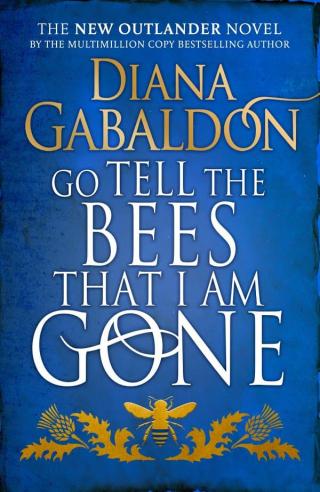
Go Tell the Bees That I Am Gone
- Автор: Гэблдон Диана
- Серия: Outlander #9
- Год: 2021
- Язык: английский
- Год: Delacorte Press
- ISBN: 978-1-473-51900-8
- Жанр: Исторические приключения

Электронная книга - «Go Tell the Bees That I Am Gone». Краткое содержание книги:
The past may seem the safest place to be . . . but it is the most dangerous time to be alive. . . .
Jamie Fraser and Claire Randall were torn apart by the Jacobite Rising in 1746, and it took them twenty years to find each other again. Now the American Revolution threatens to do the same. It is 1779 and Claire and Jamie are at last reunited with their daughter, Brianna, her husband, Roger, and their children on Fraser’s Ridge. Having the family together is a dream the Frasers had thought impossible. Yet even in the North Carolina backcountry, the effects of war are being felt. Tensions in the Colonies are great and local feelings run hot enough to boil Hell’s teakettle. Jamie knows loyalties among his tenants are split and it won’t be long until the war is on his doorstep. Brianna and Roger have their own worry: that the dangers that provoked their escape from the twentieth century might catch up to them. Sometimes they question whether risking the perils of the 1700s—among them disease, starvation, and an impending war—was indeed the safer choice for their family. Not so far away, young William Ransom is still coming to terms with the discovery of his true father’s identity—and thus his own—and Lord John Grey has reconciliations to make, and dangers to meet . . . on his son’s behalf, and his own. Meanwhile, the Revolutionary War creeps ever closer to Fraser’s Ridge. And with the family finally together, Jamie and Claire have more at stake than ever before.
She must have been gazing hungrily at a few men eating by the fire, for William nudged his horse nearer and murmured, “I’ll see you’re fed as soon as we reach the camp.”
She glanced at him and nodded thanks. There was nothing amused or offhand in his manner now. He sat relaxed in his saddle, reins loose in his hand as Lieutenant Hanson talked to the Scottish officer in command, but his eyes never left the soldiers.
They passed through the checkpoint in silence. She could feel the eyes of the soldiers on her skin, and the hair prickled on her scalp. The enemy …
The American siege lines lay no more than a quarter mile away, the camp perhaps a half mile beyond, but Lieutenant Hanson led them immediately inland, in order to circle the American redoubts and the French artillery, dragged overland from the ships. The guns were silent—thank God—but she could see them plainly, dark shapes beginning to emerge from the morning’s fog, still thick here near the river.
“You were telling me about General Pulaski,” she said, pushing up beside the lieutenant. She didn’t want to look at the cannon and think of Jem and Mandy in the city—or the holes and burnt roofs she’d seen in the houses of Savannah nearest the river. “He was on a ship, you said?”
The lieutenant had relaxed a little, once out of Savannah, and was pleased to tell her of the dreadful but gallant death of Casimir Pulaski.
“Yes, ma’am. ’Twas the Wasp, as I said. When the general went down, his men got him back directly, of course, but ’twas plain he was bad hurt. Dr. Lynah—he’s the camp surgeon, ma’am—took the grapeshot out of him, but then General Pulaski said as how he wanted to go aboard ship. I don’t know why—”
“Because the French aren’t going to hang about much longer,” William interrupted. “It’s hurricane season; D’Estaing will be nervous. I imagine Pulaski knew that, too, and didn’t want to risk being left behind, wounded, if—when, I mean—the Americans abandon the siege.”
Hanson turned in his saddle, pale with rage.
“And what would you know of such matters, you—you dandy prat?”
William looked at him as he might regard a humming mosquito, but answered politely enough.
“I have eyes, sir,” he said. “And if I understand aright, General Pulaski is—was—the Commander of Horse for the entire American army. Is that right?”
“It is,” Hanson replied, between gritted teeth. “So what?”
Even Bree could tell that this was purely rhetorical, and William merely lifted one shoulder in a shrug.
“I want to hear about the general’s cavalry charge,” John Cinnamon said, interested. “I’m sure he must have had a good reason,” he added tactfully, “but why did he do that?”
“Yes, I’d like to hear that, too,” Bree put in hastily.
Lieutenant Hanson glared at William and John Cinnamon, but after a muttered remark in which she caught only the words “… fine pair of backgammon players …” He stiffened his shoulders and fell back a little, so that Brianna could ride up alongside him on the narrow road. The countryside here was flat and open, but the earth was sandy and thickly grown with a sort of coarse, rough-edged grass that caught at the horses’ feet.
She could see that the road, though, had been heavily used of late. Hoofprints, footprints, horse droppings, wagon wheels … the road was churned and muddy, the verges trodden down by marching troops, moving fast. A sudden shiver went up her back as the wind changed and she caught the scent of the army. A feral smell of sweat and flesh, metal and grease, tinged with the stink of lye soap, manure, half-burnt food, and gunpowder.
Mr. Hanson had relaxed a little, seeing that he had his audience’s full attention, and was explaining that the Americans and their French allies had planned and executed an assault on the British forces at the Spring Hill redoubt—“You can see that from here, ma’am,” pointing toward the sea. As part of that assault, General Pulaski’s cavalry was to follow the initial infantry attack, “so as to cause confusion, d’you see, amongst the enemy.”
The cavalry charge had evidently accomplished that modest goal, but the overall attack had failed, and Pulaski himself had been cut down when caught in the crossfire between two British batteries.
“A great pity,” William said, with no sense of sarcasm whatever. Lieutenant Hanson glanced at him, but accepted the remark with a brief nod.
“It was. I heard that the Wasp’s captain meant to bury the general at sea—but one of his friends who’d gone aboard with him said, no, they mustn’t, and came ashore with his body just after dawn this morning, in a longboat.”
“Why would his friend not want him to be buried at sea?” she asked, careful not to imply any criticism with the question.
“His men,” William said, before Lieutenant Hanson could answer. He spoke with a sober certainty. “He’s their commander. They’ll need to bid him farewell. Properly.”
The lieutenant had risen slightly in his stirrups, ready to be indignant at the interruption, but hearing this, subsided and gave Brianna a brief bow.
“Just so, ma’am,” he said.
PAST THE ARTILLERY, they wound their way through an acre of so of mud-spattered tents and soldiers, the air around them a strange combination of sea tang, the acrid ghost of gunpowder, and a breath of autumn rot from the harvested fields beyond. Brianna took a deep, inquisitive breath and let it out hastily. Latrine trenches.
They were headed toward a cluster of large tents—this must be General Lincoln’s field headquarters—that billowed and moved gently in the morning air, like a group of friends with their heads together, talking. This pleasant illusion was shattered in the next instant, as a battery of cannon went off behind them.
Brianna started and jerked at the reins. Her mule, evidently used to this kind of thing, jerked impatiently back with a toss of his head. Lieutenant Hanson’s mule and the horses were less phlegmatic about the noise and shied violently, nostrils flaring.
“Getting rather a late start this morning, aren’t you?” William said to Hanson, bringing his horse round in a circle to calm it. And who taught you to ride, brother? she thought, seeing him. Lord John was a good horseman, but Jamie Fraser had been a groom at the estate where William had grown up.
“The fog,” Hanson replied shortly. “Cannon fire disperses it.” He turned his mule’s head toward one of the large tents. “Come. You’re to see Captain Pinckney.”
She found herself next to William, as they resumed their plodding advance, and leaned close to speak to him quietly.
“You said they’d left it late—the artillery firing, you meant?”
“Yes.” He glanced at her, one dark eyebrow raised. “You needn’t worry; it’s only a gesture.”
“I wasn’t—” she began, but stopped. She was worried, worried that perhaps her father had been mistaken, that the siege would continue … “Well, all right, I was,” she conceded. “What do you mean, a gesture?”
“They’ve lost,” William said, with a quick glance toward Lieutenant Hanson. “But they haven’t lifted the siege officially. Likely General Lincoln is arguing with D’Estaing about it.”