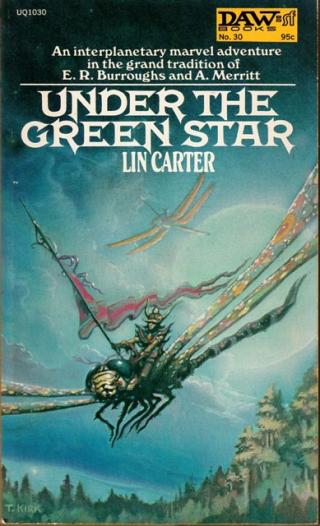
Under the Green Star
- Автор: Картер Лин Спрэг
- Серия: Green Star Rises #1
- Язык: английский
- Жанр: Научная фантастика

Электронная книга - «Under the Green Star». Краткое содержание книги:
The action was a purely instinctive one, performed without forethought, a mere lashing out at something which annoyed me. I had not really meant to kick him at all, just to shove him away, and had my hands been free at the moment, I would doubtless have used them. But they were not, and hence it was my foot that went crashing into his ugly, smirking visage and sent him sprawling.
A roar of amusement rang out as the hunched, sidling little thief crashed, squalling, into the tables. He was on his feet in an instant, eyes agleam with malice, a wicked hooked knife clutched in one hand. He snarled, spitting curses, face vicious, for all the world like a cat dunked suddenly in cold water.
I sprang from the bed as he lunged at me, the knife blade flashing in his hand. On Earth my knowledge of the tricks of rough-and-tumble fighting had necessarily been limited to what I had read in books or watched on television; but the body of Lord Chong knew all about gutter brawls, and instinctive habit patterns snapped into action.
I knocked his knife-hand aside, blocking his lunge with the blunt edge of my forearm, and sank my balled fist into his abdomen. The breath whistled from between his yellow snagged teeth. His face paled to a sickly hue and he sank to his knees and crouched there, gagging and sucking for breath. The fight had suddenly gone out of him from that one blow of mine, and as I bent to pick up the wicked little knife that he had let fall from numb, nerveless fingers paralyzed by my blocking blow, I reflected yet again on the obvious benefits of possessing the body of a fighting man, a body with superbly trained, hair-trigger reflexes!
In the next instant, burly Yurgon stepped between us, plucking Sligon from the ground by the scruff of his neck and shoving him away, turning stern eyes on me—stern, that is, if you discounted the appreciative grin that tugged at the corners of his mouth.
“No fighting, you two!” he snapped. “Siona’s rule—any further trouble between the two of you and I’ll have you both flogged. Is that understood?”
I nodded. “Perfectly! But it should also be understood that if yonder fellow or anyone else comes slinking around to peer through the curtains at the prin—at my mate and myself—he will get another boot in the teeth, flogging or no flogging. I hope that is understood!”
Yurgon chuckled. “Aye, Champion! Sligon, you sneak, stay away from our guests from now on, or I’ll give you the boot myself, understand?”
The little weasel of a man nodded silently, eyes vicious, saying nothing. I tossed him his knife and turned on my heel to where Niamh crouched in the doorway of the sleeping cubicle, flushed and bewildered, not understanding the reason for this altercation.
I assumed the incident was closed, and put it out of my mind. But as the little thief turned to slink away, he shot one glance at me from scowling eyes. It was a shaft of pure scarlet hatred, that glance, and I would have done well not to have discounted it. However, I paid it and him no particular heed, and therein, as shall ere long be seen, lay my downfall and Niamh’s doom. On such slight accidents do the hinges of destiny turn.
Siona, who slept with the unwed women in another part of the keep, had missed the altercation and no one bothered to inform her of it. When she appeared for the morning meal she noticed the sorry condition of our garments, which by now had been reduced to mere rags hardly sufficient to conceal our modesty, and curtly bade one of the foresters to find us more fitting raiment.
After breakfast, the huntsman commanded to this duty conducted us to the storerooms and saw us outfitted properly.
The fellow in question, by the way, was a fresh-faced, eager young lad named Kaorn, who seemed to be about sixteen or seventeen as far as I could judge—which was not very far, as the age of the Laonese people and their average life span remains something of a mystery to me to this very hour. I have not yet had occasion to touch upon the mystery of time on the World of the Green Star thus far in the course of this narrative, but if my reader will permit a slight digression at this point, while Niamh and I are getting dressed, I will mention that there was something peculiar and extraordinary about time on this planet.
The passage of time went largely unmarked among the Laonese, and even in their conversation they hardly ever referred to it. Among my own people, it is very common to employ such words as day and night, hour and minute—all of which, of course, refer to minor time divisions commonly, indeed universally, understood. “I’ll be there in ten minutes,” we are accustomed to saying; or “I spoke to him only an hour ago,” or “I called him last week.”
Virtually every action and activity undertaken by us in our everyday lives is performed against, or rather within, a framework of reference to time.
This is, most mysteriously, not at all the case with the slender, ivory-skinned inhabitants of the World of the Green Star. Such familiar time references are almost wholly absent from their speech as from their way of thinking, although this fact is not at once noticeable and took me quite some time to become aware of. When I did begin to notice it I believe I put it down to two facts. The first of these facts is that the Laonese people are of a pre-industrial civilization which has not yet reached the level of technology appropriate to the invention of clocks. Without possessing clocks, or some kind of device to measure the passage of time, it is understandable that references to hours and minutes would be highly arbitrary and unlikely—a fact generally overlooked by the authors of popular historical novels.
The second fact is, simply, that the Laonese rarely observe their sun. Both their sun and the various stars and constellations are generally hidden behind the dome of pearly mists that veil the heavens from their view as effectively as if they were inhabitants of the planet Venus. On Earth, of course, the sun is continuously visible throughout the daylight hours, and its passage from dawn to dusk easily observed. But the Green Star that is the sun of this world can scarcely be seen through the clouds that cover the skies, and although it is even then dimly visible as a center of brightness, the heavy leafage and immense branches wherein the folk of this world commonly dwell further obscure their notice of it.
But above and beyond the fact that the Laonese seldom refer to time by its subtler divisions—their language lacking even the words for hour or minute—they make no reference to the seasons of the year, and seldom refer even to the passage of the years. Unfortunately, my stay on the World of the Green Star was far too brief for me to have observed the passage of the seasons, but it may well have been that this planet is not so severely inclined upon its axis for the differences in temperature between the seasons to be particularly noticeable. I am left with the feeling that the Laonese dwell in a world of perpetual summer, verging, it may be, on the beginnings of autumn.
At any rate, during the time I lived among them, the Laonese seldom referred to years in any sense and for any purpose. I believe that I have already mentioned how difficult it was to estimate the age of some of the individuals whom I encountered during my stay on this strange and alien planet. Khin-nom, the old sage of Niamh’s court who taught me the language spoken by the Laonese, was an example of this. He was clearly a man of more than mature years, lean and gaunt and bewhiskered, his keen eyes and measured tones indicative of long experience and deep thought. But I would be at a loss to guess his age, for the flesh of his face was firm and healthy and unlined, his step vigorous and not in the least halting, and his body preserved the elasticity and suppleness of youth.