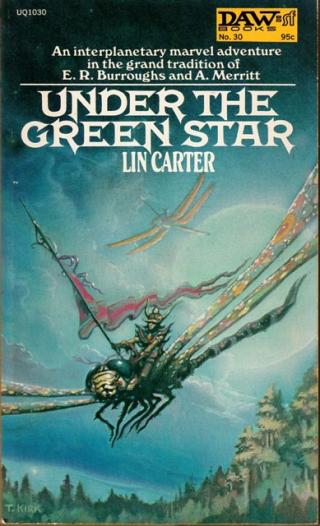
Under the Green Star
- Автор: Картер Лин Спрэг
- Серия: Green Star Rises #1
- Язык: английский
- Жанр: Научная фантастика

Электронная книга - «Under the Green Star». Краткое содержание книги:
The exertion of pulling Niamh free had drained the last dregs of strength from my body. I slumped, staggered, and all but fell. One of the tall foresters gently took the girl’s limp body from me; another steadied me as I sank to my knees. A third uncorked a belt canteen—made, I dimly realized, from a hollowed nut of size sufficient to hold nearly a pint of fluid—and held it to my lips. I drank strong red wine, bitter and resinous, but bracing.
Still too dazed to speak, I blinked as another figure emerged from the leaf-gloom—a tall, long-legged girl, bronzed and fit, with brown-gold eyes and gossamer mane of silver, dressed in an abbreviated tunic, leggings, and feathered cap. A girl among these woodland outlaws—and a girl of astonishing beauty?
I must have gaped at her with goggling eyes, for she laughed, a clear, silver peal of mocking music. She had a wide-mouthed, boyish face, tanned, glowing with health. I saw full lips, voluptuously crimson, flashing eyes under arched, sardonic brows, and a full-breasted, wasp-waisted figure that moved with seductive grace and Amazonian vigor.
Then my weary, drugged mind could cling to consciousness no more, and darkness rose to drown me.
When I awoke, the succulent odor of roasting meat was thick in my nostrils and the din of strange twanging music, mingled with the casual laughter of men, was in my ears. I lay in warm softness, drinking in the mouthwatering smell of hot food, dreamily thinking of nothing, until someone said, quite close to me, “He has awakened. Call Siona!”
I opened my eyes and looked around me. All was gloom and shadow, struck through with wavering orange firelight, and for a moment I thought it must be night. But—no—that could hardly be, for our struggle with the vampire blossom had been in early morning and I could hardly have slept for so many hours as to awake after sunfall.
Looking about, I saw we were enclosed on all sides by a rough dark surface. A cave? Surely that could not be! Then I saw the roughness was that of wood, and I realized we were within the trunk of a hollow tree, or a hollowed-out portion of a tree. A cheery fire blazed amidst the tree cave, painting monstrous black shadows over the uneven walls. Perhaps twenty men and boys sat or sprawled around the blaze, some drinking from cups that looked like halves of hollowed, enormous acorns; others strummed on musical instruments that resembled mandolins or Medieval viols. Turning on a wooden spit over the crackling fire, meat was roasting, fat dripping into the flames.
By my side, eyes enormous in her pale, heart-shaped face, Niamh sat with her back against the wooden wall, staring into the flames. She looked pale and exhausted, and was doubtless weak from loss of blood, but she was alive and did not seem to have taken harm from her horrible experience.
“Who are these people who have rescued us, Niamh?” I asked in a low voice.
“Outlaws and bandits of the forest,” she said. “Exiles, fled from justice … oh, I fear we have but fallen into a greater danger, having come into their hands!”
“Why do you say that?” I asked. “They are friendly, or they would not have saved us from that terrible flower …”
She shuddered at the memory of the experience.
“They know no law but their own, and every man’s hand is against them, even as their hand is turned against every man. I fear they saved our lives for some reason of their own! Ransom, perhaps, or … even worse.”
“Slavery?” I hazarded.
She shook her head reluctantly. “They live in lawless freedom, bandit warriors equal each to the other, under an elective chieftain—in the case of this band, that strange woman, Siona—‘the Huntress,’ they call her. Oh!”
Her eyes widened. I looked up into the grinning face of the strange outlaw girl whose face had been the last thing I had seen before I fell unconscious. Lithely she stood, legs spread in boyish stance, head on one side, regarding us with bright-eyed curiosity, the slim, tanned fingers of one strong, capable little hand toying with the pommel of a dagger.
“Aye, mistress, ‘the Huntress,’ my men call me,” the woman said in a clear bell-like voice in which overtones of sleek, cat-like mockery were audible. “And what shall I call you, whom I plucked from the bosom of the blood-drinking flower?—‘the Quarry’?”
Her mocking gaze fell on me, and her expression sharpened with reluctant admiration, measuring my inches, lingering on my flat belly, deep chest, broad shoulders.
“And what of you, my lusty lad? You have the girth of a gladiator, the arms of a wrestler. Ah! I have it ‘the Champion,’ eh?” She laughed throatily, revealing small, even teeth, startlingly white against the bronze tan of her features.
“We are harmless travelers, nothing more,” said Niamh in a toneless, controlled voice.
“Perhaps,” Siona purred. “And yet ‘tis curious, you’ll admit—unarmed, lone travelers seldom venture into the middle terraces, preferring the upper tier and the great cities. Your champion has the look of a woodsman about him, but not you, my dainty lady! I’ll warrant those soft legs are more used to velvet skirts and silken couches than to scrambling about the giant boughs. And where are you bound, unarmed and unmounted, you travelers?”
“To the city of Phaolon,” murmured Niamh. I kept my mouth shut, sensing that she had more insight into this situation and its hazards than had I.
“Phaolon, is it? In truth, you choose an awkward route, and will find the road difficult, without a dhua! And I wonder what purpose you have, ragged travelers, in seeking the Jewel City alone and afoot? The wild is a savage realm, and the great trees conceal a thousand horrors which lie in wait for the unwary. To venture forth into such peril argues an overwhelming cause …”
“We are from the city of Kamadhong,” Niamh said with a glibness that won my admiration. “We did not flee into the wild from free choice, but to avoid persecution. We make for the Jewel City of Phaolon for ‘tis said the queen of that realm offers a haven to all who come to her in need.”
The Huntress frowned, pouting her ripe red mouth.
“A haven, is it? Well, mayhap; but the outlaws of the wild have never found a gracious host in her who holds the gold throne of Phaolon. In truth, her chevaliers hunt us as they will, as if we were but savage beasts, not men!”
At this candid appraisal, Niamh bit her lip, flushing, and bent her head. But the wild outlaw girl did not seem to notice.
“But, now—your story interests me, girl! ‘Persecution,’ you said it was you fled from. Tell me of that—what manner of persecution do they practice in Kamadhong against dainty ladies and their stalwart champions?”
Again, Niamh glibly concocted a reasonable story to account for our fictitious flight from a city of which I had never heard.
“We are the children of rival houses,” she said firmly, “and we—we would wed against the wishes of our houses. I am of an ancient family of the thurkuz, and my lover is a mighty warrior of the khaweng-ya, whose love is deemed beneath one of my rank.”
Now it was my turn to flush and fidget, but again the Amazon girl did not appear to notice the involuntary reaction.
The story which the princess had invented on the spur of the moment to account for our being found alone and unarmed, wandering amidst the branches of the colossal trees, was, actually, a good one which made perfect sense. I have mentioned before something of the system of hereditary castes into which the civilization of the Laonese is divided. To Siona, it would be quite logical that a daughter of the thurkuz, the landed and titled aristocracy, should be forbidden to wed a soldier of the lowly warrior class, the khaweng-ya.