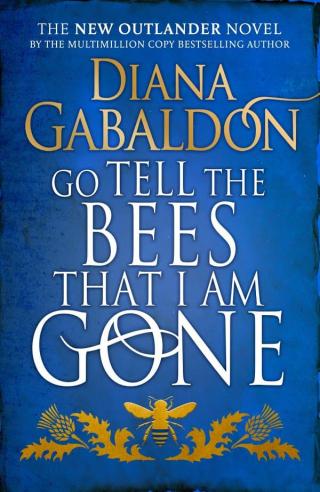
Go Tell the Bees That I Am Gone
- Автор: Гэблдон Диана
- Серия: Outlander #9
- Год: 2021
- Язык: английский
- Год: Delacorte Press
- ISBN: 978-1-473-51900-8
- Жанр: Исторические приключения

Электронная книга - «Go Tell the Bees That I Am Gone». Краткое содержание книги:
The past may seem the safest place to be . . . but it is the most dangerous time to be alive. . . .
Jamie Fraser and Claire Randall were torn apart by the Jacobite Rising in 1746, and it took them twenty years to find each other again. Now the American Revolution threatens to do the same. It is 1779 and Claire and Jamie are at last reunited with their daughter, Brianna, her husband, Roger, and their children on Fraser’s Ridge. Having the family together is a dream the Frasers had thought impossible. Yet even in the North Carolina backcountry, the effects of war are being felt. Tensions in the Colonies are great and local feelings run hot enough to boil Hell’s teakettle. Jamie knows loyalties among his tenants are split and it won’t be long until the war is on his doorstep. Brianna and Roger have their own worry: that the dangers that provoked their escape from the twentieth century might catch up to them. Sometimes they question whether risking the perils of the 1700s—among them disease, starvation, and an impending war—was indeed the safer choice for their family. Not so far away, young William Ransom is still coming to terms with the discovery of his true father’s identity—and thus his own—and Lord John Grey has reconciliations to make, and dangers to meet . . . on his son’s behalf, and his own. Meanwhile, the Revolutionary War creeps ever closer to Fraser’s Ridge. And with the family finally together, Jamie and Claire have more at stake than ever before.
But the wet, sluggish air stirred, and suddenly Roger caught the scent of baking bread from the public ovens in Savannah; faint, but so heady that his empty stomach growled.
Brianna. She was there, somewhere in the fog with the fresh-baked bread.
Someone murmured something in French, too low to catch the words but evidently witty, for there was a ripple of laughter and the tension relaxed for a moment.
They were bunched into columns now, four columns, each column eight hundred strong. There was no need to keep quiet; the British certainly knew they were here. He could hear shouts from one of the redoubts at the edge of the city now, echoing oddly in the fog. Spring Hill, they called it. There was another redoubt, somewhere to the left, but he didn’t remember what that one was called.
It was cold, so early, but sweat trickled down the side of his face and he wiped it away, morning stubble rasping under his palm. The officers had all shaved before dawn, putting on their best uniforms like bullfighters preparing for the ring, but the men had risen from their blankets and bed sacks frowsty as scarecrows. Wide awake, though. And ready.
It’s the wrong day. Surely it’s the wrong day …
He shook his head violently. He was a historian, too—or had been. He of all people should know how imprecise history really was. But here they were, swallowed up in swirling fog, facing an invisible armed city at dawn. On the wrong day.
He drew a deep, trembling breath.
We’re going to lose this one.
Frank Randall said so.
His stomach clenched, hunger forgotten.
Lord, help me do what You want me to do—but in the name of Christ Your son, let me live through it.
“Because if You don’t, You’ll have my wife to answer to,” he murmured, and touched the hilt of his borrowed sword.
General Marion was bending down from his saddle, speaking French to two of the officers from Saint-Domingue—murky as it was, he was close enough to see the bright yellow of the officer’s lapels and cockades. Yellow-breasted sapsuckers, he thought.
They might as well be, too, for as much of their speech as he understood. Theoretically, Roger spoke French, but he didn’t speak this kind of French, full of hissing and glottal stops.
No one was trying to be quiet. Everyone knew what was about to happen, including the British garrison. The Americans and their allies had given up their position before the city, and—dragging their unwieldy cannon through the marshes, in the dark—had circled Savannah, the army gathering again before the two points where they might break through the city’s defenses, south of the Louisville Road.
Lord, help them. Help me help them. Please, deliver us.
And he knew it was a vain prayer and still he prayed with all his heart.
“Les abatis sont en feu!” He heard the shout above the rumble and murmur and clanking of the army, and felt the jolt of hope like a stroke of lightning in his heart.
Someone had managed to set the abatis on fire! The news was rocketing around the marshes, and Marion stood up in his stirrups to peer through the fog.
Roger licked his lips, tasting salt. The British knew how to defend against a siege; the whole city was encircled on the landward side by trenches liberally spiked with abatis, sharpened logs jammed into the earth, points outward.
He could smell smoke, different in character from the smell of the ovens or of chimney smoke from the town—a wilder, rougher kind of smoke.
But then the wind changed and the smoke died. There were groans and curses in multiple languages; evidently the fire had gone out, been extinguished by the English, failed to catch hold in the damp, who knew?
But the abatis remained, and so did the cannon, aiming from the ground between the redoubts. He stared in fascination as they faded slowly into sight. The fog was beginning to shred and orders were being shouted. The faint skirl of a bagpipe floated on the air; there were Highlanders in the redoubt. The black snouts of the guns poked through the thinning fog, and now there was another kind of smoke that he knew must be slow-match, to touch off the cannon.
It was time, and his heartbeat echoed in his ears.
“You go back if you want, Reverend.” It was Marion, bending down from his horse, his breath visible in the chilly air. “You aren’t sworn nor paid to be here.”
“I’ll stay.” He couldn’t tell whether he’d said that or only thought it, but Marion straightened up and drew his sword from its scabbard, resting the blade on his thigh. He had a blue tricorne on his head, but there were dewdrops in the puffs of hair that covered his ears.
Roger took hold of his borrowed sword, though God knew what he’d do with it. God knew. That was, in fact, a comforting thought, and for a moment he was able to draw a deep breath.
“Save your life, maybe,” Lieutenant Monserrat had said, handing it over yesterday. “Even if you don’t mean to fight.”
I don’t mean to fight. Why am I here?
Because they’re here. The men around him, sweating in the chill, smelling death with the scent of fresh-baked bread.
There was a roar from the first column that spread over the field, and he was seized by panic.
I don’t know what to do.
Mortars nearby fired with a sudden bomph! and he found that his knees and his hands were shaking and he urgently needed a piss.
You didn’t know what to do when the bear killed Amy Higgins, a voice that might have been his said inside his head. But you did something anyway. Things would have been worse if I hadn’t, I know that much. I have to go.
The first column suddenly began to run, not in tidy lines but a mob, surging toward the redoubt and the crack of musket fire, yelling their lungs out, some firing, some just running and screaming, a knife in one hand, clawing their way over the abatis, and they were falling as the bullets struck, those farther out knocked down like bowling pins by bouncing cannonballs. A panicked frog erupted suddenly from a patch of wiry yellow grass near Roger’s foot and landed in a puddle, where it vanished.
“I don’t like this, me,” Marion said, in a brief moment between explosions. He shook his head. “No, I don’t.” He raised his sword. “God be with you, Reverend.”
IT WASN’T GOD he found with him, but the next best thing. Major Gareth Barnard, one of his father’s friends, an ex–military chaplain. Barnard was a tall, long-faced man who wore his graying hair parted down the middle in a way that made him look like an old hound dog, but he’d had a black sense of humor and he’d treated Roger, thirteen years old, as a man.
“Did you ever kill anyone?” he’d asked the major when they were sat around the table after dinner one night, the old men telling stories of the War.
“Yes,” the major replied without hesitation. “I’d be no use to my men, dead.”
“What did you do for them?” Roger had asked, curious. “I mean—what does a chaplain do, in a battle?”
Major Barnard and the Reverend had exchanged a brief look, but the Reverend nodded and Barnard leaned forward, arms folded on the table in front of him. Roger saw the tattoo on his wrist, a bird of some kind, wings spread over a scroll with something written on it in Latin.
“Be with them,” the major said quietly, but his eyes held Roger’s, deeply serious. “Reassure them. Tell them God is with them. That I’m with them. That they aren’t alone.”