Esperanto Revolutionaries and Geeks: Language Politics, Digital Media and the Making of an International Community
- Автор: Fians Guilherme
- Год: 2022
- Язык: русский
- Жанр: Культурология

Электронная книга - «Esperanto Revolutionaries and Geeks: Language Politics, Digital Media and the Making of an International Community». Краткое содержание книги:
Rephrasing these questions in Anna Tsing's terms, 'global connections are everywhere. So how does one study the global?' (2005: 1). While I was interested in understanding Esperanto as a global phenomenon, I found that also Esperanto speakers were sometimes unsure about how to engage with this form of global and how to establish Esperanto-mediated global connections in order to effectively use the language.
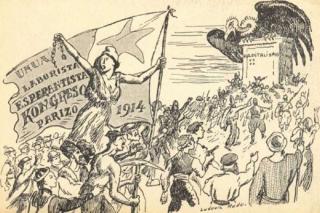
Reading Esperanto literature—for instance, the books that Andrei and I were packing—provides a way for people to use the language. However, it only allows for the use of one receptive skill (namely, reading), not making for a fully-fledged engagement with verbal commu- nication through four language skills. Yet, books are not the only things that circulate through Esperanto: in the early years of the language, letter exchanges were among the first materialisations of this dispersed speech community. To do justice to it, a great number of postcards and stamps were produced with Esperanto themes throughout the early twentieth century, containing images of Esperanto as a classic goddess enlightening peoples and bringing them together through mutual understanding, of children holding hands around the terrestrial globe, of Ancient Greek-looking figures reaching out to each other from different sides of the world map, among others. These images allegorically depicted what Esperanto proposed: to bring people together—even though not necessarily physically together—sharing ideas and, in multiple ways, communicating.
At the local level, Esperantists can gather, learn and speak the language at Esperanto associations and clubs, which provide the settings for regular meetings and language classes. However, given that the effective use of Esperanto as an international auxiliary language requires oppor- tunities for its speakers to see the world beyond the limits of their mother tongues, such local gatherings end up being regarded as imperfect enactments of this wider, globally dispersed community.
This perception was first shown to me in a debate held in Esperanto at the Paris-based association Esperanto-France. While the participants commented on the frame of that debate itself, Patrice, a 50-year-old French Esperantist, pointed out:
For me, this is artificial; this is not real Esperantujo. We are a group of French people speaking Esperanto, but we could as well be speaking French. What is real is to go abroad and speak with foreign Esperan- tists. You, for instance [pointing at me, the only foreigner at the debate that day], give us reasons to speak Esperanto, and this is good, but this meeting here, the meetings we have in these associations here in Paris... They are all very nice, but this is not the best way to be an Esperantist. I always take part in these meetings because I like you guys, I like to be here and to have opportunities to use Esperanto, but I find this artificial.
In Patrice's view, even though the debates held in Esperanto among speakers of the same mother tongue provided him with moments of learning and pleasure, the immersion in what he called 'real Esperan- tujo'—as opposed to 'artificial Esperantujo'—would not be complete without people from different national and linguistic backgrounds.
Along these lines, real Esperantujo largely dwells on international Esperanto meetings, such as the Universal Congress that Andrei and the UEA staff were thoughtfully preparing. On these occasions, this imagined community becomes materialised as a speech community and community of practice through the use of the language they share and the enactment of the cosmopolitan principles that prompt Esperan- tists to pursue fairer and more egalitarian communication. Nonetheless, these international gatherings are short-lived, such that real Esperantujo cannot last longer than one week. This condition that Esperantists face also becomes a methodological issue: where should this ethnographer go to find the Esperanto speech community and live with his 'natives' if these are scattered everywhere and grouped nowhere—or at least not for any length of time?
The use of Esperantujo or, alternatively, Esperantio to refer to the Esperanto community reveals linguistically pertinent choices. Both terms can be roughly translated as 'Esperantoland', as the suffixes -uj- and -i- are used to refer to most countries' names in Esperanto.[13] Addition- ally, the suffix -uj-, as proposed by Zamenhof in the fundamentals of the language, refers to containers (such as in monujo, 'wallet' or inkujo, 'inkwell'), whereas -ia late variation to refer to countries, can also be used to denote sciences and occupations (as in antropologio, 'anthro- pology' or telegrafio, 'telegraphy'). In this sense, the suffix -uj- emphasises the population contained in a country,[14] whereas -i- focuses on the area or territory of a country. Even though the two words that stand for Esperan- toland imply, more or less directly, a reference to territory, Esperantists do not normally make any claims for an Esperanto-speaking nation-state or defined territory.
History, nonetheless, is not free from short-lived endeavours to create such territories. The most remarkable attempts in this regard included a project led by a small group of Esperantists to introduce Esperanto as an official language in the contested Belgian-Prussian territory of Neutrala Moresneto (Neutral Moresnet) in 1908 (Okrent 2006: 93; Zelichowski 2009: 215). A more radical venture took place in 1968, when the Italian engineer Giorgio Rosa built a platform in the Adri- atic Sea, near the Italian coast, and declared it to be the micronation of Respubliko de la Insulo de la Rozoj (Republic of Rose Island). This micronation, which was both declared independent and destroyed in 1968 (Hayward 2014: 2), was to have Esperanto as its official language. Aside from producing hostile reactions in their surrounding countries, these short-lived attempts to give Esperantujo a territory failed to gain substantial support of the Esperanto community.
Such refusal to stabilise Esperantujo in territorial terms is entirely in line with this community's understanding of itself as a relational assem- blage dispersed across the globe, rather than confined to a given location. The very fact that the members of this community are scattered is one of the core features that drive Esperantists to occasionally come together. However, the fact that the real Esperantujo epitomised by the Universal Congresses and other international gatherings is only in place once a year imposes the emic question of how Esperantists can systematically find or forge 'real', 'authentic' Esperantist contexts—and this question's etic analogous, of how ethnographers can engage with Esperantists full-time.
When Moshe Shokeid (1988, 2007: 309) studied Israeli immigrants in the United States in the early 1980s, he too faced a similar ethnographic challenge in locating a dispersed community. Coming across occasions on which Israeli immigrants in New York gathered at private or public venues to sing along to popular Israeli songs, he coined the expression one-night-stand ethnicity. Given that these immigrants did not seem to form a stable and close-knit group and did not carry traits and indexes that could easily identify their ethnic and national belonging, these occa- sional gatherings constituted the only moments in which their use of the Hebrew language and their singing among their fellow nationals rendered their origin evident.
In a similar vein, Esperantists may casually exhibit their relationship with the language by wearing t-shirts, caps or tote bags with refer- ences to Esperanto, as well as reading Esperanto books in public places and promoting the language. Nonetheless, the occasions on which such engagement becomes acutely visible are when Esperantists meet and use the language. Holding gatherings and bringing this speech community into being, in turn, include preparing classes, organising meetings, as well as booking conference venues and advertising these events in Esperanto channels on digital media. Materialising this community, then, requires a significant amount of labour, critical to regularly create contexts to enable the use of the language and the maintenance of Esperantujo. Following Shokeid, we could argue that the intermittent and short-lived character of the materialisations of the Esperanto community characterises it as a one-night-stand (speech) community, which is grounded on labour that is, as expected, often carried out in Esperanto.