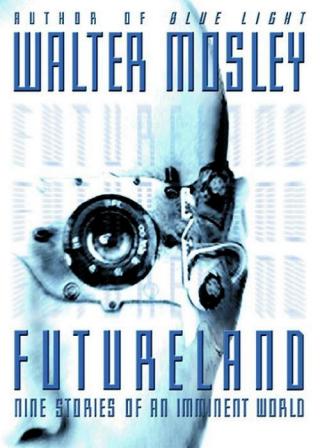
Futureland: Nine Stories of an Imminent World
- Автор: Мосли Уолтер
- Год: 2001
- Язык: английский
- Год: Aspect / Warner Books
- ISBN: 978-0-446-52954-9
- Жанр: Научная фантастика

Электронная книга - «Futureland: Nine Stories of an Imminent World». Краткое содержание книги:
“One mark no matter what you do?”
“Mostly.” Roger smiled.
“Why’s that?”
“Your freedom,” Roger said, “is a matter of you accruing no points in a span of three years. Follow the rather simple rules we have and you will not be here long.”
“Wake up on time and don’t jack off and I’m outta here in three?” Bits said.
Roger smiled. He tapped his glove screen a few times. “Why do they call you Bits?”
Bits felt the snake tighten almost imperceptibly when Roger made his entry. He knew that the needles were probing him for the truth.
“Computers are run on an eight-bit symbol system. I developed a virus that would force the operating system to reconfigure itself in RAM allowing an external OS to control it. That way, with the slightest window, I could take over almost any computer system by translating it into a code that no one else could read or decipher. I used a simple two-bit differential to offset the resident system. Because I added two bits my friends gave me Bits as a nickname.”
“But then all one had to do was pull the plug and reboot the system to get rid of your smart-virus,” the warden said.
“Yes. If they got to the program within one thousandth of a second. After that algorithms would have been placed in thousands of memory devices attached to the computer. The only way to get rid of it would be to purge all data in all files associated with the system.” Bits smiled. “It would cost trillions of dollars to abort me. No one was willing to pay that price.”
“So you destroyed the intercorporate council’s database of economic affairs because they wouldn’t pay you to ransom their computer?”
“No,” Bits said proudly. “I destroyed it because it was evil. Through that database they were systematically dismantling private property rights around the world.”
“I suppose you know my next question?”
Bits stared at the white emptiness behind the warden.
“I expect you to respond to my questions or else a pain dosage will be applied,” the warden said.
“I don’t know exactly what question you have, Roger. It probably has something to do with how you can obtain my virus or maybe who else knows anything about it.”
“I’d like the answer to both if you please, M Arnold,” Roger said politely.
“I don’t know.” Bits ground his teeth, expecting an explosive jolt of pain. But it did not come.
The warden seemed surprised.
“How can that be?”
“Hammerstein, the memory man.”
“No,” the warden was incredulous. “A scientist like you? The Ripper?”
“My blood for you,” Bits said looking directly into the warden’s eyes. “The process isn’t complete. I remember shreds and I’ve forgotten some things that had nothing to do with the virus. I forgot a whole episode with a girlfriend and many other minor details. But everything I just told you I read in Worldweek. Their science writer understands the system better than I do now.”
“Could you rebuild the system?”
“Given years and a lab, maybe. But I’m twenty-three now. Math is a young man’s game.”
“The Ripper,” the warden said shaking his head.
Karl Hammerstein was the Jack Kevorkian of the twenty-first century. He had developed a process that could erase whole sections of memory. Using radioactive dyes and a chemical targeting system much like the magic bullets developed in cancer cures, Hammerstein claimed that he could locate and erase entire episodes from memory. The process wasn’t exact, and other memories — even facets of a personality — could be lost. The Hammerstein Process had been outlawed in most of the world. Only his hometown, Berlin, allowed the neurosurgeon to ply his trade.
Bits Arnold smiled a sad smile. “My blood for you,” he said again, mouthing the anarchist slogan that he and his fellow revolutionaries had followed.
“Outside of this chamber,” Roger said, “you will find a purple-dotted yellow line. From now on that is your color scheme. It will lead you to your cell.”
“You didn’t answer one of my questions, Roger.”
“What was that?”
“How do I communicate with the prison staff if I never see them?”
“You,” the warden said and then paused for a moment, “don’t see us, but we see and hear everything that you do and say. Just whisper and we will know it.”
2
The choke plantation was in a large valley between two mountains on Angel’s Island in the East Indian Sea. For many miles the twenty-foot choke plants grew in rows, broad-leaved stalks that spread out from a huge silver and scarlet flower. This flower smelled like a sewer and shed a soft white pollen that was the base for cosmetics used by half the Orient.
All over the valley naked men armed with machetes hacked off the leaves, bound them with the tendrils that spread the root systems of the choke, and carried the bundles to robot-operated flatbed trucks that drove off automatically when their optimum load had been reached.
The sun hovered above the valley, red in the mist of morning. Bits followed his cell mates with an aluminum bucket gathering the silvery pollen bound for production lines in Tokyo, Seoul, and Hanoi. Even through the mask that he was allowed to wear Bits coughed mightily from irritant dust. Choke was named for its pollen’s effect on the respiratory system.
Gnats, black flies, mosquitoes, and fire ants infested the island, but after one bite the snake pack developed a serum based on the convict’s DNA that would make his skin anathema to that species’ bloodlust.
Loki and Moomja worked carrying the bales to the truck. They were young and powerful, enjoying the exertions of their muscles. Loki was an American born in Sweden to a white mother from a black soldier dad. He was thin, with the mischief of his namesake in his eyes, when the snake did not drug him for insubordinance. Moomja was a broad Samoan with murder in his gaze even when he was being drugged for some institutional slight. Jerry, the boy-Adonis, spotted the men with their loads while Needles, Darwin, and Stiles chopped down the five-foot-broad leaves and wrapped them with root.
Stiles was the sole white man. He kept to himself and spoke little. Darwin was the eldest, at forty-seven; he had killed his own mother and never shown remorse. Needles was a drug addict. He stayed up past curfew every night just to get the snake juice that put him in a stupor and sometimes to sleep.
“They can’t exceed the dosage,” Needles told Bits on his first night with the cell. “They changed my prescription six times already. I figure they got pure H in there now and I still got my eyes open till about a hour ’fore wake time.”
They crossed paths with workers from other cells at the robot trucks loading up and sometimes on the paths. This was one of the few times outside of eating periods that Bits had any contact with men from other cells.
The cells were isolated units on broad floors in the bowels of the island. There were twenty-five of these floors and on each one there were over a hundred cells.
A cell was a group of seven men who slept in close proximity and worked together. There were no bars to restrain them, as the snake pack and a circle of light proscribed their mobility. To set foot across the line of the sleep area resulted in a dosage of pain. To cross that line completely put you in a coma. After three comas you were not revived.
“Pretty day, eh?” Darwin said to Bits on the food break after four long hours of work.
“If I could breathe maybe it would be.”
“Yeah,” the elder convict said. “That powder’ll be comin’ up for days. But don’t worry, you’ll switch off with somebody after a week. They can’t let you work longer’n that. That shit’ll kill if you breathe in too much.”