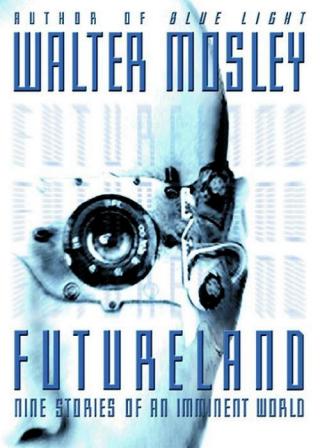
Futureland: Nine Stories of an Imminent World
- Автор: Мосли Уолтер
- Год: 2001
- Язык: английский
- Год: Aspect / Warner Books
- ISBN: 978-0-446-52954-9
- Жанр: Научная фантастика

Электронная книга - «Futureland: Nine Stories of an Imminent World». Краткое содержание книги:
The RadCon6 co-chair ran his powerful fingers through a full mane of coarse blue-gray hair, hair that was combed straight back and down to shoulder length. XX Y, chairman of the board, radical separatist, would rather have seen the world burn than give one inch to compromise. His eyes were holocausts of four hundred years of black suffering; their only promise was vengeance.
“Why?” he asked again.
“This world was set when they dragged the first African into a slave ship,” Akwande intoned. “Like the child who sees his mother and father slain by devils wearing white faces. Like the girl raped by her imbecile brother in the playhouse next to her dolls. The heart,” he said and paused, “the heart is rotten.”
“Is it the bones?” XX Y asked. He had never liked Akwande and his diplomacy. He never followed the Go master, he never would.
“No, I’m not afraid. That was a crash I walked away from. No, I’m not afraid. But after I woke up and found those bones I went to the Infochurch that they put up in Newark. You ever been there?”
“No,” the Lion sneered. “Never.”
“There’s five hundred workstations and service twenty-four hours a day. The hologram minister, Dominar of the Blue Zone, blesses and instructs the people on the usage of the terminals in deciphering God’s secrets.”
“That’s a bunch’a shit and you know it.”
Fayez ignored the quip. “Almost all of the parishioners are black,” he said. “Those who aren’t are Dominicans, Puerto Ricans, and poor whites. A couple’a people recognized me but they didn’t speak. They just stared at their monitors. They spoke and the computer remembered them and started the lesson where it left off. Lessons in science.”
“What lessons?”
“The force of gravity. The bending of light. The path of the living cell through evolution. Infinity and black holes—”
“If it’s black then that must be the devil,” XX Y interrupted.
“Yes, yes. Black for them is evil or random or unknown. Black robs the mind of sight. It is the collapse of the whole universe.”
“And you don’t want to fight against that? You don’t get so mad that you wanna get a gun and let loose?”
“Oh absolutely I do, Brother X. I felt your arguments in there. I wanted to short out those lessons. I wanted to go back to Home and gut that Dominar. All of those black people kneeling in front of computer screens. Confessing their secrets, robbed of their greatest commodities, their minds.”
“Then why leave?”
“Because... because I can’t change it.” Akwande was thinking of Eye. Her genetically crafted body, her soulless orbs. Her life for his, Kismet’s. “And so I’m taking my family to Mars.”
“Says which?”
“I’ve been to the master’s home. I’ve been to the master’s church. I live on his plantation. I begged him to feed Mali, to give them freedom. They took his money but it didn’t buy their freedom. They just joined the International Economic Congress and put mercenaries at their borders.”
“But you ended the famine,” XX Y said. “You gave them the strength to make their own way.”
“They will refuse our embassy,” Akwande said.
“You don’t know that.”
“NGOs are banned by the IEC from any official capacity. You know that, brother.”
“But even if it’s true, even if they turn their backs on us, what the hell do you accomplish by flying off to Mars?”
“On Mars there will be fewer people. There will be a new world. Maybe we can have something there. Maybe.”
“You just runnin’ away.”
“But I’m leaving the guns with you, brother,” Akwande said, laying his hand on the revolutionary’s shoulder. “And I leave you my blessings, too.”
Angel’s Island
1
Six naked men walked into the weak circle of light in a corner of the great chamber. They weren’t manacled or restrained in any way but their hands hung down at their sides and there was no escape or rebellion in their eyes. Each man had a bulky sack of iridescent blue-green material wrapped around his upper right biceps. The sacks writhed sluggishly, resembling serpents slowly digesting their prey. There was something hard and particular in each sack.
“This is the new meat,” Lieutenant L. Johnson said to the assembly of men. They gave no response. They might have all been deaf as far as Bits knew.
“Vortex ‘Bits’ Arnold,” the lieutenant continued. “He will be number seven in your cell from now on.”
“No more Logan?” a young black man with highly defined muscles spoke up.
“Vortex,” the lieutenant replied harshly.
The young convict, who was completely hairless and who had no scars that Bits could see, lowered his eyes.
“And as long as you can’t keep quiet, Jerry, maybe you won’t mind taking him to the center for a fitting,” the guard said as he punched something into the palm screen attached to his gloved hand.
“Yes, Lieutenant,” the specimen of perfection said meekly.
L. Johnson was not large or strong, and as far as Bits could see, he wasn’t armed either. None of the guards he had seen was armed. Bits didn’t understand why six full-grown men were docile beside this paunchy and arrogant sublife of a white man. The only reason Bits didn’t jump on him was because he was bound hand and foot and floating in a gravity chair.
“Get him to ChemSys,” Johnson said to Jerry. “The rest of you get up to the plantation. We need the whole upper tier harvested before the typhoon hits.” Again Johnson punched information into his palm screen.
Of the prisoners, four were Negro, one was brown and Asian — a Pacific Islander, Bits thought — and one was white. The oldest of the group, a lanky black man somewhere in his forties, showed distaste when Johnson ordered the harvest. The light of anger shone in his eyes. But fast on the heels of that anger came the jab of sudden pain, and then there was nothing — no anger or will of any kind, just resignation as he joined the herd of five moving back across the huge darkened chamber.
Trussed up as he was in the floating chair, Bits watched the men cross into the room. Before them, on the floor, ran a bright green line which they followed until they finally faded into darkness.
Bits was reminded that he hadn’t seen the sun since his conviction for antisocial behavior. It was only his second conviction but the court nevertheless used its prerogative to have him sentenced to a licensing facility that would hold him until it was scientifically proven that he was no longer a threat to society.
They tried him in a Manhattan subbasement, had him transferred at night to the tube train that sped through its mile-deep Synthsteel tunnel at over six hundred miles an hour from New York to the East Indian Ocean. He arrived at night also and was delivered in bonds to the tender mercies of L. Johnson, orientation officer of Angel’s Island, the first and most feared nonnational private prison.
Bits twisted around to see what the orientation officer was doing but he too was gone. It was only Bits and Jerry there in the weak light.
“Got a cig, Jerry?”
The big man grabbed hold of the handle at the back of the chair, which resembled an oversized fancy plastic scoop, and began pushing Bits ahead of him.
“Jerry, did you hear me?”
“No talk in the halls. Follow the pathway given and speak only when spoken to by authority.” Jerry’s words weren’t the soulless mouthings of the zombie he resembled but soft warnings that chilled Bits into hushed tones.
“They got mikes on us?” Bits asked.
Jerry did not respond. He walked along just behind Bits’s left side. The gravity chair, a product of PAPPSI — Polar/Anti-Polar Power Systems Inc. — floated silently down the gloomy hall. The strangeness of the interiors that Bits had seen so far had been due to a trick the architects had come up with. Only things that were meant to be seen received lighting. Doorways, signs, and long baseboard directional lights indicated where you might go and when you got somewhere. Everything else was black as space. The walls and ceiling, even the floors, were coated with a completely nonreflective material that made the inside of the prison seem like the deep of starless space. Every step taken was a step of faith. You’d never see a hole or wall that wasn’t marked. Your feet fell on nothingness. People shone in the darkness as did any object not treated with the nonreflective material.