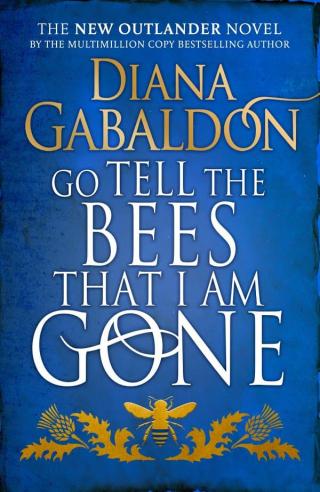
Go Tell the Bees That I Am Gone
- Автор: Гэблдон Диана
- Серия: Outlander #9
- Год: 2021
- Язык: английский
- Год: Delacorte Press
- ISBN: 978-1-473-51900-8
- Жанр: Исторические приключения

Электронная книга - «Go Tell the Bees That I Am Gone». Краткое содержание книги:
The past may seem the safest place to be . . . but it is the most dangerous time to be alive. . . .
Jamie Fraser and Claire Randall were torn apart by the Jacobite Rising in 1746, and it took them twenty years to find each other again. Now the American Revolution threatens to do the same. It is 1779 and Claire and Jamie are at last reunited with their daughter, Brianna, her husband, Roger, and their children on Fraser’s Ridge. Having the family together is a dream the Frasers had thought impossible. Yet even in the North Carolina backcountry, the effects of war are being felt. Tensions in the Colonies are great and local feelings run hot enough to boil Hell’s teakettle. Jamie knows loyalties among his tenants are split and it won’t be long until the war is on his doorstep. Brianna and Roger have their own worry: that the dangers that provoked their escape from the twentieth century might catch up to them. Sometimes they question whether risking the perils of the 1700s—among them disease, starvation, and an impending war—was indeed the safer choice for their family. Not so far away, young William Ransom is still coming to terms with the discovery of his true father’s identity—and thus his own—and Lord John Grey has reconciliations to make, and dangers to meet . . . on his son’s behalf, and his own. Meanwhile, the Revolutionary War creeps ever closer to Fraser’s Ridge. And with the family finally together, Jamie and Claire have more at stake than ever before.
Rolling fire? he thought suddenly. Because that’s what it bloody was, and he rolled over and sat up in amazement to see a company of British infantry, some efficiently rounding up persons attempting to flee the scene, others efficiently reloading their muskets, and two officers on horseback, surveying the scene with an attitude of fierce interest.
He palmed mud away from his eyes and stared hard at the officers. Reasonably sure he didn’t know either of them, he relaxed slightly. He wasn’t injured, but the impact of Bart’s collision had left him shaken and bruised. He went on sitting in the middle of the road, breathing and letting his brain begin to restore its relations with his body.
The altercation, such as it was, had died down. The soldiers had rounded up most of the men he’d been gambling with and prodded them with bayonets into a small group, where a young cornet was efficiently tying their hands behind them.
“You,” said a voice behind him, and a boot nudged him roughly in the ribs. “Get up.”
He turned his head to see that he was being addressed by a private, an older man with a good deal of assurance about him. Quite suddenly, it occurred to him that the infantrymen might suppose him to be a participant in the recent fracas, rather than its victim. He scrambled to his feet and stared down at the much shorter private, who took a step back and flushed red.
“Put your hands behind you!”
“No,” William said briefly, and, turning his back on the man, took a step toward the mounted officers. The private, affronted, lunged at him and seized him by the arm.
“Take your hands off me,” William said, and—the private ignoring this civil request—shoved the man away and sent him staggering.
“Stand still, damn your eyes! Stand, or I’ll shoot!” William turned again, to find another private, hot-faced and sweating, pointing a musket at him. The musket was primed and loaded—and it was William’s musket. His mouth dried.
“Don’t … don’t shoot,” he managed. “That gun—it’s not—”
The first private stepped up behind him and punched him solidly in the kidney. His insides clenched as though he’d been stabbed in the stomach, and his vision went white. He gave at the knees but didn’t quite fall down, instead curling up on himself like a dead leaf.
“That one,” said an educated English voice, penetrating the buzzing white fog. “That one, that one, and—this one, the tall fellow. Stand him up.”
Hands seized William’s shoulders and yanked them back. He could scarcely breathe, but he made a strangled noise. Through a haze of tears and mud, he saw one of the officers, still on horseback, looking down at him critically.
“Yes,” the officer said. “Hang that one, too.”
WILLIAM EXAMINED HIS handkerchief critically. There wasn’t much left of it; they’d tried to bind his wrists with it and he’d ripped it to shreds, getting it off. Still … He blew his nose on it, very gently. Still bloody, and he dabbed the seepage gingerly. Footsteps were coming up the tavern’s stairs toward the room where he sat, guarded by two wary privates.
“He says he’s who?” said an annoyed voice outside the room. Someone said something in reply, but it was lost in the scraping of the door across the uneven floor as it opened. He rose slowly to his feet and drew himself up to his full height, facing the officer—a major of dragoons—who had just come in. The major stopped abruptly, forcing the two men behind him to stop as well.
“He says he’s the fucking ninth Earl of Ellesmere,” William said in a hoarse, menacing tone, fixing the major with the eye that he could still open.
“Actually, he is,” said a lighter voice, sounding both amused—and familiar. William blinked at the man who now stepped into the room, a slender, dark-haired figure in the uniform of a captain of infantry. “Captain Lord Ellesmere, in fact. Hallo, William.”
“I’ve resigned my commission,” William said flatly. “Hallo, Denys.”
“But not your title.” Denys Randall looked him up and down but forbore to comment on his appearance.
“Resigned your commission, have you?” The major, a youngish, thickset fellow who looked as though his breeches were too tight, gave William an unpleasant look. “In order to turn your coat and join the rebels, I take it?”
William breathed, twice, in order to avoid saying anything rash.
“No,” he said in an unfriendly voice.
“Naturally not,” Denys said, gently rebuking the major. He turned back to William. “And naturally, you would have been traveling with a company of American militia because …?”
“I was not traveling with them,” William said, successfully not adding “you nit” to this statement. “I encountered the gentlemen in question last night at a tavern, and won a substantial amount from them at cards. I left the tavern early this morning and resumed my journey, but they followed me, with the obvious intent of taking back the money by force.”
“‘Obvious intent’?” echoed the major skeptically. “How did you discern such intent? Sir,” he added reluctantly.
“I’d imagine that being pursued and beaten to a pulp might have been a fairly unambiguous indication,” Denys said. “Sit down, Ellesmere; you’re dripping on the floor. Did they in fact take back the money?” He pulled a large snowy-white handkerchief from his sleeve and handed it to William.
“Yes. Along with everything else in my pockets. I don’t know what’s become of my horse.” He dabbed the handkerchief against his split lip. He could smell Randall’s cologne on it, despite his swollen nose—the real Eau de Cologne, smelling of Italy and sandalwood. Lord John used it now and then, and the scent comforted him a little.
“So you claim to know nothing of the men with whom we found you?” said the other officer, this one a lieutenant, a man of about William’s own age, eager as a terrier. The major gave him a look of dislike, indicating that he didn’t think he needed any assistance in questioning William, but the lieutenant wasn’t attending. “Surely if you were playing cards with them, you must have gleaned some information?”
“I know a few of their names,” William said, feeling suddenly very tired. “That’s all.”
That was actually not all, by a long chalk, but he didn’t want to talk about the things he’d learned—that Abbot was a blacksmith and had a clever dog who helped him at his forge, fetching small tools or faggots for the fire when asked. Justin Martineau had a new wife, to whose bed he longed to return. Geoffrey Gardener’s wife made the best beer in the village, and his daughter’s was nearly as good, though she was but twelve years old. Gardener was one of the men the major had chosen to hang. He swallowed, his throat thick with dust and unspoken words.
He’d escaped the noose largely because of his skill at cursing in Latin, which had disconcerted the major long enough for William to identify himself, his ex-regiment, and a list of prominent army officers who would vouch for him, beginning with General Clinton (God, where was Clinton now?).
Denys Randall was murmuring to the major, who still looked displeased but had dropped from a full boil to a disgruntled simmer. The lieutenant was watching William intently, through narrowed eyes, obviously expecting him to leap from the bench and make a run for it. The man kept unconsciously touching his cartridge box and then his holstered pistol, clearly imagining the wonderful possibility that he could shoot William dead as he ran for the door. William yawned, hugely and unexpectedly, and sat blinking, exhaustion washing through him like the tide.
Right this moment, he really didn’t care what happened next. His bloody fingers had made smears on the worn wood of the table and he stared at these in absorption, paying no attention to what was being said—until one battered ear picked up the word “intelligencer.”