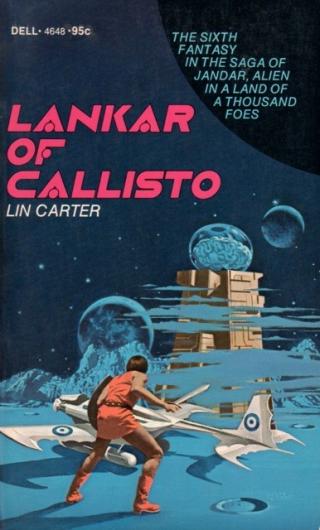
Lankar of Callisto
- Автор: Картер Лин Спрэг
- Серия: Callisto #6
- Язык: английский
- Жанр: Научная фантастика

Электронная книга - «Lankar of Callisto». Краткое содержание книги:
...in the mysterious and treacherous domain of the insidious Mind Wizards. Searching for him is a fearless armada of his loyal friends, and a stranger who knows him better than anyone on Callisto. The stranger, Lankar, is none other than Lin Carter, accidentally transported through the Gate Between the Worlds to the land of the Thanatorians. Aware of Jandar's plight, Lankar joins the search beyond the world's edge and suddenly finds himself battling for his own existence against the most nightmarish creatures on the planet - the gruesome flesh robots of Kuur and the fiendish Mind Wizards of Callisto themselves...
We settled on roast trei chkowk, a local variety of lake chub roasted crisp and tender over a pot of charcoal, served up on a bed of steaming rice. It was tangy and delicious, topped off with heady Cambodian tea served in curious wooden pots, with ansamcheks for dessert-rice cakes with banana centers, wrapped in leaves and served piping hot. The restaurant was crowded and noisy, sawdust on the floor and odorous of fish-heads. Pretty girls in gorgeous sarongs twirled in the national folk dance, called the lamthon, in a kind of floor show; they were followed by musicians who played eight-stringed gares, a native orchestra of gongs and flutes and instruments called tros which look like one-stringed violins. We ate hugely, enjoyed ourselves enormously, and the bill came to a staggering thirty riels, which was about ninety cents American.
After supper we went strolling among the shops. Noel wanted to pick up a few souvenirs to bring home as gifts for her sister, the Jellerette children across the street, and our next-door neighbors, the Roethers, who were usually kind enough to collect our mail and newspapers for us when we were off on trips. She also hoped to find something nice for Marie Cerut, a local antique dealer with whom she had struck up a close friendship.
“Keep your eyes open for something to bring back for Ron Stoloff,” she said, referring to the President of the Philadelphia Science Fiction Society, whose guests we would be at the annual Philcon the following month.
Everywhere we went we saw clear evidence that this was a country at war. Military vehicles were to be seen moving through the streets or parked at corners, and there were many Cambodians in uniform, some of them carrying weapons, mingling with the crowds along the street. The recent explosion of rebel action in the outlying provinces and the dangers of an attempted Communist take-over of the new Lon Nol government had caused our State Department to be more than a little reluctant to permit Noel and me to have passports for Cambodia. Obviously, Uncle didn’t like the idea of U.S. citizens getting into a Southeast Asian country at war, for fear of American nationals getting mixed up in what might be an international incident. While we were in the capital, though, we didn’t see any evidence of trouble, although once we got out on the river and down into the jungle regions, we might expect a little more danger.
Well, we had determined to take our chances on that, and hoped that everything turned out all right.
The streets were very crowded by now, and made a gorgeous and exotic sight, lit by swaying paper lanterns, colored lights shining on strange brown faces, gilded wood, signs in curious characters. I wished we had more time to sample the nightlife, but we did not.
Back on the dock we found our transportation awaiting us, in the form of a rusty, patched, decrepit little steam-launch that was a dead ringer for the dilapidated craft Humphrey Bogart captained in one of our favorite movies, The African Queen. Sir Malcolm’s number-one boy, Charlie Phuong, had already located and loaded our luggage aboard. He was a short, cheerful, grinning, bowlegged boy of indeterminate age, who carried his life’s savings around with him in the form of a wide grin bright with gold fillings. Sparkling black eyes greeted us under the bill of a battered old baseball cap, around which a scrap of fluttering red scarf had been knotted for good luck, or to keep the devils away, or maybe both. The rest of his costume consisted of muddy tennis shoes, a ragged pair of khaki shorts, and a cast-off olive drab army shirt.
The moon had risen while we were at dinner, and the river traffic was at its pitch as we cast off, chugging noisily, into the main channel. Brightly lit sampans and junks floated by us; boats of every description were loading at docks heaped with tins of pitch, bales of raw, unprocessed rubber from the great Chup plantations to the northeast of the capital. We saw workmen, naked to the waist, laboring under flaring torches at sacks of fragrant yieng yieng bark from which incense is made, shoving about baskets filled with garish peppercorns, stalks of green bananas, bundles of peacock feathers, cords of cut bamboo, bundles of turtle shells, anteater skins and kapok. Amusingly, one boat was unloading cases of Coca Cola bottles.
Our boat threaded its noisy path through an arrangement of mud dikes, canal locks, and waterways. Wooden cowbells went click-clack in fields beside the river; oil lamps gleamed in the waxed paper windows of farmhouses and huts as we sailed downriver under star-crowded skies. Peasants worked late in flooded, shallow ricefields, bent double and looming like black cutouts against the moon. We sailed past bamboo forests, lemon groves, ungainly stands of banana trees, and thick banyans. In one hillside farm a clumsy Zadrugar tractor, imported from Yugoslavia, rumbled, belching black, oily smoke.
Noel and I struck up a conversation with our friendly pilot. Charlie Phuong, it turned out, was not a native of Phnom Penh but hailed from a hamlet with the delicious name of Battangbang, which I gathered was the capital of the northwestern province. He had nothing but contempt and derision for the locals hereabouts, whom he considered city slickers, more interested in organized sports, movies from Hong, Kong, and political squabbles, than in the traditional elements of Cambodian life. He was very uneducated and very superstitious, what with his crimson head scarf to frighten off night-wandering demons, and the copper bracelet he wore clasped about one muscular brown bicep which was a good-luck charm. He chattered in friendly, amiable fashion while we glided down the star-mirroring river, which widened. He had worked nearly a calendar year for Sir Malcolm, whom he held in good-humored veneration―his name for the British archaeologist was Lok Thom, which means something like “Mr. Big”―and, although uneducated, he had picked up a surprising vocabulary in English: pungent, earthy, shot through with French cuss-words and the names of Cambodian deities and demons, all mixed together in a patois so inimitable I will not even attempt to reproduce it in these pages.
We passed something like an enormous, densely black, floating island, around the edge of which Charlie Phuong maneuvered the laboring little steam-launch while purpling the night air with a torrent of profanity in at least three languages. This floating island turned out to be a logjam, drifting downstream from the forest around Kratie. Native lumberjacks, only their red, devil-frightening head-scarves visible in the gloom, scampered nimbly about this gigantic raft of logs, keeping careful eyes peeled to be certain the heavy hardwood logs of teak were buoyed up on hollow bamboo trunks.
I smoked cigarette after cigarette, sitting in the prow, staring dreamily out on the starry skies, the moonlit river, and the jungle thickets which lined the river to each side; Noel dozed in the rear, pillowed on our luggage. The trip would take hours.
Then I must have dozed off myself, for the next thing I knew was Charlie Phuong grinning down at me, gold fillings glittering in the torchlight, shaking me awake. I stretched and sat up and looked about me. We were pulled over to one shore of the river, where a crude little log-built dock thrust out on sunken pilings a few yards into the stream. The dock was crowded with small, nimble men passing our luggage ashore, each snatching a bag and tossing it into the waiting hands of the next.
Then a spry, sixtyish, little man with bright, inquisitive blue eyes and a goatee of silvery white, his scrawny form clad in filthy khaki shorts and a mud-besplattered T-shirt, popped up directly in front of me, squinted about, spotted me, and grinned―a grin which made his entire leather-tanned face dissolve into a mass of laughter-crinkles.
“Mr. Carter, I gather?” I nodded, still half-asleep. He rubbed bony hands together briskly.
“Excellent! Excellent! And your charming lady, I see. Well, hop out―hop out―you’re here, you know! Welcome to the city of Arangkor; population twenty-six―now twenty-eight! It’s a five minute stroll through the brush―watch your step, dear lady, or you’ll go up to your waist in mud―the dock we built for a reason, you know! Come-Billy-Boy, my cook, has fresh tea brewing, or instant coffee, if you prefer … come along now. Careful with the gentleman’s luggage, you clumsy monkeys!”