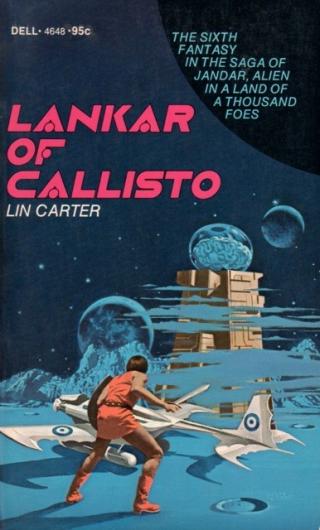
Lankar of Callisto
- Автор: Картер Лин Спрэг
- Серия: Callisto #6
- Язык: английский
- Жанр: Научная фантастика

Электронная книга - «Lankar of Callisto». Краткое содержание книги:
...in the mysterious and treacherous domain of the insidious Mind Wizards. Searching for him is a fearless armada of his loyal friends, and a stranger who knows him better than anyone on Callisto. The stranger, Lankar, is none other than Lin Carter, accidentally transported through the Gate Between the Worlds to the land of the Thanatorians. Aware of Jandar's plight, Lankar joins the search beyond the world's edge and suddenly finds himself battling for his own existence against the most nightmarish creatures on the planet - the gruesome flesh robots of Kuur and the fiendish Mind Wizards of Callisto themselves...
Lankar of Callisto
Lin Carter
Book I
Chapter 1
THE CITY IN THE JUNGLE
It was early afternoon when we landed at the Siem Reap airport just north of the capital city. We had to wait in interminable lines to collect our luggage and to go through passport examination and customs inspection. Eventually we emerged under a darkening sky to be greeted by grinning pedicab-drivers who shrilled out the names of hotels, vying with each other for our trade. We selected one cheerful little man from the line who greeted us in a comical mixture of French and Cambodian.
“Bonsoir, lok!”―which meant “good evening, mister”―he called. I think Noel was attracted to him because of his smile, which was gleaming and colorful. I mean that quite literally, by the way, for his teeth were inlaid with gold and plaques of red carnelian. The Cambodian natives, it seems, regard white teeth as bad luck, and while the poor peasants color them by chewing on betel nut, those who can afford to do so have their teeth set with gold fillings or with semiprecious stones like lapis or carnelian, or even with jewels.
Babbling merrily in at least three languages, our driver heaped the luggage on the rack and we climbed in and settled ourselves while he mounted the rear of the vehicle, taking a running start, and steered us smoothly into the flow of traffic. These pedicabs look like an odd hybrid of bicycle and the traditional rickshaw and most of the street traffic of the Cambodian capital is composed of them, since gasoline has recently become very expensive due to shortages and the cutoff of foreign imports. “Legs are cheaper than gas,” is the saying here.
For a time we were pedaled along a narrow country road beside a muddy yellow waterway. Naked brown boys scrubbing dusty elephants amid the stream waved and catcalled as we went clicking by; grimacing gibbons chattered from tall stands of bamboo that rattled and clattered in the spanking breeze; birds with red plumage screeched from immense banyans or fragrant lemon-groves. We saw entire families up to their knees in the muddy water, scooping up silver, wriggling fish in wicker buckets. Occasionally the waterway widened and we saw stately, if clumsy, wooden junks competing with all manner of rivercraft for right of way―everything from bamboo rafts to rusty packet boats, loud motorboats scooting by graceful crafts that looked for all the world like Venetian gondolas. Far off downstream a huge oil tanker stood at dock.
Before long we entered the city proper and moved through narrow streets lined with open-air shops which sold an amazing profusion of odd merchandise―wrought-silver elephants, gongs, bamboo flutes, paper good-luck flags, incense sticks, betelnuts, begging bowls of polished wood, dogmeat sausages (at which we shuddered), modern Chinese comic books. Buddhist monks strolled the sidewalks in their saffron robes under yellow parasols. Old women with shaven heads went by, wrapped from armpit to ankle in black sarongs called sampots, with spotless white blouses. Mobs of ragamuffin children were everywhere, chewing sugarcane―the local equivalent of lollypops-lugging shoeshine kits, begging for pennies, munching on sunflower seeds. Fortune-tellers squatted on the sidewalks, a jumble of mystic books, copper amulets and magical herbs spread out before them on pieces of oilcloth. Most of the traffic was composed of pedicabs similar to the one in which we rode, which are called cyclos; there were very few automobiles to be seen.
Noel had brought along a street map of Phnom Penh which she had been studying on the plane while I read Jandar’s manuscript; so we were able to follow our progress through the city easily enough. Phnom
Penh is a city of many waters, laid out so that it straddles the intersection of the Tonle Sap and the Bassac River, where they merge with an elbow of the mighty Mekong which empties into the ocean one hundred and thirty miles downstream. This intersection, called the quatre bras, the “four arms,” is like a great `X’ of water, and most of the local transportation is by means of the various rivers, canals and suchlike. The country itself is quite small, covering 66,000 square miles, about the size of the state of Washington back home. The capital is rather small, in keeping with about four hundred thousand inhabitants.
We entered the Boulevard Norodom, a broad tree-lined avenue. Here for the first time we saw automobiles in number, mostly small foreign imports I could not name. Our driver, pedaling away behind us, called our attention to a local landmark, the famous Wat Phnom, a tapering, battered, weather-beaten, spire-topped shrine which rises atop a wooded hill near the approximate center of the city, gained by a wide flight of stone steps. We passed by it close enough to see the stone seven-headed cobras that adorned its roof. “Wat Phnom” means “Hill Temple,” and the legend has it that six centuries ago when rainy season floodwaters arose, they washed the trunk of a great koki tree up this hill to the doorstep of a lady named Penh. Inside the tree were found four bronze images of the Buddha, and the omen was interpreted to mean the gods had withdrawn their favor from the old imperial capital, the famous jungle metropolis of Angkor, and were searching for a new home. Rumors of the miracle spread and a fair-sized town grew up rapidly around the central hill whereon lived Lady Penh, who built the spired temple to house the idols. Later, when an invasion from Thailand overran Angkor, the king of that day moved south, settling here, making this his capital. The city has been known as Phnom Penh, “the Hill of Lady Penh,” ever since.
We reached the waterfront where we were supposed to meet Sir Malcolm’s head boy, checked our luggage in a riverside passenger station, paid our cyclo-driver, tipping him handsomely, and, as we had plenty of time to spare, decided on an early dinner. The station manager, or dockmaster, or whatever he was, spoke a fair bit of English, recommending the center of the local nightlife, an establishment called le Bar Jean, where the local members of the French colony meet for cocktails, conversation and continental cuisine. Noel demurred, preferring something more Cambodian to French; the stationmaster told us how to find the Lotus d’Or, a floating restaurant serving traditional Vietnamese dishes, which had originally been built as a movie set.
We set out on our own. The steep golden yellow roofs of the Throne Hall, reserved for coronations, gleamed in the fires of sunset; paper lanterns bobbled from bamboo rods above open-air shops inwardly lit by kerosene lamps; colored paper good-luck flags fluttered from doorsills as we passed, displaying a bizarre bestiary―the half-human Garuda bird, the three-faced god Chak Kboun, fantastically colored elephants, and a green-faced giant named Pipchek, borrowed from Hindu myth. Eager-faced urchins, who could spot a “wealthy” tourist ten miles off, vied to escort us to local monuments like the great Preah Morokoe pagoda with its famous floor of solid silver tiles. There was certainly a motley throng filling the lamplit streets, among them a surprising preponderance of terribly respectable-looking Chinese businessmen in neat, gray Western business suits, with narrow, black conservative ties. Since about a third of Phnom Penh’s citizens are Chinese, and since they control most of the trade and own nearly all of the shops, I suppose this wasn’t really surprising.
The city was crowded and colorful, a place where many different cultures meet and mingle. Along Rue Khemarak Phoumin―over which garish paper banners advertise soccer games and boxing matches to the sports-mad Cambodians―there is a restaurant serving a traditional Chinese menu, crossed, in a most unlikely fashion, with a French sidewalk cafe. But we finally settled on a seedy little eating-place which offered Cambodian dishes and even a headwaiter who spoke English. Shunning the dogmeat sausages, Noel asked about a dish called chong roet, which turned out to be live locusts or cicadas broiled over pans of charcoal.